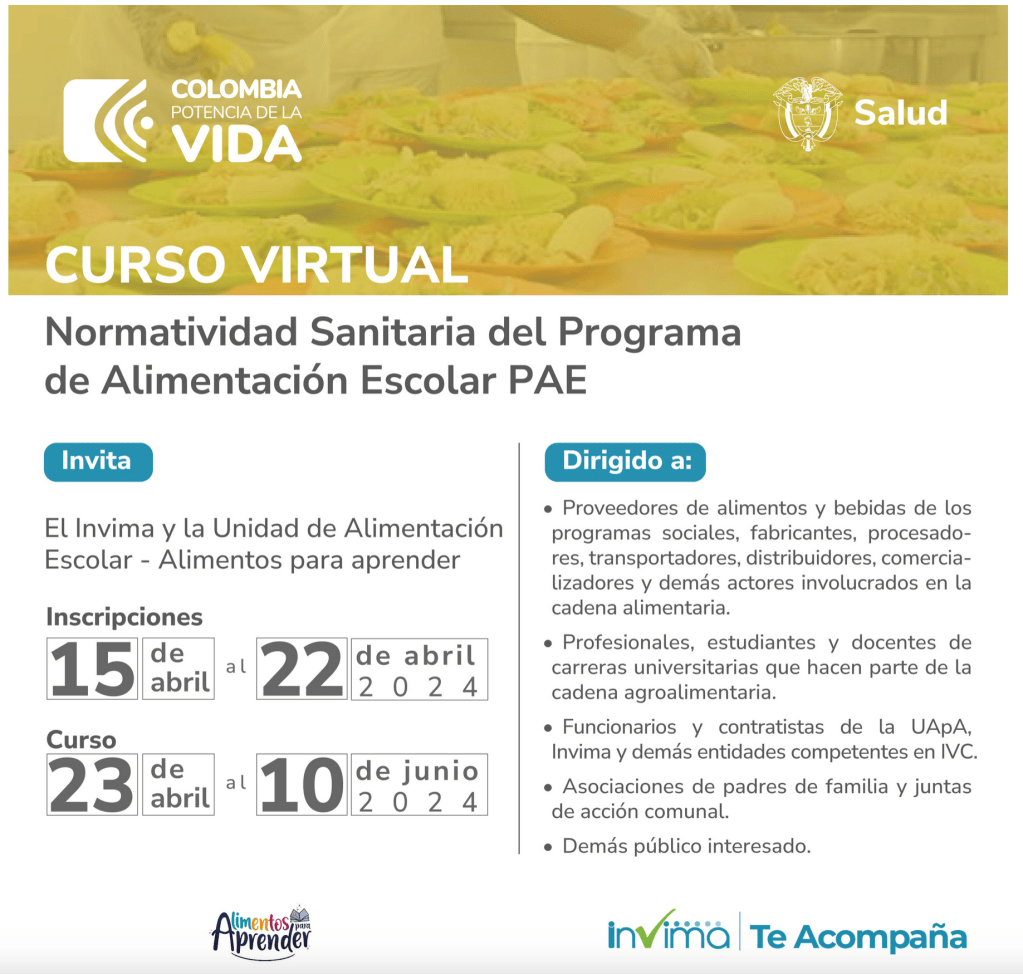
Colombia – INVIMA announces virtual seminar on sanitary regulation of the School Feeding Program

The Instituto Nacional de Vigilancia de Medicamentos y Alimentos (INVIMA in Spanish) and the Unidad de Alimentación Escolar -Alimentos para Aprender (UApA in Spanish) inform those interested that, from April 15 to 22, registrations are open for the Virtual Course on Sanitary Regulations of the School Feeding Program (PAE in Spanish) to be held from April 23 to June 10, 2024.
This course is free, self-study, 100% virtual and with an intensity of 40 hours. A certificate of approval will be granted online by INVIMA.
The course is aimed at food and beverage suppliers of social programs, manufacturers, processors, transporters, distributors, marketers and other actors involved in the food chain; as well as professionals, students and teachers of university careers that are part of the agri-food chain; officials and contractors of the UApA, Invima and other competent entities in IVC; parents’ associations and Community Action Boards.
Article – Sociodemographic differences in nutrition labels effect on Chilean and Mexican youth

Objective. To examine sociodemographic differences in the awareness, understanding, use and effect of nutrition labels among Mexican and Chilean youth.

Methods. Online surveys among youth (10-17 years) were obtained in 2019 (n=2631). Participants reported their awareness, understanding, and use of their country-specific nutrition facts tables (NFT) and front-of-pack labels (FOPL) (Chile: warning labels [WLs]; Mexico: guideline daily amounts [GDA]). Additionally, participants reported their perceived healthfulness of a sweetened fruit drink after viewing one of six versions of it withdifferent FOPL (no-label control, Health Star Rating, WLs, GDAs, Traffic Light, or Nutri-Score) during an exper-imental task.

Results. Higher self-reported nutrition knowledge was associated with higher NFT and FOPL awareness, understanding, and use, except for WL use. WLs were the most effective FOPL in decreasing the perceived healthfulness of the sweetened fruit drink compared to a no-label condition and other FOP labels. In Chile, the effect of GDA differed by income adequacy, while in Mexico Nutri-Score differed by age.

Conclusions. Results suggest that nutrition label awareness, use, understanding, and impact differ across demographics, favoring higher income and nutrition knowledge. Despite this, WLs are likely to have a positive impact on nutrition-related knowledge and behaviors among Mexican and Chilean youth, independently of their socio-demographic groups.

Brazil – Proposed regulatory instruction on compositional and quality requirements, nutritional content and claims and list of authorized constituents for infant formulae, transitional foods and cereal-based foods for infants and young children, formulas for enteral nutrition and dietary therapeutic formulas for inborn errors of metabolism

The National Health Surveillance Agency (ANVISA in Portuguese) has published Public Consultation No. 1.243/2024 , on the proposed Normative Instruction (IN) on composition and quality requirements, nutritional content and declarations and list of authorized constituents for infant formulas, transitional foods and base foods. It establishes composition and quality requirements, content and nutritional declarations and list of authorized constituents for infant formulae, transitional foods and base foods for cereals for infants and young children, formulas for enteral nutrition and dietary therapeutic formulas for inborn errors of metabolism.

Brazil – Proposed Regulatory Instruction on Sanitary Requirements for Infant and Young Child Formulas, Transitional Foods and Cereal-Based Foods for Infants and Young Children, Enteral Nutrition Formulas and Diethotherapeutic Formulas for Inborn Errors of Metabolism

The National Health Surveillance Agency (ANVISA in Portuguese) has published Public Consultation No. 1.242/2024 on the proposed Normative Instruction (IN) on health requirements for infant formulae for infants and young children, transitional foods and cereal-based foods for infants and young children, formulas for enteral nutrition and diethotherapeutic formulas for inborn errors of metabolism.

Brazil – ANVISA publishes Food Library update

The National Health Surveillance Agency (ANVISA in Portuguese) published the update of the Food Library. Libraries are documents that bring together all current standards for a given macro-topic, divided by topics. The objective is to facilitate access and understanding of the Regulatory Stock to the internal and external public, as well as to improve the process of preparing and reviewing the regulations.