Costa Rica – Scientific Justification for Dietary Supplements Containing Hemp and its Derivatives

The Ministry of Health issues CIRCULAR MS-DRPIS-UR-0890-2024 on request for scientific justification or technical support for dietary supplements.

The scientific justification is made in the following cases:

  1. For all cases of dietary supplements containing hemp and its derivatives; according to Article 16 of the “Regulation to Law No. 10113, Law of Cannabis for medicinal and therapeutic use and Hemp for food and industrial use of March 02, 2022, Regulation of hemp for food and industrial use”, published by Executive Decree No. 43689-MP-MAG-S of September 7, 2022.
  2. For all cases of dietary supplements that include Health Claims that do not appear in Annex G and that must be evaluated by the health authority; according to Article 7.4 of the “Central American Technical Regulation RTCA 67.01.60:10 Nutritional labeling of pre-packaged food products for human consumption for the population from 3 years of age”, published by Executive Decree No. 37100-COMEX-MEIC-S of February 20, 2012.

Brazil – ANVISA publishes an amendment to the Modified Normative Instruction on technological functions, maximum limits and conditions of use of food additives and technological aids authorized for use in food

The National Health Surveillance Agency (ANVISA in Portuguese) has published Normative Instruction – INº 303/2024 , which amends Normative Instruction No. 211/2023 on technological functions, maximum limits and conditions of use of food additives and technological aids authorized for use in food.

Honduras – National Congress approves Law for the Control and Regulation of Energy Drinks

The National Congress has approved the Law for the Control and Regulation of Energy Drinks. The Health Regulation Agency (ARSA in Spanish) and the Health Commission of the National Congress jointly drafted the law that prohibits the commercialization of energy drinks for minors under 18 years of age. In addition, its sale in health, academic and sports establishments is prohibited.

With the approval of this law, the ARSA will regulate the access, sale, consumption, advertising and will implement the correct labeling to identify the dangers of the consumption of energy drinks.

In particular, the marketing of energy drinks to the general public is prohibited in the following establishments: educational centers at all levels, museums, sports facilities, day care centers, homes and other establishments intended for the care of children under 18 years of age.

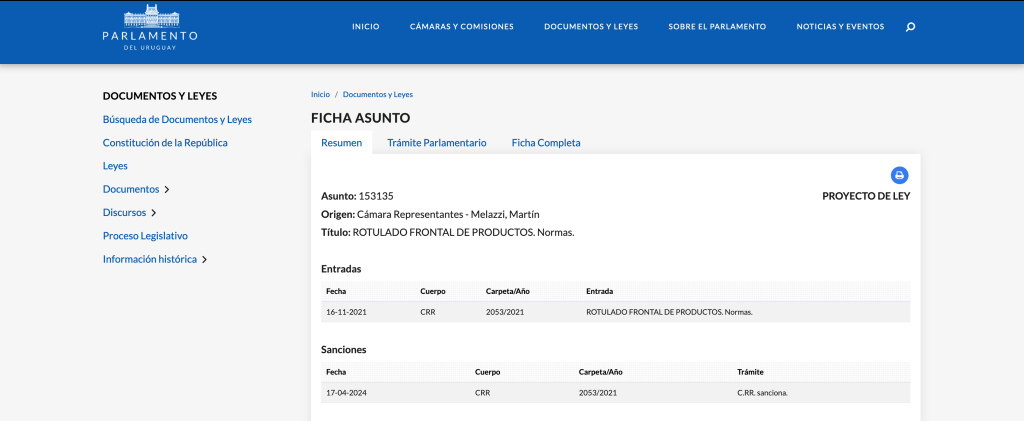
Uruguay – Bill on digital front-of-package food labeling advances in parliament

Congressmen in the national Parliament approved the bill that requires digital front labeling (QR codes or bar codes) of food. The initiative now passes to the Senate.

As explained by the deputy of the Colorado Party, Martín Melazzi “Basically, it is to incorporate digital front labeling to consumer products, which currently already have it. These are the well-known QR codes or bar codes, all the information that consumers need today”.

Mexico – Published Decree of the General Law of Adequate and Sustainable Food

The Presidential Decree was published on April 17 in the Official Gazette of the Federation (DOF), by which the General Law of Adequate and Sustainable Food is issued, with the aim of guaranteeing the constitutional right to food.

It is highlighted in the Drcreto, in the first article, that federal and municipal entities and territorial demarcations must establish planning, coordination and competition mechanisms, with the objective of guaranteeing the full exercise of the right to adequate food.

Likewise, the third article states that “all people, individually or collectively, have the right to adequate food at all times, and to have food for daily consumption, as well as physical and economic access to safe, nutritional quality and in sufficient quantity to satisfy their physiological needs at all stages of their life cycle that enable their integral development and a dignified life, in accordance with their cultural context and specific needs.”