The National Institute for Drug and Food Surveillance (INVIMA) announces the update of the Fee Schedule, which includes the payment of fees for services related to:
Sanitary registration, sanitary permit, and food health notification.
Renewal of health registration, sanitary permit, and food health notification.
Sanitary registration and renewal of sanitary registration for food supplements.
Laboratory analysis to verify the quality of foods, beverages, and other materials for human consumption and use.
The National Institute for Food and Drug Surveillance (INVIMA) announces that, as of January 14, 2026, Decree 1083 of 2025 will enter into force, amending Decree 1686 of 2012, Decree 162 of 2021, and Decree 1366 of 2020, which pertain to the sanitary requirements that must be met for the manufacture, production, hydration, packaging, storage, distribution, transportation, marketing, sale, export, and import of alcoholic beverages intended for human consumption.
Most relevant aspects of Decree 1083 of 2025:
Elimination of mandatory Good Manufacturing Practices (GMP) certification. Elimination of mandatory Good Manufacturing Practices (GMP) certification. The Good Manufacturing Practices (GMP) certification is eliminated as a mandatory requirement for obtaining the sanitary registration of alcoholic beverages, both domestic and imported. However, the implementation of GMP remains mandatory, and certification becomes voluntary.
Recognition of the Certificate of Free Sale (CFS) for imported products. For imported alcoholic beverages, the requirement to submit a valid Certificate of Free Sale (CFS) issued by the competent health authority of the country of origin or its equivalent remains in place as proof of compliance with sanitary requirements.
Extension of the validity of previously issued GMP Certificates. The validity of Good Manufacturing Practice (GMP) certificates previously issued by Invima is extended for an additional two (2) years, counted from the entry into force of Decree No. 1083 of 2025, in accordance with a gradual and proportionate approach.
Specific adjustments for micro-entrepreneurs: the provisions contained in Decree 1366 of 2020 are updated, maintaining a differentiated regime for micro-entrepreneurs. Within this framework, the validity of previously issued Good Manufacturing Practices (GMP) certifications is extended by five (5) years.
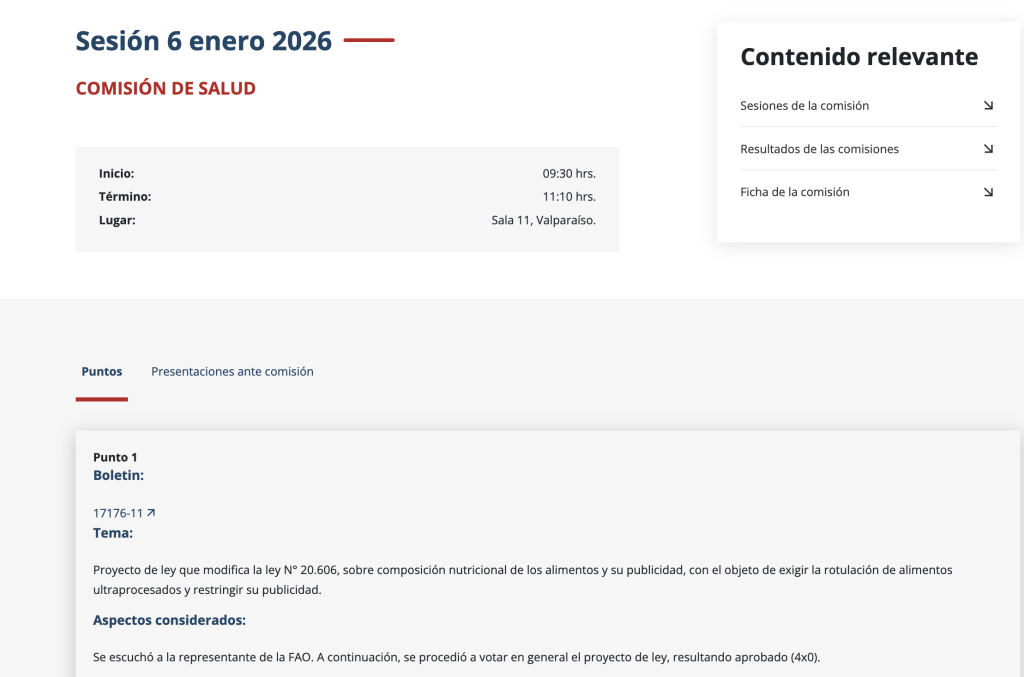
The Chilean Senate Health Committee has approved a bill aimed at regulating the labeling and advertising of ultra-processed foods, in an effort to combat obesity and malnutrition in the country.
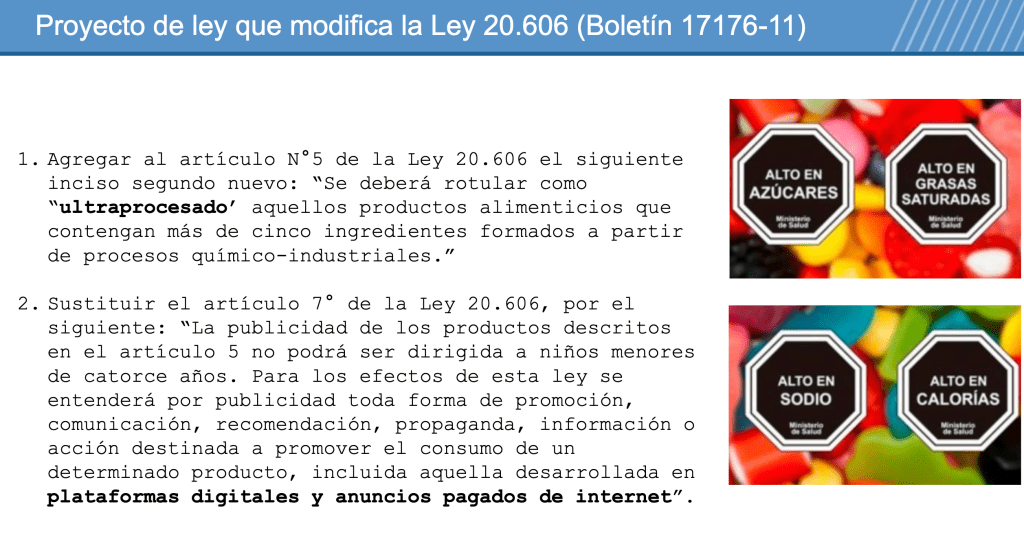
The bill, which amends the existing law on the nutritional composition of foods, stipulates that products containing more than five ingredients derived from industrial chemical processes will be considered ultra-processed. This initiative complements the legislation in place since 2016, which already regulates foods high in fat, salt, sugar, and calories.
During the session, Senators Ximena Ordenes, Iván Flores, Francisco Chahuán, and Juan Luis Castro expressed their support for the proposal, recognizing that the consumption of ultra-processed foods is a key factor in the rise of obesity and overweight among the population. Senator Ordenes highlighted that “the consumption of these products is one of the most important determinants of overnutrition.”
Godoy stated that “this bill complements the existing law, which has succeeded in reducing the per capita intake of products high in salt, sugar, and fats by 23%.” The new regulations also prohibit advertising of these products aimed at children under 14, covering all forms of promotion, including digital platforms.
The Federal Consumer Protection Agency (PROFECO in Spanish) has published in the first edition of the 2026 Consumer Magazine a study evaluating the most consumed dairy products in Mexico: yogurt.
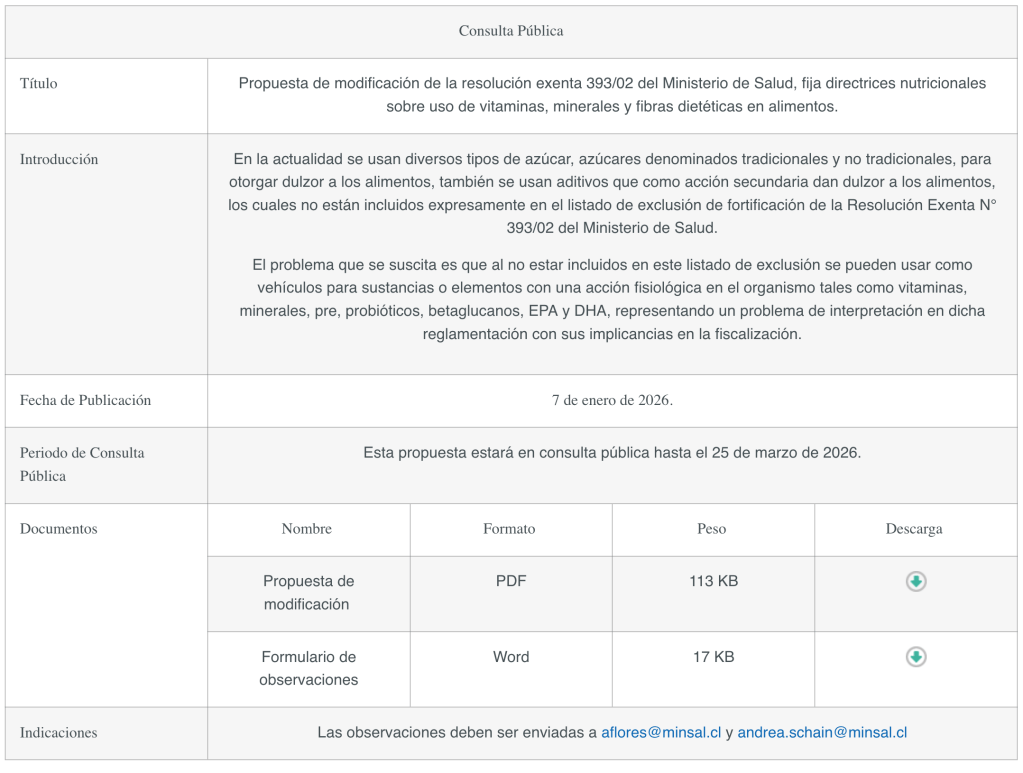
The Ministry of Health has published a proposed amendment to Exempt Resolution 393/02 of the Ministry of Health, which establishes nutritional guidelines on the use of vitamins, minerals, and dietary fiber in foods.
Currently, various types of sugar—both traditional and non-traditional—are used to sweeten foods, as are additives that, as a secondary effect, impart sweetness, none of which are expressly included in the fortification exclusion list of Exempt Resolution No. 393/02 issued by the Ministry of Health.
The problem that arises is that, since they are not included in this exclusion list, they can be used as vehicles for substances or elements with a physiological effect on the body, such as vitamins, minerals, pre- and probiotics, beta-glucans, EPA, and DHA, posing an interpretive challenge under the regulations and affecting enforcement.
 infoAlimentario