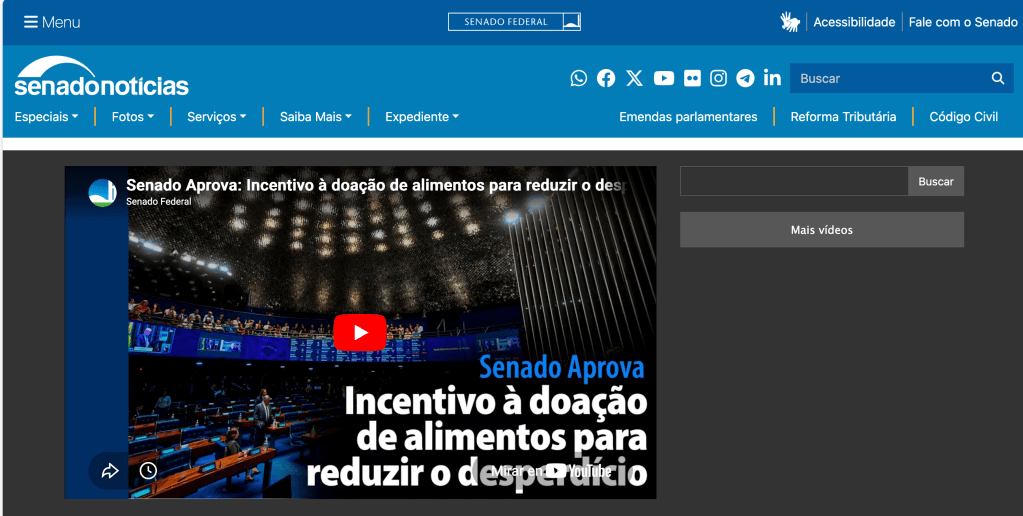
Brazil – Senate passes bill to facilitate food donations to reduce waste

The Social Affairs Committee approved a bill that facilitates food donations by businesses, such as supermarkets and restaurants. The measure covers food that would otherwise be discarded but is still safe to eat. The author of the proposal, which amends the National Policy to Combat Food Loss and Waste, is Senator Giordano (Podemos-SP). He states that his goal is to encourage donations and reduce food waste. The text stipulates that each donation must be formalized through a contract (or collaboration agreement) between the donor and the intermediary. The bill will proceed directly to the Chamber of Deputies for review, unless an appeal is filed.

Argentina – New coating agents for solid dietary supplements incorporated into the Food Code

The National Administration of Medicines, Food and Medical Technology and the Ministry of Agriculture, Livestock, and Fisheries, thru Joint Resolution 2/2026, incorporate Basic Methacrylate Copolymer (INS 1205) and Anionic Methacrylate Copolymer (INS 1207) into the Argentine Food Code (CAA), with the aim of being used as coating agents in solid dietary supplements.

These compounds have a positive scientific opinion from the European Food Safety Authority (EFSA) for the proposed uses as food additives. Their function is to act as a coating film or glazing agent in solid dietary supplements (tablets, capsules, or pills).

Main Benefits:

  • Protects sensitive ingredients, as it helps preserve vitamins, probiotics, and bioactive compounds against moisture, oxygen, and degradation.
  • It allows controlled release of ingredients, as it modulates the dissolution rate of these in the intestinal tract.
  • Greater bioavailability of active compounds, as it helps nutrients or probiotics reach the intestine intact.

The regulation sets a maximum limit and restricts its use in supplements intended for the pediatric population (infants and young children).

Argentina – Department of Agriculture Implements a New Protocol for Packaged Honey

Thru Resolution 61/2026, the National Ministry of Agriculture officially updated the Quality Protocol for Packaged Honey. For Misiones and the region, the regulation not only redefines the physicochemical standards to access the Argentine Foods (“Alimentos Argentinos” in Spanish) Seal, but also positions itself as a strategic tool to decouple the price of the regional producer from the fluctuations of bulk commodities, allowing for the capture of income thru packaging at the source.

Argentinian honey, globally recognized for its excellence, now faces an international market with surgical selectivity. The replacement of the protocol in effect since 2007 with the new SAA 013 Code responds to the need to safeguard the genuineness of the product against the competition of adulterated syrups and increasing sanitary demands. For the beekeeping sector in Misiones, where production is characterized by its origin in the Paraná jungle and native forests, this technical update allows for the certification of differential attributes that are, in essence, the real comparative advantage over the mass production in the Pampas region.
Technical parameters: rigor as a commercial asset

The new protocol imposes strict limits that act as a quality filter for the external market, raising the standard of local fractionation rooms:

  • Controlled Humidity: A general maximum of 18% is established, with technical exceptions for Chilca honey (19%) and Caá-tay honey (20%). This is vital in the NEA, where environmental humidity challenges the stability of the product.
  • Freshness and Purity: Hydroxymethylfurfural (HMF), an indicator of heat or aging deterioration, is set at a maximum of 25 mg/kg.
  • Microbiological Safety: The count of fungi and yeasts must be less than 10 CFU/g, a critical parameter to prevent fermentation in shelf-stable packaging.
  • Genuineness: The use of Thin Layer Chromatography (TLC) is reaffirmed to detect adulterations with glucose or corn syrups, ensuring that the product is 100% the result of the honeybee.

Argentina – ANMAT incorporates Monk Fruit extract into the Food Code

The National Administration of Medicines, Food and Medical Technology and the Ministry of Agriculture, Livestock, and Fisheries, thru Joint Resolution 3/2026, incorporates Monk Fruit extract (Siraitia grosvenorii), also known as Monk Fruit, Luo Han Guo, or Rakanka; it is a natural sweetener derived from a small Asian fruit; used internationally as an alternative to sugar and is incorporated into article 1398 of the CAA.

Its sweetness mainly comes from mogrosides, especially mogroside V, with a sweetening power between 100 and 250 times that of sugar, practically without any caloric contribution.

Main benefits:

  • It does not significantly raise blood sugar levels as it is not metabolized like common sugars.
  • Its caloric contribution is practically negligible, and therefore, it is useful in “sugar-free,” “low-calorie” formulations or aimed at people who cannot consume other natural sweeteners like sucrose.
  • Its sensory profile is more pleasant than other intense sweeteners because it has less bitterness, less metallic aftertaste, and a sweetness sensation closer to sugar.
  • Technological versatility: It is stable in beverages, dairy products, supplements, baked goods, and functional formulations.

The most frequently used applications worldwide are: Sugar-free drinks, dietary supplements, sports proteins, protein bars, products called “keto,” table sweeteners.

The incorporated regulation establishes the criteria for identity, quality, and purity, ensuring its safe use in food and making significant nutritional contributions to food and beverage matrices.
Ecuador – ARCSA establishes a temporary and definitive regulatory regime for the registration of importers and distributors in health notifications

The competent health authority, in coordination with the Foreign Trade Committee, has issued a binding regulatory directive to definitively establish the administrative regime applicable to the processing of applications for the inclusion or registration of importers and distributors in health notification certificates, health records, and mandatory health notifications. This legal measure is directly framed within the official implementation phase of the strategic guidelines set forth in Resolution 017-2025, a commercial control instrument originally issued in December of the previous year and formally published in the Official Register 188 for national observance. In strict application of the Second Transitional Provision of the aforementioned regulation, the mandate establishes an exceptional and temporary regime with an exact duration of one hundred and twenty calendar days, counted rigorously from the date the legal document comes into effect. During this transitional period of administrative adaptation, all procedures aimed at the inclusion or updating of import and distribution entities in the current health records will be processed under the technical figure of record modification. To facilitate the operational regularization of commercial agents in the regulated sector, the governmental body stipulates that, for the purpose of collecting official fees, a financial amount equivalent to ten percent of the originally set tariff value for obtaining the respective primary certificate will be applied. Under this temporary scheme, the regulation expressly authorizes product holders to simultaneously incorporate one or more associated importers and distributors thru the submission of a single application, significantly reducing the bureaucratic and economic burdens for companies. However, the legal text explicitly warns that, once this peremptory transition period of one hundred and twenty days has expired, the technical incorporation of new actors in the marketing chain will be irrevocably subject to the permanent provisions stipulated in Article 4 of Ministerial Agreement 112. Consequently, under this definitive and post-transitional framework, the regulatory entity will require the individualized payment of the fee corresponding to ten percent of the base amount of the sanitary registration for each additional importer or distributor intended to be added to the file, consolidating a strict monitoring scheme that requires companies to strategically plan their distribution logistics before the conclusion of the tariff flexibility period.