The Decentralized Service for Standardization, Quality, Metrology and Technical Regulations (SENCAMER in Spanish), has published the draft Venezuelan Standard COVENIN 1291-1:2025 Isolation and identification of Salmonella spp. Part 1: Food.
This standard applies to the method for isolating and identifying Salmonella spp. in food samples for human and animal consumption. Water samples and environmental samples in the food production and handling area are excluded from the scope of this standard.
The Americas
Regulatory news in the Americas
Brazil – Anvisa publishes results achieved in its food regulation agenda in 2024
The National Health Surveillance Agency (ANVISA in Portuguese) released the Activities Report of the General Directorate of Food. The document presents a brief summary of the main results of the area in 2024, with emphasis on the risk and safety assessment processes, regulation of food and packaging, determination of regulatory and service standards, transparency and communication.
The relevant aspects in the report:
- Execution of 46% of the matters of the Regulatory Agenda 2024/2025 under its responsibility.
- Granting of two regulations in the matter with the Seal of Good Regulatory Practices, one in the gold category and another in the silver category.
- 46% reduction in global liability for registration, post-registration and evaluation applications.
- Greater agility in the analysis of requests for competence in the area, with a reduction in time of 30 days in the case of registration and post-registration and 55 days for risk and effectiveness assessments.
- Reduction in the percentage of rejections out of all approved requests, which reached the lowest level in the five-year historical series.
- Reduction in the response time of queries sent to the area by the Call Center, maintaining the percentage of user satisfaction (90%).
Brazil – DICOL approves optimization of requests in the Food sector
One of the highlights of the 2nd Public Meeting of the Collegiate Council (DICOL in Portuguese) of 2025 was the proposal of a Normative Instruction (NI) to establish the conditions of the optimized procedure for the analysis of evaluation requests in the area of Food by admitting supporting documentation issued by an Equivalent Foreign Regulatory Authority, an agenda item approved unanimously, due to its positive impact.
Optimized analysis
According to the technical presentation presented by the head of the Directorate General for Food (GGALI in Portuguese), Patrícia Castilho, the proposal covers issues related to risk assessment, the possibility of optimizing the analysis process and the criteria and procedures for the admission of new documents issued by the Foreign Regulatory Authority Equivalent (AREE in Portuguese). This means that all issues involved in risk assessment, including packaging materials and technologies, food additives, processing aids, new foods and ingredients and veterinary medicines, can benefit from an optimized analysis.
Improved management
Director Daniel Pereira, rapporteur of the proposal, stressed that the measure will allow for better management of Anvisa’s human and financial resources, expanding its capacity to respond to the market and to society as a whole.
In this regard, for an increasingly efficient and proportional regulatory action by the Agency, capable of reconciling health security with the creation of an environment favourable to the development of the country, the director stressed the importance of integration with global dynamics and the adoption of innovative forms of collaboration as fundamental elements for the continuous improvement of regulatory practices.
Costa Rica – Commission rejects and archives bill on front labeling of food and beverages
The Committee on Disability and Senior Citizen Affairs archived a bill that sought to require the placement of front labels on prepackaged foods to warn of excess calories, sugars, sodium and fats.
After two tied votes, the legislative forum proceeded to archive file 23,861 that was presented in August 2023 by the Liberationist deputy Andrea Álvarez Marín.
Álvarez Marín and the Frente Amplio member Priscilla Vindas Salazar voted in favor of the project, while the Christian Socialist Daniela Rojas Salas and the independent María Marta Padilla Bonilla voted against it.
As part of the arguments against the project, Deputy Padilla expressed that the file raised legitimate concerns about the “repercussions of front labeling on regional trade.” She pointed out that this type of initiative mainly affects those who sell products in a more informal manner.
Sources (in Spanish):
Costa Rica – Bill on Front Labeling with Nutritional Warnings for Food Products and Beverages Reintroduced in the National Assembly
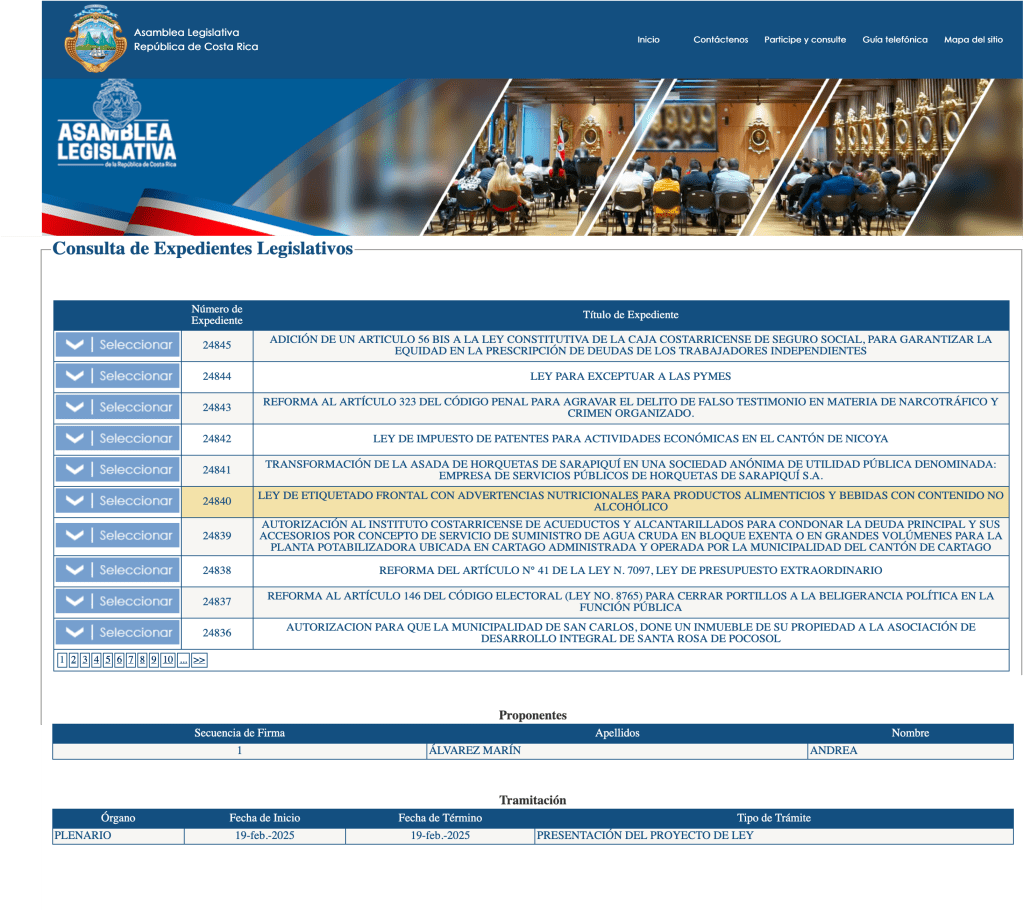
On the same day that Deputies of the Legislative Assembly of Costa Rica sent to the archive File No. 23,861, on the draft Law on Front Labeling with Nutritional Warnings for Food Products and Beverages with Non-Alcoholic Content, the deputy of the National Liberation Party, Andrea Álvarez, again presented the draft law to include warnings on the nutritional labeling of food products and non-alcoholic beverages. The initiative, now processed under file 24.840, defends the use of front seals or labels that allow citizens to identify products with a high content of calories, sugars, sodium or fats. It also seeks to warn about the use of sweeteners.
 infoAlimentario