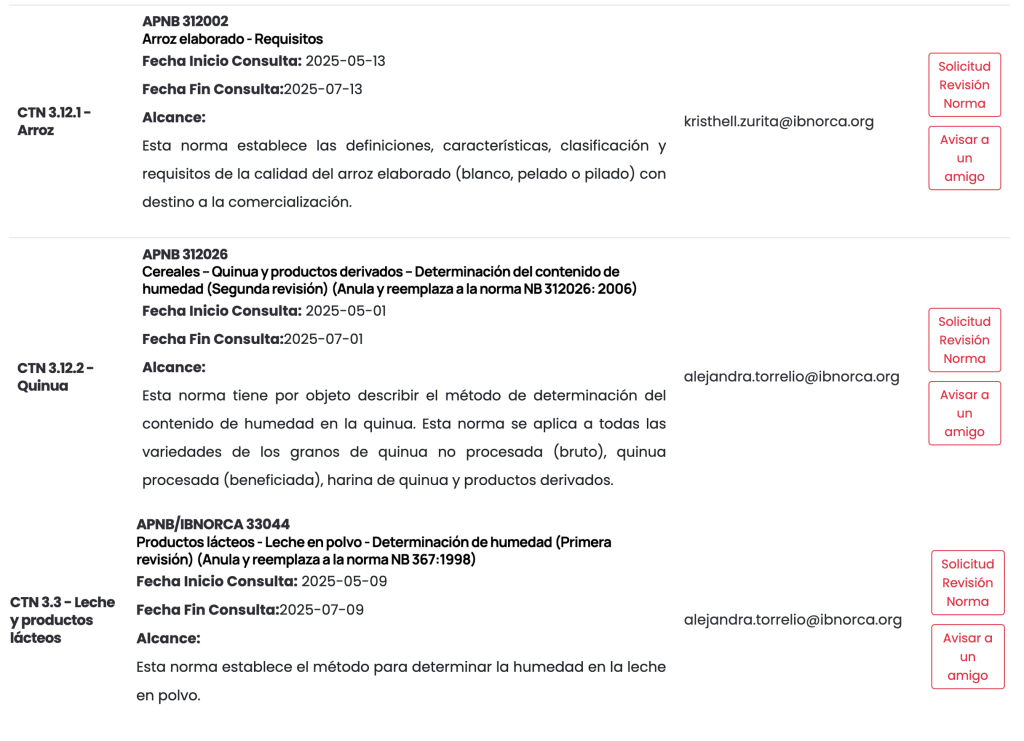
Bolivia – IBNORCA announces public consultation on rice standard and testing standards for Quinoa and milk powder

The Bolivian Institute for Standardization and Quality (IBNORCA in Spanish) has published for public consultation a set of technical standards related to food:

  • APNB 312002
    Processed Rice – Requirements.
  • APNB 312026
    Cereals – Quinoa and derived products – Determination of moisture content (Second revision) (Cancels and replaces NB 312026: 2006).
  • APNB/IBNORCA 33044
    Dairy products – Milk powder – Determination of moisture content (First revision) (Annuls and replaces NB 367:1998).

Argentina – Modification of the Argentine Food Code on requirements for drinking water

Joint Resolution 22/2021 of the Secretariat of Health Quality and the Secretariat of Food, Bioeconomy and Regional Development modifies Article 982 of the Argentine Food Code for drinking water.

ARTICLE 1.- Article 982 of the Argentine Food Code is hereby replaced and shall be worded as follows: “Article 982: The designations Drinking water for public supply and Drinking water for domestic use are understood to mean water suitable for food and domestic use: it shall not contain substances or foreign bodies of biological, organic, inorganic or radioactive origin in such quantities as to be dangerous to health. It shall have a pleasant taste and be practically colorless, odorless, clear and transparent. Drinking water for domestic use is water from a public supply, well or other source, located in domestic reservoirs or tanks.

Drinking water should meet the following physical, chemical and microbiological criteria:

Physical characteristics:

Turbidity: max. 3 N T U:

Color: max. 5 Pt-Co scale;

…….

Argentina – Argentine Food Code amended for corn flour

By Joint Resolution 26/2025 the Secretariat of Health Management and the Secretariat of Agriculture, Livestock and Fisheries have amended Article 694 of the Argentine Food Code on “Farinaceous Foods”, specifically corn flour.

ARTICLE 1.- Article 694 of Chapter IX “Farinaceous Foods” of the Argentine Food Code is hereby replaced and shall be worded as follows: “Article 694: With the denomination of Corn Flour (or Corn Semolina) is understood the product obtained from the milling of clean, healthy and well preserved grains of Zea mays L. to which part of the pericarp and germ are extracted during the process. It must meet the following specifications:

– Water (at 100-105°C, 3 hours): max. 13.5%.

– Ash (at 500-550°C): max. 1.0% on dry matter.

– Fat: max. 1.3% fat on dry matter.

– Proteins: min. 7.0% on dry matter.

– It should not leave residues on the 2,000 micron sieve and no more than 5% should pass through the 250 micron sieve.

……

Trinidad and Tobago – CARICOM has published 2 voluntary draft Standards for cocoa beans

The Caribbean Community (CARICOM) Regional Organization for Standards and Quality has issued two (2) voluntary draft CARICOM Regional Standards for public comment:

  • DCRS 82:202X, Cocoa bean quality – Sampling requirements
  • DCRS 83:202X, Cocoa bean quality – Specifications

These Draft CARICOM Regional Standards can be viewed using the link: https://tinyurl.com/2DCRSCOCOA

Uruguay – Draft amendment to GMC Resolutions Nº 50/97, 53/98, 51/00, 08/06 and 09/07 on food additives

Draft Resolution Nº 01/25, prepared within the scope of the Food Commission (CA) of MERCOSUR’s Working Subgroup Nº 3 “Technical Regulations and Conformity Assessment” (SGT Nº 3), which introduces amendments to GMC Resolutions Nº 50/97, 53/98, 51/00, 08/06 and 09/07 on food additives, has been published for public consultation on the Digital Citizen Participation Platform.

The document submitted for public consultation proposes the inclusion of different additives, with their respective functions and concentration limits, in various food categories. On the one hand, rosemary extract, INS 392, is considered to have an antioxidant function in bakery and biscuit products, industrial culinary preparations, sauces and condiments, and cereals and cereal-based products. On the other hand, the additives tetrasodium diphosphate, INS 450(iii), and calcium sulfate, INS 516, with stabilizing and acidity regulating function, are proposed for inclusion in jams. The allocation of additives and their maximum concentrations for the aforementioned food categories are regulated by GMC Resolutions Nº 50/97, 53/98, 51/00, 08/06 and 09/07, whose modification is proposed in the document submitted for consultation.