Mexico – Ministry of Economy proposes a consultation to modify NOM-051 and update nutritional warning labels

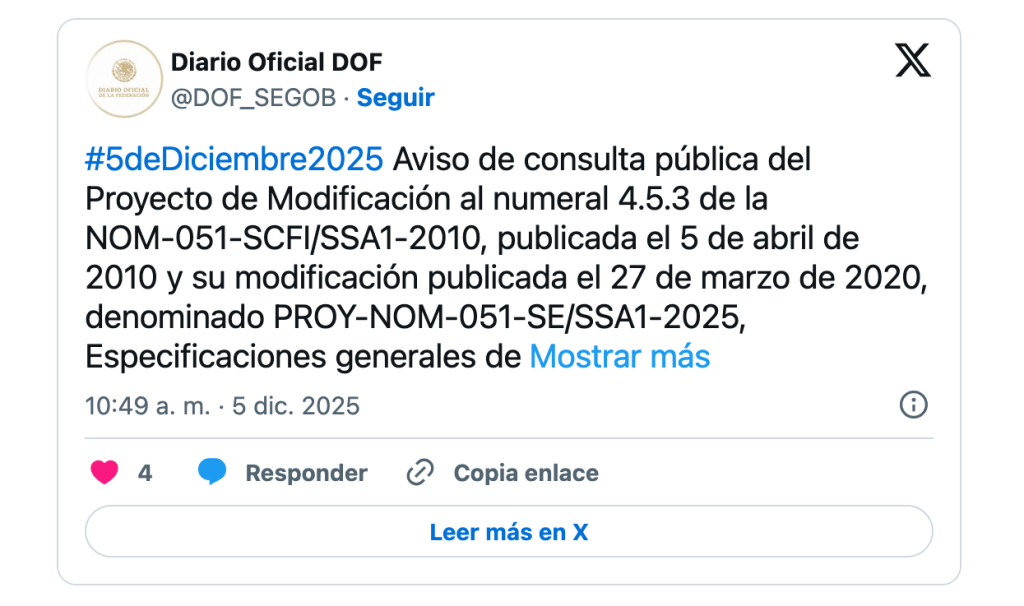
The Ministry of Economy opened for public consultation the draft PROY-NOM-051-SE/SSA1-2025, an update to the food and non-alcoholic beverage labeling standard that seeks to adjust the criteria for evaluating added critical nutrients and define when a product must bear warning seals.

The proposal focuses on modifying section 4.5.3 of NOM-051-SCFI/SSA1-2010, a technical component that had already been reviewed in 2020. Now, the objective is to refine the parameters that determine the limits for sugars, sodium, fats, and calories, in order to update how the presence of added critical nutrients is calculated.

This review means that companies will need to re-evaluate their product formulations, as the updated criteria could change the number and type of warnings on packaging. The measure reflects an international trend: periodically adjusting labeling parameters to align them with the latest scientific evidence.

The notice was published in the Official Gazette of the Federation on December 5, initiating a regulatory process that will impact the industry and consumers in 2026.
Chile – Ministry of Health proposes amending Article 118 of the Food Sanitary Regulations on nutrient labeling

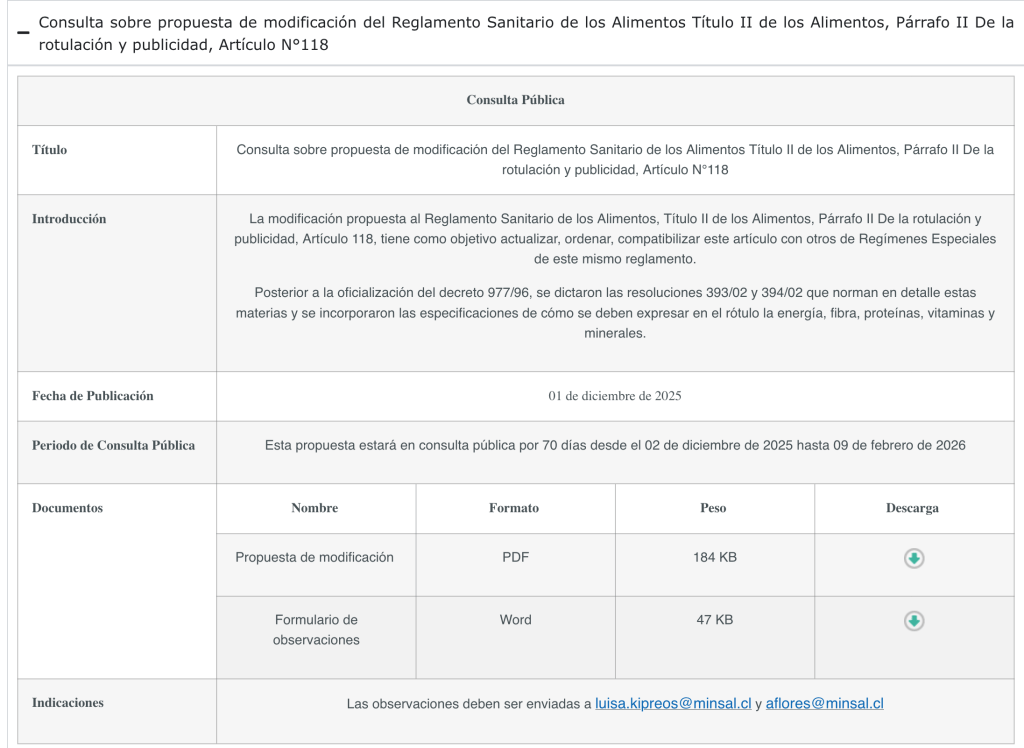
The Ministry of Health proposes amending the Food Sanitary Regulations, Title II on Foods, Paragraph II on Labeling and Advertising, Article 118, with the aim of updating, organizing, and aligning this article with other Special Regimes in the same regulations.

Following the official publication of Decree 977/96, Resolutions 393/02 and 394/02 were issued, which regulate these matters in detail and incorporate specifications on how energy, fiber, protein, vitamins, and minerals must be expressed on the label.

Proposed modification:

When a nutrient declaration is made, vitamins and minerals present in significant amounts—5% or more of the recommended intake for the population—may also be listed.
relevant. For the population over four years of age, the Daily Reference Intake (DRI) for energy, fiber, protein, vitamins, and minerals, as officially established by Exempt Resolutions 393/02 and 394/02, both issued by the Ministry of Health, or any future resolutions that replace or supplement them.
supplement.

For infants and children under four years of age, the ranges established in Title XXVIII, “Foods for Special Dietary Uses,” shall be used; for pregnant and breastfeeding women, the respective RDIs shall be used.
As Reference Daily Intakes, the respective RDIs shall be used. In the case of iron and vitamin A, the following will be accepted as the Daily Dose:
For iron and vitamin A, the reference daily intake during pregnancy is 30 mg/day for iron and 800 mcg/day for vitamin A. Numerical information on vitamins and the vitamin and mineral content must be presented in accordance with Article 115 of this Regulation, in metric units per 100 g or 100 ml, and per serving size, expressed as a percentage of the reference Recommended Daily Intake. Additionally, this information must be specified per serving on the label if the number of servings the package contains is indicated.

Ecuador – INEN publishes several draft standards on alcoholic beverages and dairy products

The Ecuadorian Standardization Service (INEN in Spanish) has published a series of draft standards for public consultation related to alcoholic beverages and dairy products.

  • NTE INEN 2802 Amendment 1
    ALCOHOLIC BEVERAGES – COCKTAILS OR MIXED ALCOHOLIC DRINKS AND APERITIFS – REQUIREMENTS.
  • NTE INEN 1837 Amendment 1
    ALCOHOLIC BEVERAGES – LIQUEURS – REQUIREMENTS.
  • NTE INEN 298
    Powdered milk and powdered cream – Requirements.
    This standard establishes the requirements for milk powder, modified milk powder, and cream powder.
    Powder intended for direct consumption or further processing.
  • NTE INEN 704
    CONDENSED MILK – REQUIREMENTS
    This standard establishes the requirements for condensed milk intended for human consumption.

Ecuador – ARCSA proposes a procedure for exhausting labels on processed foods and foods for special dietary uses

The National Agency for Health Regulation, Control and Surveillance (ARCSA in Spanish) publishes the draft External Instruction IE-B.3.1.1-ALI-04 “External Instruction: Procedure for Exhausting Labels on Processed Foods and Foods for Special Dietary Uses.

Ecuador – ARCSA proposes requirements for the registration and renewal of the sanitary notification of processed foods thru the Ecuadorian Single Window

The National Agency for Health Regulation, Control and Surveillance (ARCSA in Spanish) proposes a draft of External Instruction IE-B.3.1.2-ALI-01, “Requirements for the Registration and Renewal of Health Notifications for Processed Foods via the Ecuadorian Single Window (VUE).”