The National Health Surveillance Agency (ANVISA in Portuguese) has published Normative Instruction – IN No. 262/2023, which amends Normative Instruction – IN No. 159/2022, which establishes the lists of plant parts authorized for the preparation of teas and for use as spices.
The Americas
Regulatory news in the Americas
Chile – Ministry of Health publishes Manual of graphic standards for warning messages and graphics and energy value of alcoholic beverages
The Ministry of the Interior and Public Security, informs that in virtue of the obligations of the of implementation of Decree No. 98/2023, the Ministry of Health has published the Manual of Graphic Standards for Messages and Warning and Energy Value Graphic Standards for Warning Messages and Graphics and Energy Value of Alcoholic Beverages according to the Regulation on the Regulation on Consumer Information and Advertising of Alcoholic Beverages. alcoholic beverages.
All beverages with an alcoholic content equal to or greater than 0.5° that are intended to be marketed in Chile must have a clear, precise, visible and easily legible warning on the container that contains it about the consequences of its harmful consumption.
Mexico – Senate regulates food distribution in schools
The Senate approved a resolution establishing guidelines to regulate the preparation, distribution and sale of processed and bulk food and beverages in basic education institutions.
The proposal, approved unanimously by 81 votes, highlights the monitoring of the nutritional criteria determined by the Ministry of Health, as well as their updating every five years. These include the principles of sustainability, progressiveness, absence of conflict of interest and guarantee of the best interest of children.

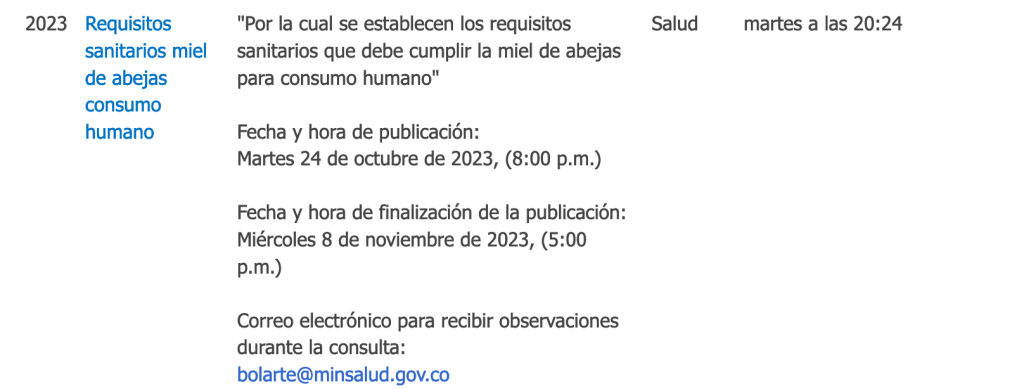
Colombia: Ministry of Health publishes draft resolution on sanitary requirements to be met by honey bees for human consumption
The purpose of the resolution is to establish the sanitary requirements The purpose of the resolution is to establish the sanitary requirements that must be met by bee honey for human consumption that is extracted, packaged, stored, transported, imported, marketed and sold in the national territory, in order to ensure the safety of this product, protecting human health and preventing possible damage to it. possible damages to it.
Chile – INTA performs Plant Based Certifications informing the absence of animal ingredients in foods
The Institute of Nutrition and Food Technology (INTA in Spanish) of the University of Chile, through the Directorate of Technical Assistance, is recently offering a Plant Based Certification that reports the absence of animal ingredients in its foods.
INTA, as an impartial external certifying body, developed this certification that can additionally include an INTA “Plant Based” seal to be used in the labeling of products that are marketed in Chile and Latin America.
The applicant company, in order to obtain a certification like this, must agree to a review of its documentary records, an audit of its production plant and eventually laboratory analysis.
 infoAlimentario