Objectives. To estimate the number of processed and ultra-processed beverages and foods that provide nutritional information on their packaging, and to describe the characteristics of this information, as well as to determine the presence of nutritional information on products with octagons. Materials and methods. Photographs were taken of the labels of 4404 processed and ultra-processed beverages and foods marketed in supermarkets in Metropolitan Lima. The information on the label was collected and registered in the mobile and web version of the Food Label Information Program (FLIP). We analyzed
variables related to the nutritional information, the way in which such information is declared and the information in beverages and foods with octagons. Results. Only 71.4% of the products had some type of nutritional information. Of these, 13.8% provided the nutritional information as a text and not in a table, and only 56.3% declared it per 100 grams or milliliters. Of the total number of foods with the
octagon “Contains trans fats”, only 19.2% declared their content. Conclusions. More than a quarter of the beverages and packaged foods in the Peruvian market did not provide nutritional information of any kind, and of those that did, only one did so in different formats and units. In addition, we found that a proportion of beverages and foods for each type of octagon did not declare information of the nutrient
that is mentioned in the octagon.
Articles
Articles overview
Article – Do Brazilian consumers intend to use food labels to make healthy food choices? An assessment before the front-of-package labelling policy
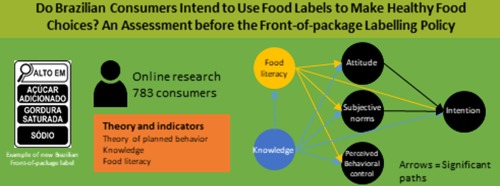
Front-of-package labelling is a measure that can facilitate consumption of healthier foods. This study examined the predictors of consumers’ intentions to use food labelling to make healthy food choices and prevent non-communicable diseases before the implementation of the front-of-package labelling policy in Brazil. An extended theory of planned behaviour incorporating knowledge and food literacy served as the theoretical foundation. First, experts (n = 6) and the target population (n = 30) validated the questionnaire, and the validation data were analysed using content validity coefficients (CVC). An online questionnaire was administered to 783 participants, and data were collected between May and October 2022. Partial least squares structural equation modelling (PLS-SEM) was used to test the prediction hypothesis. The questionnaire showed adequate content validity, with all indicators of CVC ≥ 0.75. In the PLS-SEM attitudes (p < 0.001), subjective norms (p < 0.001), knowledge (p < 0.001), and food literacy (p < 0.001) positively predicted the intention to use food labels to make healthy food choices, confirming the main hypothesis. Also, Food literacy and knowledge predicted all constructs of the theory of planned behaviour (p < 0.001). The results highlight the importance of providing nutritional knowledge and food literacy, developing nutritional skills and abilities to encourage consumers to make healthy food choices, and to strengthen other policies such as front-of-package labelling.
Article/Costa Rica “Stop focusing. Influencer marketing and advertising of unhealthy products aimed at children and youth in digital spaces” (in Spanish)
The research “Stop Focusing. Influencer marketing and advertising of unhealthy products aimed at children and youth in digital spaces”, conducted by the Coalition for a Healthy America (CLAS) and Young Leaders Program, indicates that it has been evidenced that the marketing of ultra-processed products has been a determinant in food choices.
Article – Efficacy of front-of-pack warning label system versus guideline for daily amount on healthfulness perception, purchase intention and objective understanding of nutrient content of food products in Guatemala: a cross-over cluster randomized controlled experiment
Front-of-package warning labels (FOPWL) have been adopted in many countries aiming at reducing the consumption of unhealthy food and drink products and have also been considered in Guatemala. The aim of the study is to evaluate the efficacy of FOPWL versus Guidelines for Daily Amount (GDA) on products’ healthfulness perception (HP), purchase intention (PI) and the objective understanding of the nutrient content (UNC) in Guatemala.
FOPWL reduces products’ healthfulness perception and purchase intention, and increases understanding of products’ nutrient content compared to GDA.
Article – Front-of-package Label in Brazil: Comparison of Guideline Daily Amounts, Traffic-light and Warning Systems
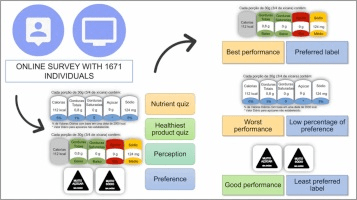
Chronic non-communicable diseases (NCDs) are considered a global public health problem related to dietary factors. In this sense, front-of-package (FOP) labeling is a valuable tool to help consumers assess food products’ composition and make healthier choices. The mandatory FOP labeling adoption process in Brazil was initiated in 2014 and ended in 2020. This work aims to evaluate consumer’s perception and preference towards three different FOP label systems (Guideline Daily Amounts (GDA), Traffic-Light (TL), and Triangular Warnings (TW)) and identify which one is more effective in improving consumer’s understanding. An online survey with 1671 participants was conducted with a nutrient quiz, a healthiest product quiz, and questions about perception and preference. Data were analyzed using chi-square tests, analysis of variance, and logistic regression. TL performed better on the nutrient quiz than GDA. On the healthiest product quiz, TL and TW had a higher rate of correct answers. GDA was considered helpful in deciding which product to buy. TL was considered easy and quick to understand. TW was considered incomplete but helpful in deciding which product to buy. TL was the preferred label, followed by GDA and TW. The evidence from the present study highlights TL and TW’s potential to help consumers understand the products’ nutritional profile. However, any FOP label implementation must be accompanied by educational campaigns to ensure the population can understand and use it effectively.
 infoAlimentario