The prevalence of obesity has increased significantly worldwide, including in low- and middle-income countries. In Ecuador, a middle-income country, the government has implemented two policies to improve the quality of its population’s diet: (1) a traffic-light (TL) nutritional labeling requirement for processed foods and (2) a special tax scheme for drinks with a high sugar content (HSC). This study examines changes in carbonated soft drink (CSD) sugar formulation and its associated impacts on sugar consumption after the implementation of these two policies. Sugar content in soft drinks was obtained from the National Agency for Health Regulation, Control, and Surveillance (ARCSA) and directly from the labels of carbonated soft drinks sold in the country. CSD monthly purchase data from January 2013 to December 2019 were obtained from the Kantar World Panel (Ecuador). Mixed reactions followed the introduction of the TL in the sugar content reformulation of CSD. In contrast, the implementation of the HSC tax scheme was followed by extensive efforts to reformulate CSD as all brands studied decreased their sugar content. We also found evidence that CSD consumption reduced significantly after the HSC tax scheme was imposed. Overall, sugar consumption linked to CSD decreased after the implementation of these two policies. Still, most of this decrease is related to reformulation activities observed after the HSC tax scheme was implemented.
Articles
Articles overview
Article/Brazil – Labeling with nutritional claims statements: dietary fiber
Food labeling is essential, new legislations on food labeling have been established to ensure legibility. Products with nutritional claims are present on the label and contribute to healthier choices, so it is necessary to have a clear and reliable label. This study aimed to analyze food labels with functionality claims for the presence of fiber, checking whether they comply with current legislation, in light of labeling updates. This research took place in 3 supermarkets in the city of Caucaia in the state of Ceara, North east Brazil and 30 labels with nutritional claims were selected. A check list was prepared based on RDC nº 727/2022, which included two articles, RDC nº 429/2020 and IN nº 75 with 38 items, and data analysis was carried out using the Excel program. An Adequacy of 89% was obtained in Article 4, and 73% in Article 7 of RDC 727/2022 and 51% in RDC nº 429/2020.
In relation to the percentage of conformity per label evaluated, 24 brands achieved 80%. It is observed that few labels are in accordance with the legislation, this implies nutritional labeling showed non-compliance, the nutritional claims displayed results below expectations, and so the market must initiate changes in order to meet the requirements of the current legislation.
Article – Expectation in the implementation of healthy taxes in Colombia, from the experience of Chile and Mexico
Taxation in Colombia has been changing in recent years, currently the creation of two new taxes with Law 2277 of 2022, such as the tax on sugar-sweetened ultra-processed beverages and the tax on ultra-processed food products, which begin to apply from November 1, 2023, which generate expectations on how they will be accepted in the population both among producers, marketers and consumers; and if they will reach the expected collection in favor of the State.
In this article we studied the tax regulations of countries such as Chile and Mexico, where these taxes were implemented years ago and, according to experts, with the passage of time the objective of reducing the consumption of ultra-processed foods and beverages was achieved. With respect to Colombian legislation, Law 2277 of 2022 and the labeling law were consulted, which complement each other to discourage consumption by increasing prices and providing nutritional information on food to the population.
It is concluded that like Chile and Mexico, in Colombia these taxes implemented over time will show favorable results. The actions that countries have taken with the implementation of taxes arise from the recommendations of the World Health Organization (WHO), due to the high level of diseases related to inadequate nutrition, affecting productivity, life expectancy and the nation’s budget, causing the state to allocate more resources in health for diseases that could be prevented.
Brazil – Commentary: Strengthening Food Labeling Policies in Brazil
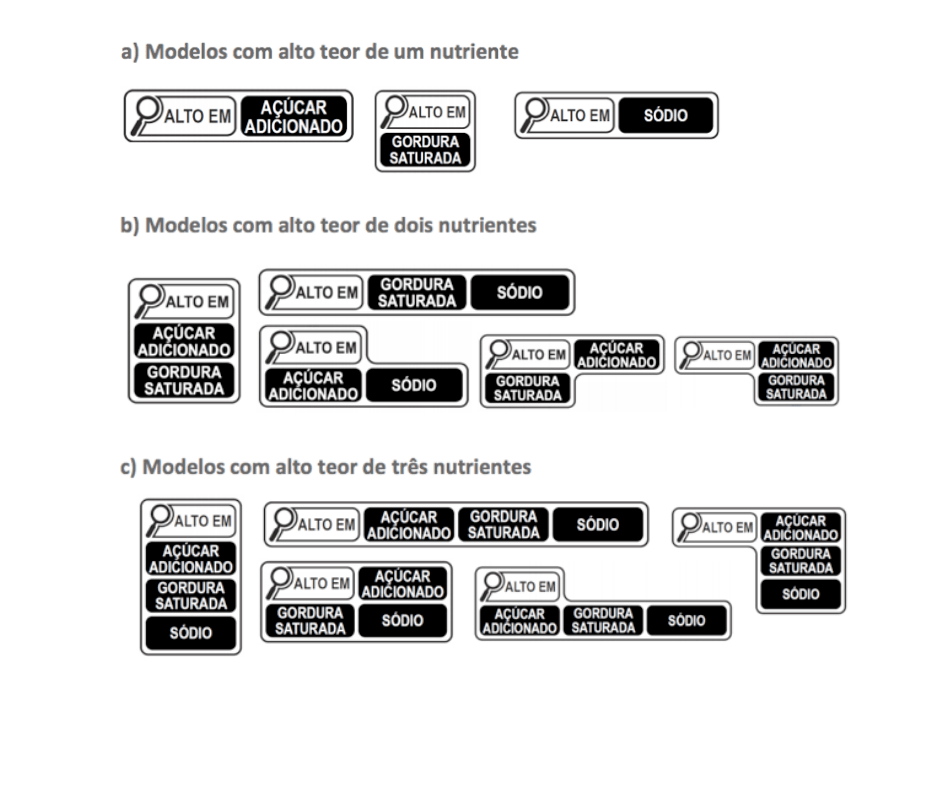
The research topic “Strengthening Food Labeling Policies in Brazil” provided an overview of food labeling policies in Brazil. Regarding the implementation of front-ofpackage nutrition labeling (FoPNL), the results discussed in the research topic suggest that the effectiveness of FoPNL systems depends on a number of factors including the design of the label, see for example, Prates et al. (1), Fernandes et al. (2), and Scapin et al. (3); and the nutrient profile model used to define which products are subject to them, see for example, Borges et al. (4), and Tomaz et al. (5). Thus, Prates et al. (1) showed that the Brazilian magnifying glass model did not perform as well as the triangular or octagonal FoPNL models, while Borges et al. (4) showed that because of the nutrient profile model adopted in Brazil, which is considerably more permissive than the nutrient profile model of the Pan-American Health Organization (PAHO), fewer products will receive FoPNL in Brazil.The aim of this commentary is to extend the discussion on the new Brazilian FoPNL regulations. Here, we will briefly comment on how Brazil missed an opportunity to make a more significant public health advance during the implementation of FoPNL by failing to learn from the experience of other Latin American countries.
Article – Front-of-package warning labelling system for pre-packaged foods and beverages: an intersectoral position of expertsin Central American and Dominican Republic
The Latin American region has been a pioneer in the implementation of a front- of-pack warning labeling system (FOPWL), which has demonstrated its efficacy and effectiveness in correctly identifying when a product contains excessive amounts of nutrients associated with Non-Communicable Diseases (NCDs). However, countries of the Central American Integration System (SICA); which includes Belize, Costa Rica, El Salvador, Guatemala, Honduras, Nicaragua, Panama and the Dominican Republic, have no adopted it. For this reason, the Institute of Nutrition of Central America and Panama convened a group of experts from academia and civil society with the aim of establishing an evidence-based technical position, in relation to front-of-pack labelling for critical nutrients of pre-packaged foods and beverages in the Central American region. Specific evidence from the SICA region demonstrating the superiority of FOPWL over other labels such as the Guideline Daily Amount (GDA), the traffic light and Nutriscore to select healthier choices is presented. Within the framework of children’s and consumer rights, arguments are provided, and a call is made to governments for the prompt adoption of FOPWL as a cost-effective policy for the prevention of NCDs. In addition, recommendations for its monitoring and evaluation are provided, as well as recommendations for other cost-effective policies such as the regulation of unhealthy food advertising aimed at children and adolescents, among others, for the prevention of NCDs and the creation ofhealthier and more sustainable environments and food systems.
 infoAlimentario