The COVID-19 pandemic has affected and afflicted human lives and been a transformative catalyst leading to closure of many companies, disrupting mental health, and reducing access to food and exacerbating food insecurity. This presents an opportunity to reflect on and examine genetically modified (GM) foods and their effective legislative regulation for the benefit of consumers. This review presents a detailed analysis of GM foods’ regulation in Peru and the analysis of certain specific cases that show the need for greater regulation of the industry.
In Mexico, the inclusion of a Front-of-Pack Label in the Official Mexican Standard-051 (NOM-051 for its Spanish acronym) has been widely discussed for years by different stakeholder groups. In 2019, the NOM-051 modification project was proposed, which included front-of-pack warning labels. To be modified, it went through a public consultation period where stakeholders sent their comments to be reviewed and considered. The purpose of this study was to analyze the perspectives of key stakeholders during the public consultation of the NOM-051 modification project in order to understand their positions and their effect on the final public policy.
The European Commission is planning to establish ‘nutrient profiles’, that is, maximum amounts for nutrients such as fat, sugar and/or salt in foods, above which the use of nutrition or health claims would be restricted or forbidden. For example, breakfast cereals exceeding a sugar limit could no longer advertise their fibre or vitamin content. The Commission was already tasked with setting nutrient profiles to restrict the promotion of food high in fat, sugar and/or salt under the Nutrition and Health Claims Regulation (‘Claims Regulation’) adopted in 2006. Now, in accordance with the action plan accompanying the EU’s ‘farm to fork’ strategy, the Commission will submit a proposal on nutrient profiles by the end of 2022. The proposal will form part of a wider package revising EU legislation on food information supplied to consumers, together with proposals on front-of-pack nutrition labelling, origin labelling, date marking, and labelling of alcoholic beverages. In the same package, the Commission also intends to solve a problem that has long been puzzling manufacturers and consumers in the herbal and plant products market, namely, that the same product can be classified both as a herbal medicine and as a food, depending on the Member State in which it is sold. While most consumer organisations and health advocates strongly support the idea of introducing nutrient profiles, opponents caution against overly simplistic labels that punish certain food groups and lead health-conscious individuals to avoid them. The European Parliament has stressed that food information is a potent tool for empowering consumers.
Different nutrient profiles (NPs) have been developed in Latin America to assess the nutritional quality of packaged food products. Recently, the Mexican NP was developed as part of the new warning label regulation implemented in 2020, considering 5 warning octagons (calories, sugar, sodium, saturated fats, and trans fats) and 2 warning rectangles (caffeine and non-nutritive sweeteners). The objective of this cross-sectional study was to evaluate the Mexican NP and other NPs proposed or used in Latin America against the Pan American Health Organization (PAHO) model.
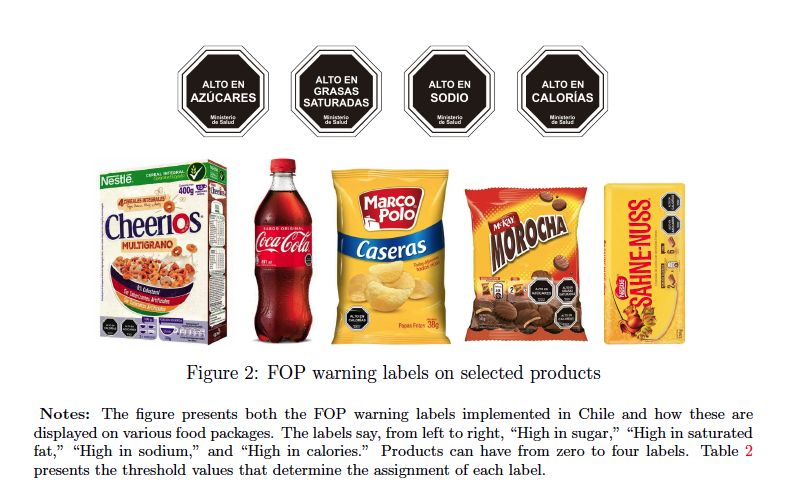
We study a regulation in Chile that mandates front-of-package warning labels on products whose sugar or caloric concentration exceeds certain thresholds. We document an overall decrease in sugar and caloric intake of 7-9%. To unpack the underlying mechanisms, we provide descriptive evidence of the impact of the policy on consumer choice, both across and within categories and firms’ behavior. We find no noticeable substitution of products across food categories and show that most of the demand effect of the regulation comes from within-category substitution. We also find that a substantive portion of the overall effect comes from product o reformulation. We discuss how these findings can inform the design of effective labeling policies.




 infoAlimentario