Article: Trans-Fat Labeling in Packaged Foods Sold in Brazil Before and After Changes in Regulatory Criteria for Trans-Fat-Free Claims on Food Labels

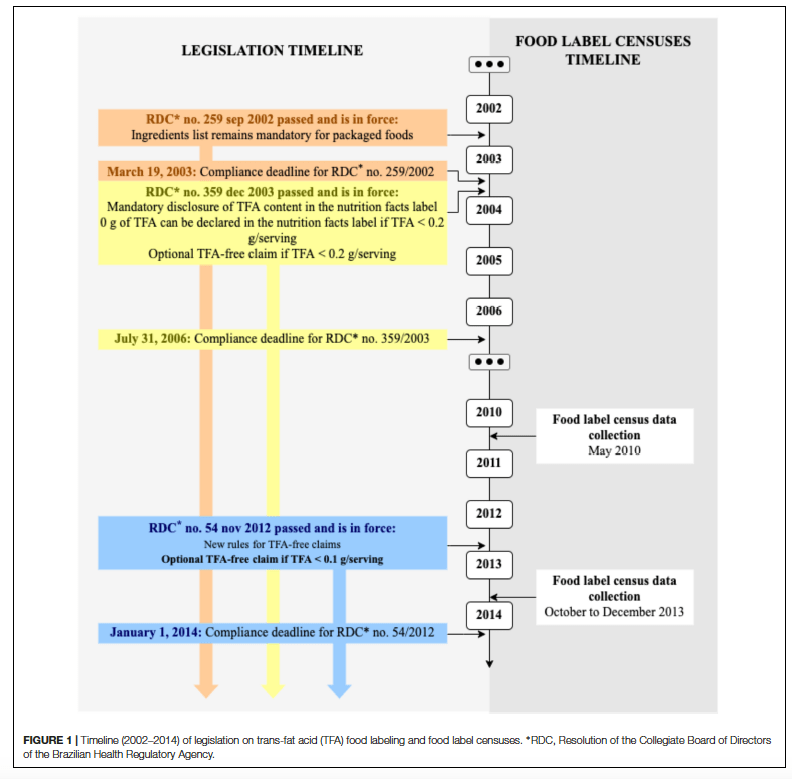
According to Brazilian and Mercosur legislation, food labeling is mandatory for all ready-for-sale foods packaged in the absence of the consumer. Labels must contain descriptive information on packaged foods and beverages, including the ingredients list and nutrition labeling ). The nutrition facts label must contain quantitative descriptions of energy value, carbohydrates, proteins, total fat, saturated fat, TFA, and sodium. Although TFA information is mandatory, current legislation has limitations that make it difficult for consumers to correctly identify TFA in food products by using food labels (. One such example is the possibility for manufacturers to declare a TFA content of 0 g in the nutrition facts label when the product contains less than or equal to 0.2 g of TFA per serving, without any distinction between naturally occurring TFA and i-TFA.
Article: Lobbying and nutrition policy in Canada: a quantitative descriptive study on stakeholder interactions with government officials in the context of Health Canada’s Healthy Eating Strategy

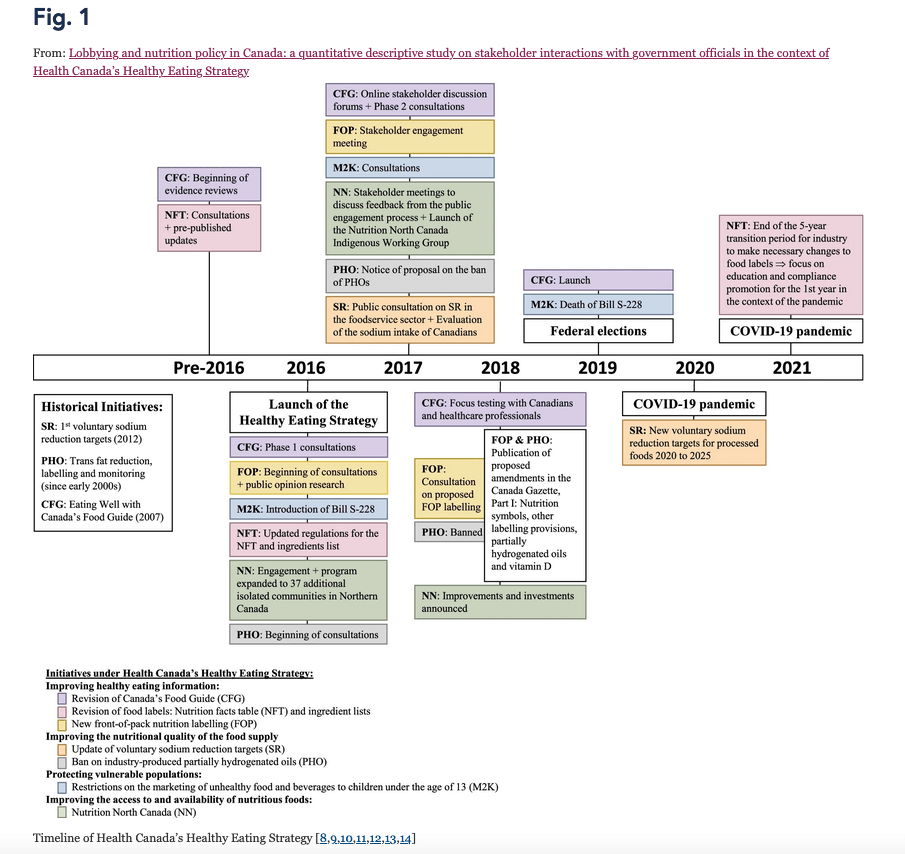
The political activities of industry stakeholders must be understood to safeguard the development and implementation of effective public health policies.

Results suggest a strategic advantage of industry stakeholders in influencing Canadian policymakers. While some safeguards have been put in place, increased transparency would allow for a better understanding of industry discourse and help protect public health interests during the policy development process.

Article: Weight stigma in Mexico and front-of-package labeling. A systemic review

Front-of-package food labeling is a public health strategy implemented to reduce the consumption
of processed food to decrease the incidence of obesity in Mexico. Although there is an increasing focus among public health officials on implementing policies designed to address obesity, much less attention has been paid to how these policies could impact those with disordered eating, despite the fact that millions suffer from such illnesses. Objective. The aim of this article is to present scientific literature related to front-of-package labeling and its impact on obesity and eating disorders. Method. Papers related to nutrition labels and obesity and eating disorders were reviewed. Results. The papers reviewed found no significant improvement regarding the consumption of processed food. Other measurements, including nutritional education, availability, physical education, and body-image acceptance, have a better impact on nutritional health. Discussion and conclusion. Front-of-package labeling is regarded as an important measure in the attempt to reduce obesity levels. However, there is insufficient scientific evidence to suggest that this type of labeling reduces the consumption of processed foods in patients with obesity.

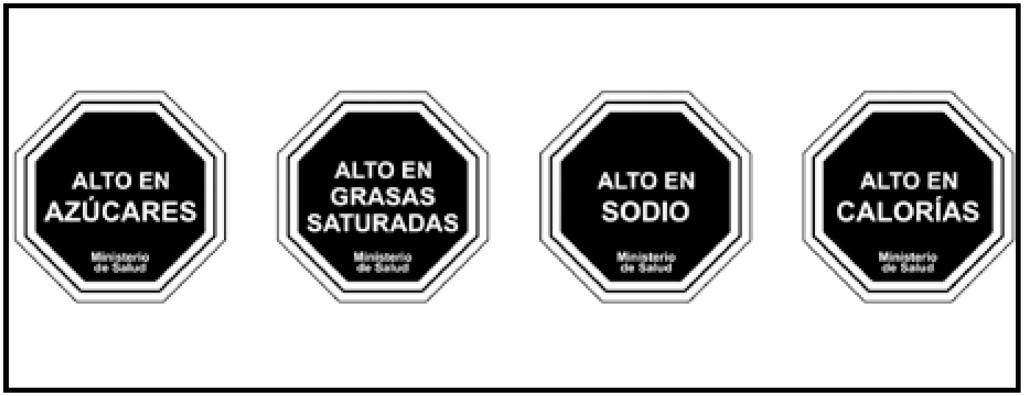
Article – Chile: How Do Nutritional Warning Labels Affect Prices?

Obesity is increasing worldwide and in many countries, the problem is particularly serious among lower income groups. To fight obesity, front-of-pack nutritional warning labels are a prominent regulatory tool that have been implemented or are currently debated in many countries. Existing studies document that warning labels incentivize consumers to substitute away from unhealthy products. However, not much is known about equilibrium price changes in response to consumers’ utility for warning labels. Using household purchase data in the cereal category, this paper studies the adjustments of prices after the mandatory introduction of warning labels in Chile. The authors develop a model which shows that warning labels lead to higher prices of labeled cereals, as is also observed in data. In contrast, prices of unlabeled products tend to drop or at least increase less, incentivizing price sensitive consumers to remain in the category. The authors decompose post-labeling market share adjustments into a pure label effect that fixes prices at initial levels after regulation and a total effect that accounts for price re-optimizations. Their findings point to self-enforcing effects of a warning label regulation as the price adjustments amplify the policy-maker’s goal of reducing unhealthy nutritional intake, especially because market forces incentivize low-income segments to choose healthier alternatives.

Article: The right to food: What do the constitutions of America and the Caribbean say?

Introduction:

Many American and Caribbean countries consider the right to food as constitutional right. Chile does not have this explicit right in the Constitution.

Objective:

To describe comparatively how the right to food is explicit in the constitutions of American and Caribbean countries, generating inputs for those countries that do not have this constitutional right, such as the case of Chile.

Data sources:

This research was carried out on platforms: Food and Nutritional Security (SAN-CELAC), Right to Food in the World (FAO) and Constitute Project which presents constitutions of the world.

Revision method:

A revision was made of all available constitutions of American and independent Caribbean countries, dependent territories and overseas departments in the Region. Subsequently, in those countries which explicitly consider the right to food in constitutional texts, a review of general characteristics and right to food-associated concepts, suggested by FAO, was carried out. The review was carried out between June and September 2020.

Results:

Of the total of countries reviewed (n= 42), 40.5% presented the right to food in constitutional text. The most frequently associated concept was food security.

Conclusion:

Most of the revised constitutions accompany the right to food with food safety, availability and accessibility characteristics, and include kinds of judicialization, concepts that should be incorporated into the new Magna Carta of Chile.