In this work, as a start, a review of the definitions of genomics, transgenics, and public policies is presented; the difference of each one is presented, an analysis is created in public policies on genomics and transgenics; The problem of its regulation in Mexico is described, and some ethical controversies that arise from the possible applications in Mexico and that come out of the legal regulatory norms in Mexico are discussed. It talks about the general problems in creating laws with respect to genomics and transgenic issues, to later explain why society it is difficult to identify and understand these terms; The lag in this type of technology in Mexico is described, indicating the possible changes necessary in the regulations and some essential points that are mentioned in the norms that allow its regulation and sanction the possible damage due to the use of transgenic and genomic products.
One strategy for the prevention and treatment of non-communicable diseases (NCDs) is the implementation of the front-of-pack labeling (FoPL) in foods and beverages. In 2020, Mexico adopted the warning label system (WL) as a new public health policy, whose aim is to help consumers make healthier food choices. Previously, the Guideline Daily Amount (GDA) was the labelling used it. This paper aims to compare the understanding of two FoPL, the GDA and the WL, through the identification of unhealthy products in Mexicans with NCDs. We analyzed data from 14,880 Mexican adults older than 20 years old with NCDs (overweight-obesity (OW/O), self-reported diabetes mellitus 2 (DM2), or/and hypertension (HT), or/and dyslipidemia (Dys)). Participants were randomly assigned to one of two groups: the GDA labeling or WL. Each group had to respond to a survey and had to classify food products images as healthy or unhealthy according to the labelling system to which they were assigned. The correct classification was determined according to the criteria of Chile’s labeling nutrient profile stage 3. To evaluate the correct classification in each one of the groups we evaluated the differences in proportions. Logistic regression models were used to assess the likelihood to correctly classify the product according to participants’ number of diseases and WL information, taking GDA label as a reference. Participants who used the information contained in the GDA label misclassified food product labels in greater proportion (70%), mostly participants with three or more NCDs (participants with OW/O+ HT+ Dys, represent 42.3% of this group); compared with those who used WL (50%). The odds of correct classification of food products using WL image were two times greater compared to GDA image in participants with NCDs; being greater in participants with three or more NCDs. The study results highlight the usefulness of WL as it helps Mexicans with NCDs to classify unhealthy food products more adequately compared with GDA.
In 2014 in Ecuador, it was promulgated a legal instrument that creates the obligation for processed foods to carry a label in the form of a traffic light that allows to know nutritional quality of a product to be reported at a single look. In Chile in 2016, it was promulgated similar legal instrument: “Ley Sobre Composición Nutricional de los Alimentos y su Publicidad” which requires that processed foods bear a label with a warning, for both legal instruments were analyzed their effectiveness through the change in consumer behavior in the consumption of sugary drinks. For Ecuador, the following data were taken: the income from taxes on soft drinks, and the tax on plastic bottles for single use; finding that, in Ecuador, that after the enactment of the Labeling Regulation there is no change in consumer behavior. In Chile, the income from taxes on non-alcoholic beverages was taken as an indicator, finding that, after the enactment of the Food Law (2016), It was no change observed in consumer behavior.
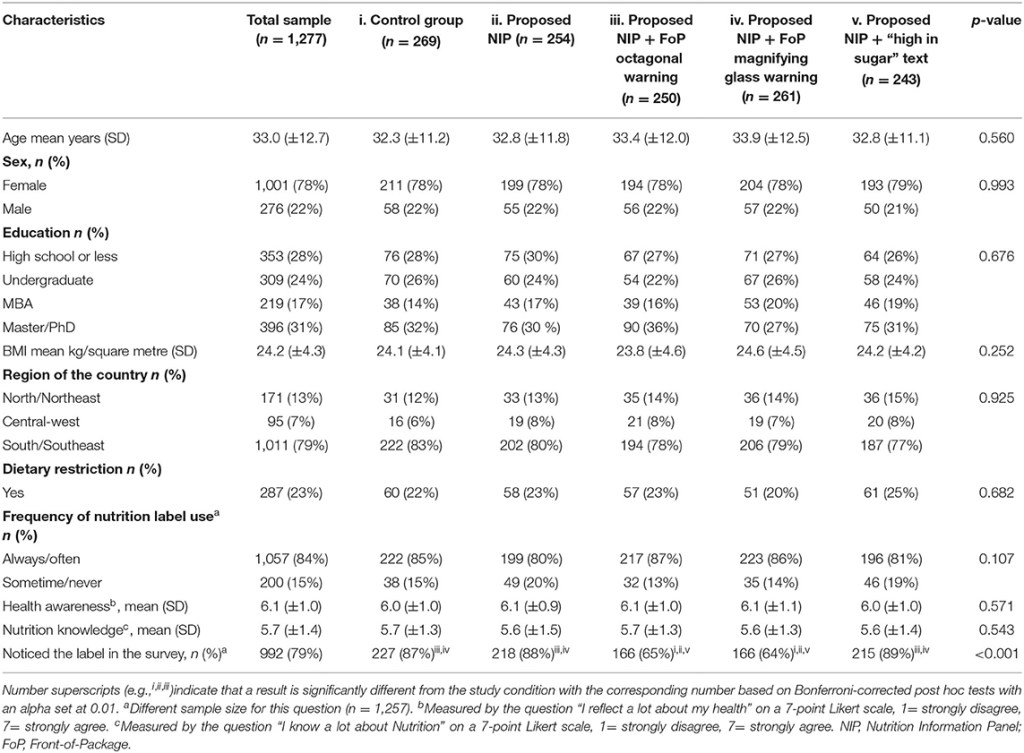
Providing information about the sugar content of packaged foods on product labels is an important strategy to lower consumers’ sugar intake. This study assessed the effect of exposure to different sugar labels on consumers’ understanding of the sugar content of foods and their food choices. In the first phase, five focus groups were conducted with a convenience sample of Brazilian adults to explore their perceptions about food labelling in general and sugar labelling in particular. Based on the qualitative results, four sugar label formats were developed and subsequently tested in a five-arm study on 1,277 adults via a randomised controlled online survey. The formats were: (i) no sugar information—control, (ii) total and added sugar content displayed in the Nutrition Information Panel (NIP), (iii) a front-of-package (FoP) octagonal warning for “high-in-sugar” products, (iv) a FoP magnifying glass warning for “high-in-sugar” products, and (v) a “high-in-sugar” warning text embedded on the NIP.
Providing information about the sugar content of packaged foods on product labels is an important strategy to lower consumers’ sugar intake.
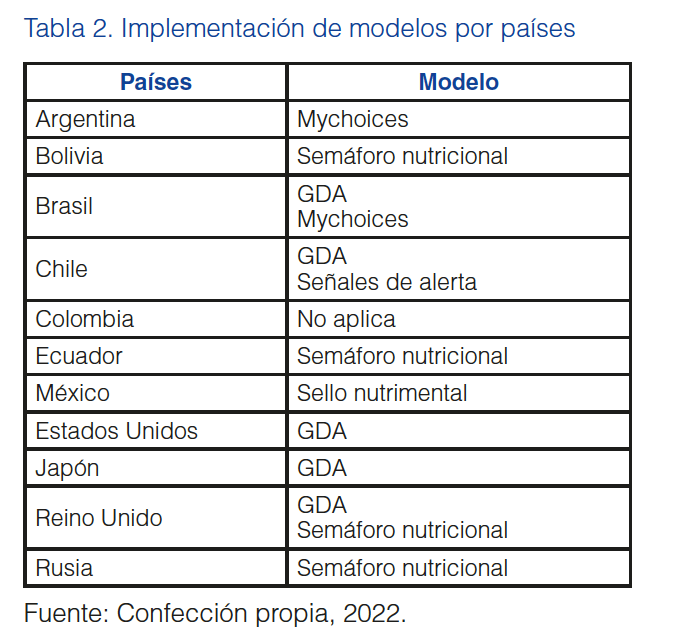
In the communication between producers and consumers, food labeling is fundamental since it allows to know the conformation and nutritional facts of food products. This work is carried out to develop a comparative study on the laws of front labeling as a guarantee of legal protection to consumers, it is a study of doctrinal and jurisprudential review on the protection of the right to health of consumers. It can be evidenced that the main models of front labeling are interpretative, non-interpretative, semi-interpretative and hybrid, of which the most used are the food guides and nutritional traffic lights. The guide system is used in Brazil, Chile, the United States, Japan and Great Britain, while the traffic light system is more widely used in Bolivia, Ecuador, Mexico and Russia.


 infoAlimentario