The National Health Surveillance Agency (ANVISA in Portuguese) Anvisa has published updated versions of guidelines for evaluating the mutagenic potential, carcinogenic potential, neurotoxicity and reproductive toxicity of pesticides.
The guidelines provide guidance on the toxicological evaluation of pesticides, which encompasses the assessment of various outcomes and is carefully conducted by the Agency, both during product registration and during a possible reanalysis.
In addition, the guides express ANVISA’s understanding of best practice in relation to procedures, routines and methods considered appropriate to meet the technical or administrative requirements mandated by the Agency’s legislative and regulatory frameworks.
Guide 66/2023 – version 2 – Guide to the Assessment of the Mutagenic Potential of Pesticides
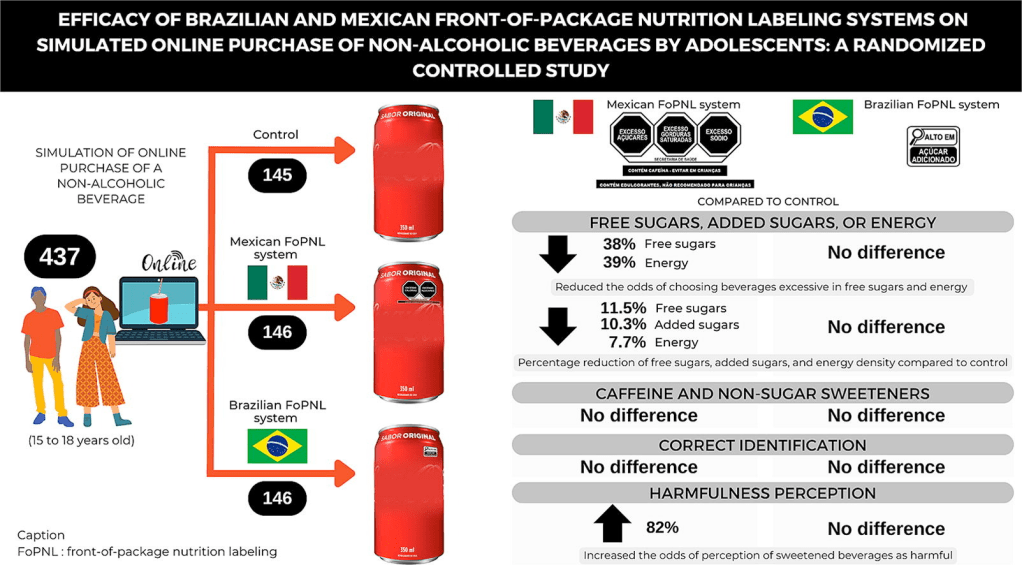
Front-of-package nutrition labeling (FoPNL) has been gaining prominence as a strategy to reduce the consumption of sugar-sweetened beverages as it helps consumers to clearly identify products with excess sugars. This study aimed to evaluate the efficacy of the Brazilian and Mexican FoPNL systems on simulated purchases of non-alcoholic beverages by adolescents in a fictitious online store. A total of 437 Brazilian adolescents (15 to 18 years old) participated in the study and were randomized into three experimental groups: control (online store with products displayed without FoPNL), Mexican FoPNL system (products with “excess in” octagonal black warning labels based on the Mexican nutritional profile), and Brazilian FoPNL system (products with “high in” magnifying glass icons following the Brazilian nutritional profile). FoPNL systems have been applied in accordance with the legislation of each country. Participants selected a non-alcoholic beverage to be purchased from 30 options in the experimental online store. After completing the simulated purchase, they responded to questionnaires regarding their perceptions of healthfulness, harmfulness, and excess nutrient content of the beverages, as well as their socioeconomic status. Compared to the control, the Mexican FoPNL system significantly reduced the prevalence of adolescents choosing beverages in the highest tertile of free sugar density (PR: 0.74, 95 %CI: 0.58 – 0.94), added sugar density (PR: 0.76, 95 %CI: 0.57 – 0.99), and energy density (PR: 0.75, 95 %CI: 0.58 – 0.96). Participants in the Mexican FoPNL system group selected beverages containing 11.5 %, 10.3 %, and 7.7 % less free sugars, added sugars, and energy density, respectively, compared to the control group. Regarding total quantities, the Mexican FoPNL system led to the choice of beverages with 5.3 %, 5.0 % and 3.7 % less free sugars, added sugars, and energy, respectively, than those in the control group. The Brazilian FoPNL system resulted in a 2.3 % reduction in the calories purchased compared to the control group but was ineffective in changing the amount of free and added sugars in the simulated purchases. Additionally, the Mexican FoPNL system increased the odds and the prevalence of participants perceiving sweetened beverages as harmful to health by 82 % and 30 %, respectively, compared to the control. In conclusion, the Brazilian FoPNL system was ineffective in reducing the simulated purchase quantities and densities of free sugars, added sugars, and energy. In contrast, the Mexican FoPNL system was effective, outperforming the Brazilian system by reducing the prevalence of participants choosing beverages in the highest tertiles of free sugar density, added sugar density, and energy density, and by increasing the odds and prevalence of adolescents recognizing sweetened beverages as harmful to health.
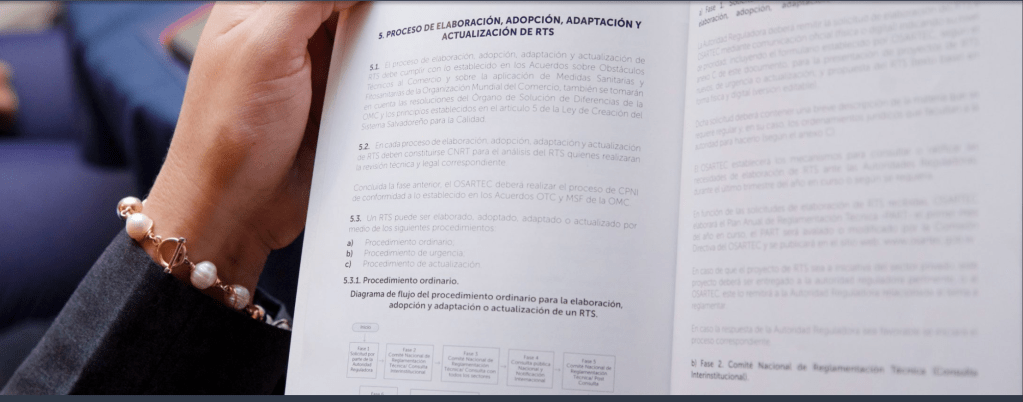
The official launch of the Regulation for the Preparation of Salvadoran Technical Regulations was held. This document establishes the guidelines for Good Practices in the preparation, adoption, adaptation and updating of Salvadoran technical regulations.
This legal instrument allows us to harmonize criteria to be fulfilled by the State’s regulatory authorities, in compliance with the commitments signed by El Salvador before the World Trade Organization.
For the Government of El Salvador, this launch is important, since the technical regulations are directly related to exports and contribute to the country’s objectives, to provide tools that open paths for Salvadoran products to enter international markets. Said Licda. Andrea Pérez, Director of Innovation and Productivity of the Ministry of Economy.
The Pan American Health Organization (PAHO/WHO) congratulates Colombia for the approval of resolution 2066 of October 23, 2024, which establishes “the technical regulation that defines the uses and maximum contents of industrial trans fats and partially hydrogenated oils and dictates other provisions.”
This measure will promote the elimination of industrially produced trans fats in food, helping to protect the cardiovascular health of the population. Excessive consumption of trans fats is associated with an increased risk of developing and dying from coronary heart disease.
The regulation, after going through a transparent process of public consultation and regulatory impact analysis, was approved by the executive branch. In this regulatory instrument, the Ministry of Health and Social Protection adopts the best practices of PAHO/WHO for the elimination of industrially produced trans fats from food in Colombia. The first is the prohibition of the use of partially hydrogenated oils in food. The second is the establishment of a 2% limit for other industrially produced trans fatty acids within the total fats.
Mexican President Claudia Sheinbaum Pardo announced that in February 2025, Congress will legislate on the prohibition of planting genetically modified corn in national territory with the aim of protecting the country’s biodiversity, in response to the resolution of the panel of the Treaty between Mexico, the United States and Canada (T-MEC) on measures related to genetically modified corn.
“The Mexican Congress, here with the help of the senators and deputies, we are going to turn this resolution around, because very soon, in February (in the next session period), they are going to legislate, I am sure, that transgenic corn cannot be planted and that Mexico’s biodiversity must be protected in our country. As we say: Without corn, there is no country!”
However, on December 20, 2024, the Panel established under Chapter 31 (Dispute Settlement) of the Treaty between the United Mexican States, the United States of America and Canada (USMCA) distributed to the Parties in dispute its Final Report on the case Mexico – measures related to genetically modified corn (MEX-USA-2023-31-01).
As part of its conclusions, the Panel considered that some elements of the Decree on glyphosate and genetically modified corn, published in the Official Journal of the Federation on February 13, 2023, cannot be applied “because they are not based on an adequate risk assessment, scientific evidence and relevant international standards.”

 infoAlimentario