The National Agency for Health Regulation, Control and Surveillance (ARSA in Spanish) has published a draft of “Requirements for Modifying the Health Notification of Foods for Special Dietary Regimens” V2.0. It is updated in accordance with the guidelines established in Resolution ARCSA-DE-2024-015-DASP, by which the Partial Amendment to the Sanitary Technical Regulations for obtaining the health notification certificate and registration of processing plants certified in good manufacturing practices for foods for special dietary uses, distribution, marketing, and transportation establishments, Published in Official Gazette No. 546 of September 27, 2021.
The National Agency for Health Regulation, Control and Surveillance (ARSA in Spanish) has published a draft of External Instruction IE-B.4.1-GN-01, “Outsourcing of Analyzes of Processed Foods, Food Supplements, Foods for Special Dietary Purposes, and Registration of Conformity Assessment Bodies (CABs) with ARCSA.”
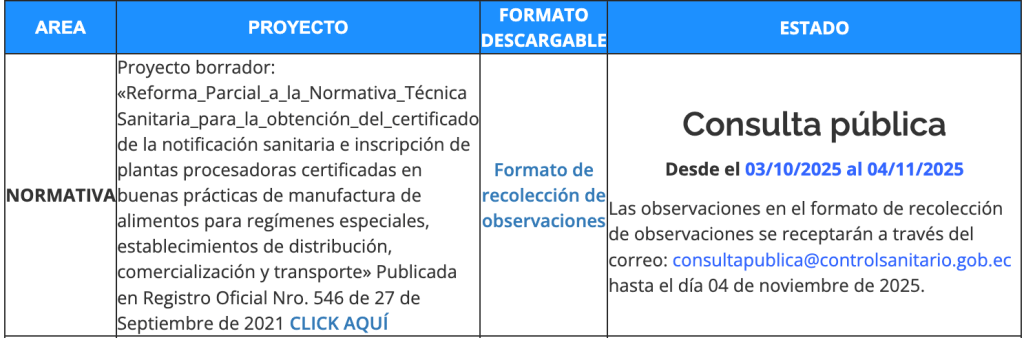
The National Agency for Regulation, Control, and Sanitary Surveillance (ARSA in Spanish) has released a draft for a partial reform of the technical sanitary regulations concerning the acquisition of the sanitary notification certificate and the registration of certified processing plants adhering to good manufacturing practices for special regimes, as well as establishments involved in distribution, marketing, and transportation.
The Ministry of Health, in collaboration with the National Health Surveillance Agency (ANVISA), the Pan American Health Organization (PAHO), and the Center for Epidemiological Research in Nutrition and Health at the University of São Paulo, has issued the first report of the “Monitoring of Food Labeling in Brazil” project. The initiative aims to monitor the labeling and nutritional profile of food products sold in the country, thereby supporting public policies for adequate and healthy nutrition. Researcher Ana Paula Bortoletto presented the analysis conducted by the USP (University of São Paulo), based on data collected by Mintel for the “Global New Products Database” platform at food and beverage retail outlets across all regions of Brazil, and on data obtained directly from the industry. All new packaged products available on the market within a three-month period were collected (the 39,000 packaged food and beverage products launched in Brazil between November 2020 and November 2024, 62% of which are ultra-processed and only 18.4% are unprocessed or minimally processed). The database included changes in size, new flavors, new packaging types, and reformulated products. The labeling assessment also considered the perspective of the Nova classification*, adopted by the Dietary Guidelines for the Brazilian Population.
Congressman Felipe Carreras (PSB-PE) has introduced a bill (PL 5229/2025), currently under debate in the Chamber of Deputies, that seeks to tighten regulations in Brazil’s dietary supplement market by expanding oversight, quality standards, and penalties for fraud and adulteration. The bill doubles the penalties for adulteration offenses. “The company could be disqualified and those responsible could face criminal charges, with the possibility of imprisonment,”



 infoAlimentario