The National Authority for Health Regulation (ANRS in Spanish) has published Administrative Resolution No. 0001-2026 regarding the online approval process for powers of attorney.
The objective of the Resolution is to establish the procedure and requirements for the approval of Powers (Power of Representation; Authorization for Import, Distribution, and Marketing; Authorization for Distribution and Marketing, Substitution or Revocation of the Power) carried out by natural or legal persons in the respective Specific Directorates that make up the National Authority for Health Regulation.
Author: infoAlimentario
Brazil – ANVISA publishes the Regulatory Agenda 2026/2027
The Collegiate Board of Directors of the National Health Surveillance Agency (ANVISA in Portuguese) has published the Regulatory Agenda 2026-2027, which includes 161 topics, of which 97 were migrated from the 2024-2025 Agenda, 26 topics for periodic updates, and 38 new topics.
The Regulatory Agenda includes 35 subtopics related to the food category.
- Regulation on the quantitative declaration of ingredients in the labelling of packaged foods.
- Nutritional Surveillance Requirements.
- Review of regulations on food additives and processing aids authorized for use in dairy products
- Review of regulations on food additives and processing aids in food.
- Review of regulations on the authorization of use and labeling of sweetener additives in food
- Review of regulations on contaminants in food.
- Review of regulations on food-grade PET-PCR containers intended to come into contact with food
- Review of regulations on food enrichment and restoration.
- Review of regulations on foreign matter in food.
- Review of regulations on health requirements for flavored ice for beverages.
- Review of regulations on the human health risk assessment of veterinary medicinal products, maximum residue limits (MRLs) in food of animal origin, and analytical methods.
- Regulations on gluten-free labeling in food.
- Review of regulations on food irradiation.
- Review of regulations on cellulosic materials, containers, and equipment intended to come into contact with food
- Review of Regulations on monomers, other substances, primers, and polymers authorized for the production of plastic containers and equipment in contact with food.
- Review of regulations on the registration of foods exempt from registration.
- Review of regulations on the labeling of allergenic foods.
- Review of regulations on the general labeling of packaged foods.
- Review of regulations on the nutritional labeling of packaged foods.
- Review of Good Practices for Food Services (Revision of RDC No. 216/2004).
- Review of hygiene and sanitation requirements and good manufacturing practices for food-producing. establishments or manufacturers (Revision of RDC No. 275/2002).
- Periodic update of the list of plant parts authorized for the preparation of teas and their use as spices.
- Regulation of the lists of novel foods and authorized ingredients and their specifications.
- Periodic update of the list of components, limits of use, declarations, and supplementary labeling of food supplements.
- Periodic update of the list of plant species Authorized names, composition, and fatty acid values.
- Maximum acidity limits and peroxide value for vegetable oils and fats.
- Periodic updates to the list of maximum permissible limits (MPLs) for contaminants in food.
- Periodic updates to the list of MRLs, ADIs, and DRfAs for veterinary medicinal product additives in food of animal origin.
- Periodic updates to the lists of food additives and processing aids authorized for use in food.
- Periodic updates to the lists of components, limits of use, and claims for infant formulas, transitional foods, and cereal-based foods for infants and young children, enteral nutrition formulas, and dietary formulas for inborn errors of metabolism.
- Regulation of the use of information transmission technology in food labeling.
- Regulation of formulated colorants and the labeling of colorants and flavorings in packaged foods.
- Regulation of foods for medical purposes.
- Regulation of foods of plant origin.
- Regulation of sanitary requirements for silicone materials in contact with food.
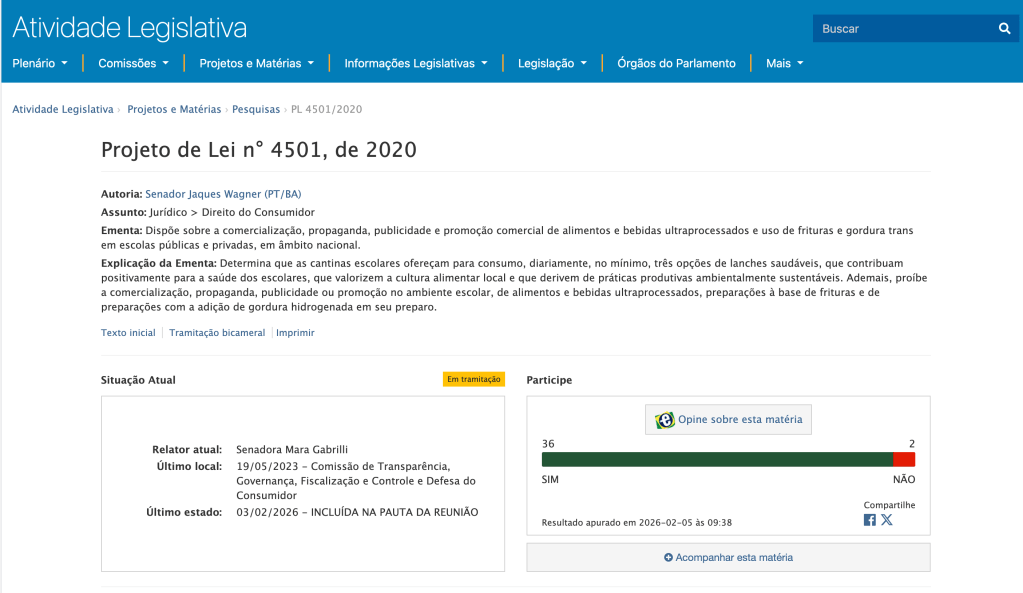
Brazil – The Consumer Protection and Oversight Committee is reviewing a bill to ban the sale of ultra-processed foods in schools
The Consumer Protection and Oversight Committee (CTFC) will on Wednesday (4) consider a bill that prohibits the sale of ultra-processed foods in public and private school cafeterias. Proposals are also included to facilitate the services of consumer protection agencies and to address the rights of hospitalized children and adolescents.
Bill 4.501/2020, drafted by Senator Jaques Wagner (PT-BA), proposes a series of regulations prohibiting the sale and distribution of ultra-processed (highly industrialized) foods and beverages or those high in calories, sugar, and fat in educational establishments. Additionally, the text requires cafeterias to offer healthy snack options or those tailored to individuals with dietary restrictions (such as diabetics and celiacs).
Colombia – Constitutional Court ratifies the tax on sugary and ultra-processed beverages
The Constitutional Court upheld the tax rate on ultra-processed and sugary beverages, as included in the first tax reform of President Gustavo Petro’s government, which had been challenged for imposing tax burdens on consumers who, for example, choose plant-based beverages.
The Full Chamber, by a 7-0 vote, approved the report by Justice Jorge Enrique Ibáñez, which called for endorsing the rule imposing a tariff on any beverage with an alcohol content not exceeding 0.5% and to which any amount of added sugar has been incorporated.
Although the regulation had already been given the green light by the Court in 2023, this ruling stems from a lawsuit alleging unfair treatment in the exclusion from the tax.
Mexico – The Ministry of Health publishes the new Mexican Dietary Guidelines 2025–2030
The Ministry of Health has published the new Mexican Dietary Guidelines 2025–2030, a technical document that updates the criteria for health promotion and the prevention of chronic diseases in the country. This regulation becomes the guiding framework for national public health, steering the transition toward healthy and sustainable food systems. The text, developed thru a consensus of experts from the National Institute of Public Health (INSP in Spanish) and international organizations, is now available for download and implementation in healthcare facilities.
The new 2025–2030 Healthy and Sustainable Dietary Guidelines are a strategic tool to improve the nutrition of the Mexican population without compromising the environment, and are therefore aimed at everyone, with special attention to school-age children and adolescents, said Anabelle Bonvecchio Arenas, Director of Nutrition Policy and Programs Research at the National Institute of Public Health (INSP in Spanish).
 infoAlimentario