The Decentralized Service for Standardization, Quality, Metrology, and Technical Regulations (SENCAMER in Spanish) has published the Draft Venezuelan Standard COVENIN 604:2025 Coffee. Terms and definitions. (1st Revision). This standard will apply to the definitions of the coffee sector, by-products, and derivatives of national and international production.
Author: infoAlimentario
Chile – MAPA updates sanitary criteria for fish evaluation
The Ministry of Health (MINSAL in Spanish) has issued Decree No 8, which amends Articles 318 and 323 of the Food Sanitary Regulation. The Decree will come into effect 12 months after its publication in the Official Gazette. The main modifications are as follows:
1) Article 318 is replaced by the following:
Article 318. Fresh fish that is not eviscerated immediately after capture may only be marketed if it has been immediately subjected to freezing at a maximum temperature of minus 18° Celsius, measured at its thermal center, for a sufficient time to kill any parasites that may be present. The sufficiency of the treatment will be evaluated and validated by the company that performs it thru tests that subject the product to freezing treatments, measured at the thermal center, and exposure time to those temperatures that demonstrate they are capable of killing the parasites. The company must keep records of these evaluations and the treatments applied, which must be made available to the health authority if requested.
2) Article 323 is replaced by the following:
“Article 323.” Fresh and frozen fish intended for human consumption must be kept refrigerated or frozen according to their condition, in accordance with the provisions of articles 314 and 315 of this regulation. Fish intended for human consumption must be free of live parasites and their cysts. Although the parasites and their cysts have been inactivated by freezing treatments, the fish must not contain two or more parasites per kg of sample unit with a cyst larger than 3 mm in diameter or an unencapsulated parasite larger than 10 mm in length.
Brazil – MAPA proposes updating the procedures for the authorization of imported animal products
The Ministry of Agriculture and Livestock (MAPA in Portuguese) has published for public consultation the draft ordinance that establishes the procedures for import authorization, reinspection, the Program for the Evaluation of Conformity of Imported Animal Products, the special controls applicable to the importation of edible animal products, the destination of the products after their internalization, and the registration of importers.
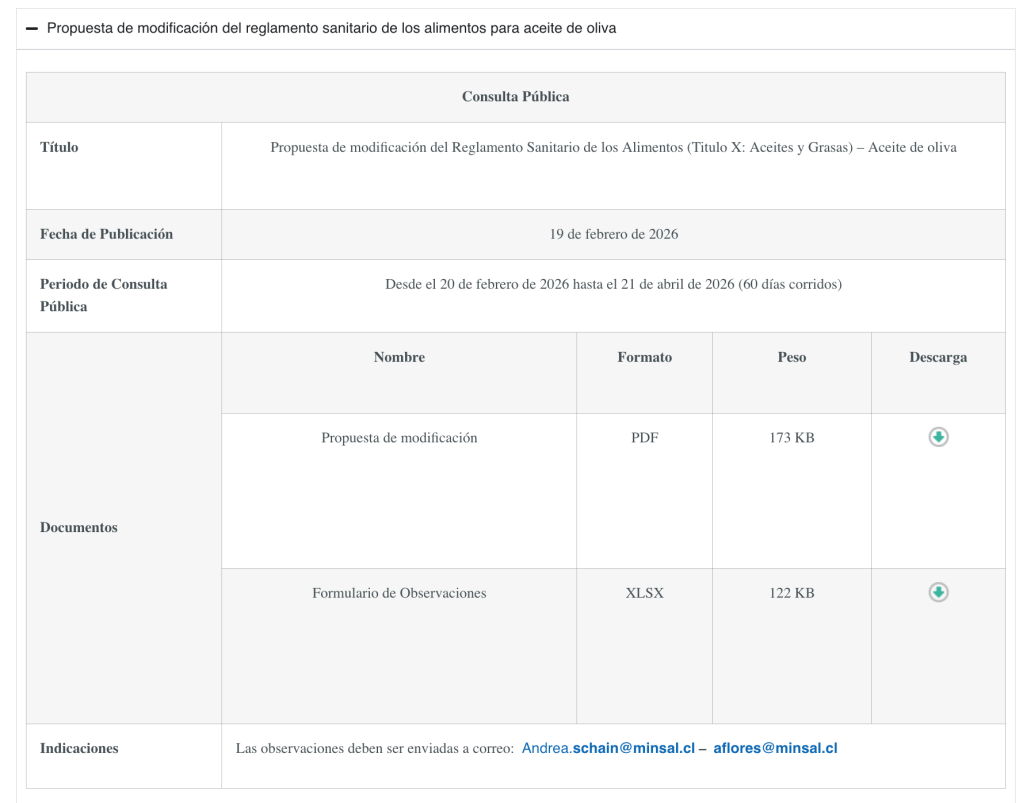
Chile – MINSAL proposes to modify quality requirements for olive oil
Ministry of Health (MINSAL in Spanish) has published the public consultation “Proposal for the modification of the Sanitary Regulation of Food (Title X: Oils and Fats) – Olive Oil.” The objective of the proposal is to incorporate into the Regulation
Sanitary Regulation of Food (D.S. 977/96) a specific regulation for olive oil, that establishes quality parameters and labeling criteria aligned with standards international standards, ensuring their authenticity and protecting the rights of consumers.
Paraguay – DINAVISA creates a working unit for the implementation and guidance on the use of artificial intelligence in regulatory processes and functions
The National Directorate of Sanitary Surveillance (DINAVISA in Spanish) has published Resolution DINAVISA No. 047/2026, which creates a strategic work unit for the implementation and guidance of the use of artificial intelligence in the processes and regulatory functions of the National Directorate of Sanitary Surveillance.
The Strategic Work Unit will have the following functions:
- Prepare technical reports and recommendations as a contribution to the decision-making process.
- Develop guidelines, recommendations, and best practices for the use of artificial intelligence in DINAVISA.
- Coordinate a multidisciplinary work team, composed of representatives from technical, regulatory, legal, technological, and other relevant areas.
- Evaluate opportunities, risks, and limitations associated with the implementation of artificial intelligence in regulatory processes.
- Promote the ethical, responsible, and transparent use of artificial intelligence, in accordance with current regulations and good regulatory practices.
- Propose pilot projects and progressive implementation strategies for solutions based on artificial intelligence.
- Lead the various departments of DINAVISA in matters of artificial intelligence applied to health regulation.
 infoAlimentario