Argentina – ANMAT updates the Food Code to set arsenic limits in rice

Thru Joint Resolution No. 04/2026, the National Administration of Medicines, Food and Medical Technology (ANMAT) and the Secretariat of Agriculture, Livestock, and Fisheries incorporated MERCOSUR Resolution No. 18/21 into the national legal framework, which updates the maximum limits of inorganic contaminants for the category “Rice and its derivatives, except oil,” specifically in relation to arsenic. The measure updates the MERCOSUR Technical Regulation on Maximum Limits of Inorganic Contaminants in Food, previously incorporated into the Argentine Food Code, with the aim of aligning national regulations with technical and scientific advances in food safety.

Main aspects of the update:

  • Harmonizes Argentine regulations with the standards in force within the MERCOSUR framework.
  • Updates the maximum permitted limits of arsenic for the category “Rice and its derivatives, except oil.”
  • Strengthens the protection of consumer health by adjusting the criteria for controlling inorganic contaminants in food.
  • It helps ensure the safety and quality of the food marketed in the country.

Likewise, Article 156 of the Argentine Food Code is updated, which establishes the maximum permitted limits for various metallic and non-metallic elements in food, incorporating the modifications approved at the regional level.

Peru – Natural Products Committee of the Exporters Association promotes the creation of a health registry for dietary supplements

The Natural Products Committee of the Exporters Association (ADEX) reiterated the importance of promoting the creation of a Health Registry for Food Supplements, as outlined in Bill No. 6435/2023-CR, approved by the Health Commission of Congress in April 2025 and currently pending debate in the Plenary.

The initiative seeks to establish a specific regulatory framework for this category, under the authority of the General Directorate of Environmental Health and Food Safety (DIGESA in Spanish), thru the implementation of a Sanitary Regulation.

He indicated that having differentiated regulation will provide greater legal certainty to companies, strengthen the competitiveness of the sector, and align national legislation with global standards and the guidelines promoted by the Pacific Alliance.

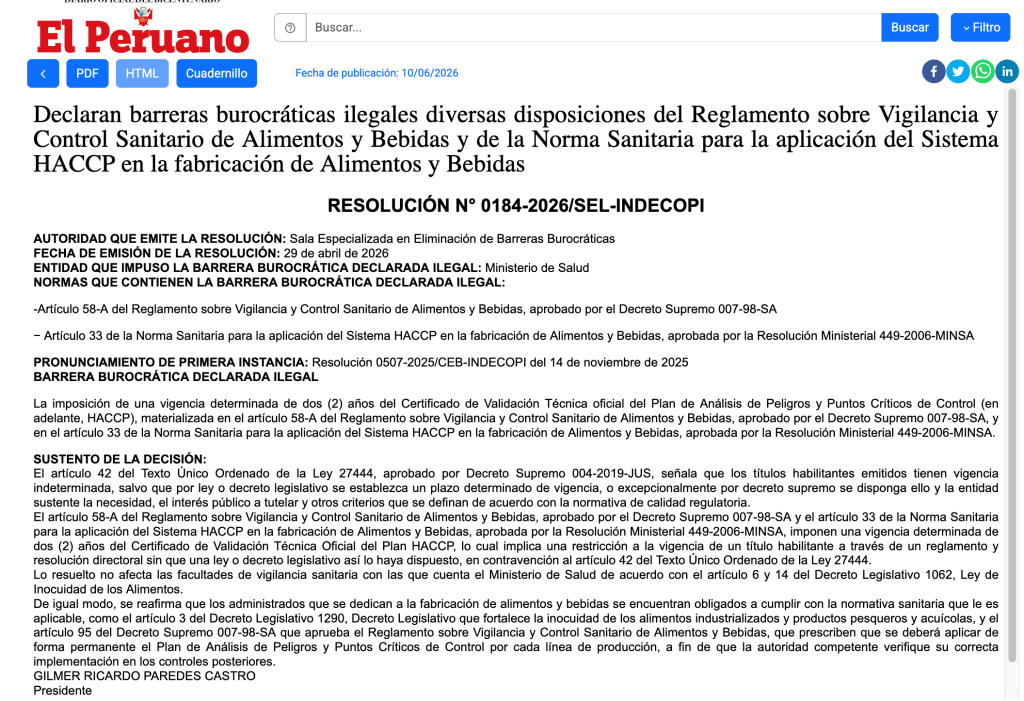
Peru – INDECOPI declared the MINSA’s requirement to renew the HACCP certificate for the food and beverage industry illegal

The National Institute for the Defense of Competition and the Protection of Intellectual Property (INDECOPI in Spanish), thru the Specialized Chamber for the Elimination of Bureaucratic Barriers, has published Resolution No. 0184-2026/SEL-INDECOPI, which orders the Ministry of Health to eliminate the validity limit on this key sanitary permit for national production.

Bureaucratic Barrier Declared Illegal

The imposition of a specific validity period of two (2) years for the official Technical Validation Certificate of the Hazard Analysis and Critical Control Points Plan (hereinafter, HACCP), materialized in Article 58-A of the Regulation on Health Surveillance and Control of Food and Beverages, approved by Supreme Decree 007-98-SA, and in Article 33 of the Health Standard for the application of the HACCP System in the manufacture of Food and Beverages, approved by Ministerial Resolution 449-2006-MINSA.

Mexico – Ministry of Health withdraws Red 3 dye from food due to health risk

The Ministry of Health, thru the Agreement published in the Official Journal of the Federation (DOF) on May 28, 2026, nullifies numeral 12, corresponding to “Erythrosine and its lakes, Red 14 Food, Red 3 FD&C,” within Annex III of colorants with an acceptable daily intake. Said annex is part of the agreement on additives and processing aids in food, beverages, and dietary supplements, published in 2012 and modified in 2013 and 2016.

The decision stems from an evaluation conducted by the Federal Commission for the Protection against Sanitary Risks (COFEPRIS), the national health authority responsible for reviewing food additives, beverages, and medications. In January 2025, the commission reported that it was analyzing risks related to Red No. 3 FD&C, according to Annex III of colorants with established ADI.

The analysis cited by the Ministry of Health calculated a Theoretical Maximum Daily Intake of 0.231 milligrams per kilogram of body weight per day. That figure exceeds the limit of 0.1 milligrams per kilogram of body weight per day established by the Joint FAO/WHO Expert Committee on Food Additives (JECFA) for erythrosine.

it eliminated the use of erythrosine and its lakes in food, beverages, and dietary supplements, after the Ministry of Health published an agreement to remove this additive from the permitted list. The measure applies to the dye known as Red 3 FD&C, FD&C Red No. 3, Red 14 Food or E-127, and responds to a risk analysis by Cofepris regarding exposure above the acceptable daily intake (ADI).

Brazil – Highlights of the 10th Regular Public Meeting of the Board of Directors

Highlights of the 10th Regular Public Meeting of the Board of Directors

Among the regulations approved by the Board of Directors is the regulatory harmonization with Mercosur standards on personal hygiene products, cosmetics, and perfumes.

Regulatory Instructions

The Board of Directors also approved three periodic Regulatory Instructions (IN) updates related to the components of food and dietary supplements, all under the direction of Director Daniela Marreco.

  • Amendment to IN 367/2025, which deals with the lists of components, usage limits, and authorized declarations for infant formulas, nutritional formulas for high-risk newborns, transitional foods and cereal-based foods for infants and young children, enteral nutrition formulas, and dietary formulas for inborn errors of metabolism.
  • Amendment to IN 211/2023, which establishes the technological functions, maximum limits, and conditions of use for food additives and technological aids authorized for use in food.
  • Amendment to IN 28/2018, which establishes the lists of components, usage limits, declarations, and supplementary labeling for food supplements.