The National Agency for Health Regulation, Control and Surveillance (ARCSA in Spanish) proposes a draft of External Instruction IE-B.3.1.2-ALI-01, “Requirements for the Registration and Renewal of Health Notifications for Processed Foods via the Ecuadorian Single Window (VUE).”
Day: 11/12/2025
Peru – INACAL publishes new technical standards on beer, fruits, cocoa, chocolate, cereals, and coffee
The National Institute for Quality has published Directoral Resolution No. 000028-2025-INACAL/DN and Directoral Resolution No. 000027-2025-INACAL/DN, which approve various Peruvian Technical Standards pertaining to beer, fruits, cocoa, chocolate, cereals, vegetables, and coffee.
- NTP 213.004:2023/CT 1:2025 BEER. Determination of alcohol. Test methods. TECHNICAL CORRIGENDUM 1. 1st Edition
- NTP 012.500:025:2025 BLUEBERRIES AND THEIR DERIVATIVES. Blueberries. Terms and Definitions. 2nd Edition. Replaces NTP 012.500:2018.
- NTP 012.507:2025 BLUEBERRIES AND THEIR DERIVATIVES. Osmodeshydrated blueberries. Requirements. 1st Edition
- NTP 208.018:2019 (revised 2025) CACAO AND CHOCOLATE. Determination of copper in foods. Colorimetric method. 2nd Edition Replaces NTP 208.018:2019 CACAO AND CHOCOLATE.
- NTP 208.029:2019 (revised 2025) Determination of crude fiber. 3rd Edition. Replaces NTP 208.029:2019.
- NTP-ISO 2292:2019 (revised 2025) Cocoa beans. Sampling. 5th Edition. Replaces NTP-ISO 2292:2019.
- NTP-ISO 7971-3:2019 (revised 2025) Cereals. Determination of bulk density, called mass per hectoliter. Part 3: Routine Method. 1st Edition. Replaces NTP-ISO 7971-
3:2019.
- NTP 209.403:2007 (revised 2025) ASPARAGUS. Stability control of canned foods Vegetables. Routine method. 2nd Edition. Replaces NTP 209.403:2007 (revised in 2018).
- NTP-ISO 11294:2001 (revised 2025) Ground roasted coffee. Determination of moisture content. Method of Determination of mass loss at 103 °C. Method of Routine. 1st Edition. Replaces NTP-ISO 11294:2001 (revised 2019).
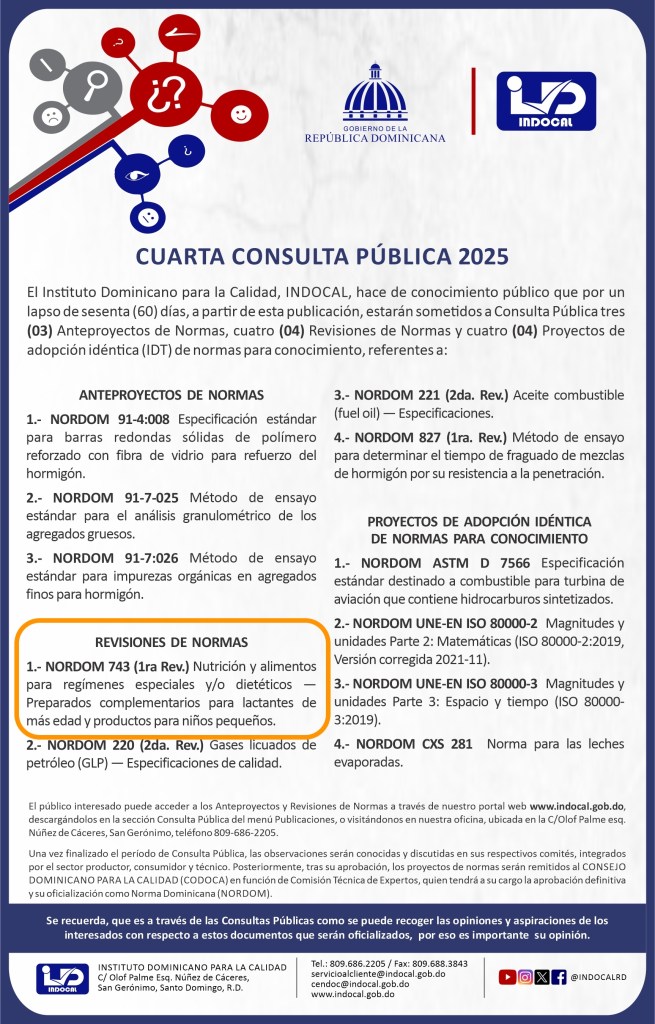
Dominican Republic – INDOCAL reviews NORDOM 743 Nutrition and foods for special and/or dietary regimens
The Dominican Institute for Quality (INDOCAL in Spanish) publishes a draft revision of NORDOM 743 (1st Rev.) Nutrition and foods for special and/or dietary regimens ― Complementary foods for older infants and products for young children.
Argentina – Updates to the Argentine Food Code have been published
The National Administration of Medicines, Food and Medical Technology (ANMAT in Spanish) and the Secretariat of Agriculture, Livestock and Fisheries have published a series of resolutions to update the Argentine Food Code (AFC):
Joint Resolution No 17/25 – Incorporation of Olive Leaves
Olive leaves are incorporated into the Argentine Food Code (CAA) for use in infusions.
The olive tree has been historically valued, and its antioxidant-rich leaves are now formally recognized for infusions. This inclusion ensures a framework of food safety and quality for this product.
Joint Resolution No 16/25 – Incorporation of pecan by-products
The Argentine Food Code (CAA) incorporates and updates the regulations on pecan nuts (Carya illinoinensis) and their derivatives: pecan nut paste, pecan nut flour, and pecan nut oil.
The pecan is a nut with high nutritional value. Its oil stands out as an important source of monounsaturated and polyunsaturated fatty acids, such as oleic and linoleic acids, known for their positive effects on cardiovascular health.
Joint Resolution No 14/25 – Incorporation of Preserved Capers
Canned caper leaves (Capparis spinosa) were incorporated into the Argentine Food Code.
By including this in the regulations, parameters are specified that guaranty the product’s quality, such as its characteristic flavor, aroma, and texture. Food safety and consumer transparency are strengthened, expanding the range of regulated foods for the benefit of the population.
Joint Resolution No 15/25 – Incorporation of Aguaribay leaves and fruits
The leaves and fruits of the aguaribay were incorporated into the CAA for use as a flavoring in alcoholic beverages.
This species, native to northeastern Argentina, has been used ancestrally by indigenous communities, and its inclusion in the CAA allows for the revaluation of traditional knowledge, promoting its application in foods under regulations that ensure quality, safety, and food security.
Joint Resolution No 13/25 – Inclusion of Virgin Palm Oil
Virgin Palm Oil is incorporated into the Argentine Food Code.
This oil is exclusively derived from the pulp of the palm fruit through mechanical processes, maintaining its quality and nutritional properties.
Brazil – Anvisa and the Ministry of Health launch a public panel with information on pesticides in food
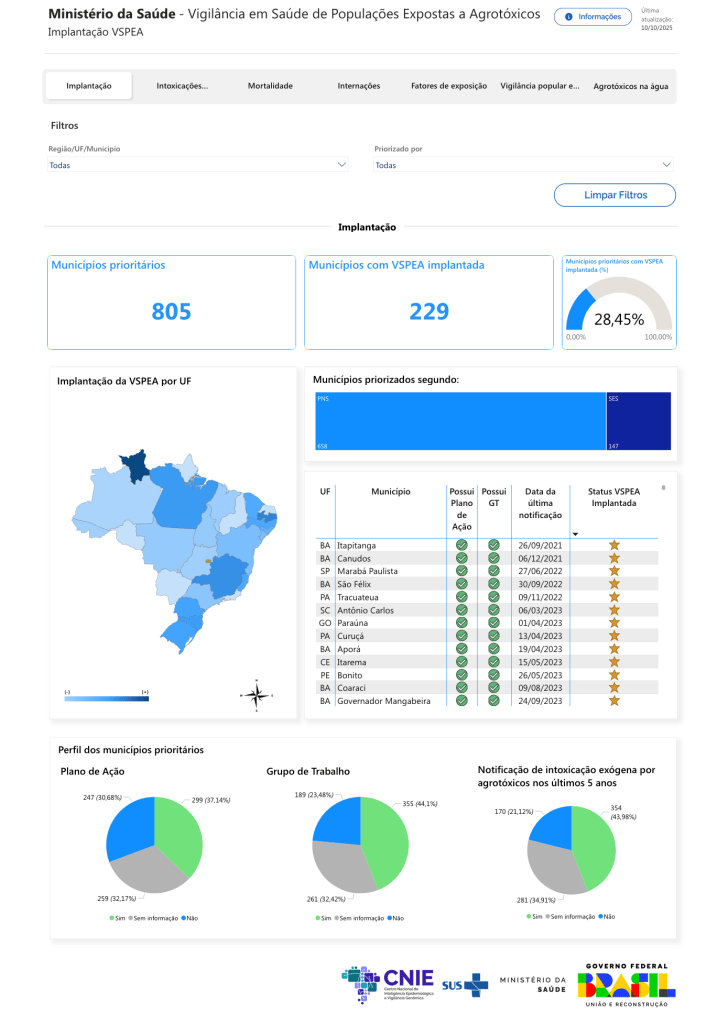
In collaboration with the National Health Surveillance Agency (ANVISA in Portuguese), the Ministry of Health launched a new tab on the Health Surveillance Panel for Populations Exposed to Pesticides (VSPEA in Portuguese), offering an unprecedented way to visualize information on pesticide residue levels in foods consumed by the Brazilian population. The initiative, developed by the Ministry’s General Coordination for Environmental Health Surveillance in collaboration with Anvisa’s General Directorate of Toxicology, reinforces the federal government’s commitment to transparency and to strengthening environmental health surveillance efforts.
 infoAlimentario