Argentina – ANMAT modifies the Food Code for wine

The National Administration of Medicines, Food and Medical Technology (ANMAT) and the Secretariat of Agriculture, Livestock and Fisheries have published Joint Resolution 6/2025, which amends Article 1.102 bis of “CHAPTER XIII FERMENTED BEVERAGES” concerning wine.


ARTICLE 1.- Article 1.102 bis is hereby incorporated into “CHAPTER XIII FERMENTED BEVERAGES” of the Argentine Food Code, which shall be worded as follows: “Article 1102 bis: The term “partially dealcoholized wine” refers to a product obtained by partially dealcoholizing wine, resulting in a reduction of the wine’s alcohol content by more than 20% vol. Provided that its final alcoholic strength by volume is equal to or greater than 0.5% vol. and comply with Law No. 14,878 – General Wine Law.


ARTICLE 2.- Article 1.102 tris is hereby incorporated into “CHAPTER XIII FERMENTED BEVERAGES” of the Argentine Food Code, and shall be worded as follows: “Article 1102 tris: The term “dealcoholized wine” or “alcohol-free wine” refers to the product obtained by dealcoholizing wine, with an alcohol content of less than 0.5% vol. and comply with Law No. 14,878 – General Wine Law.
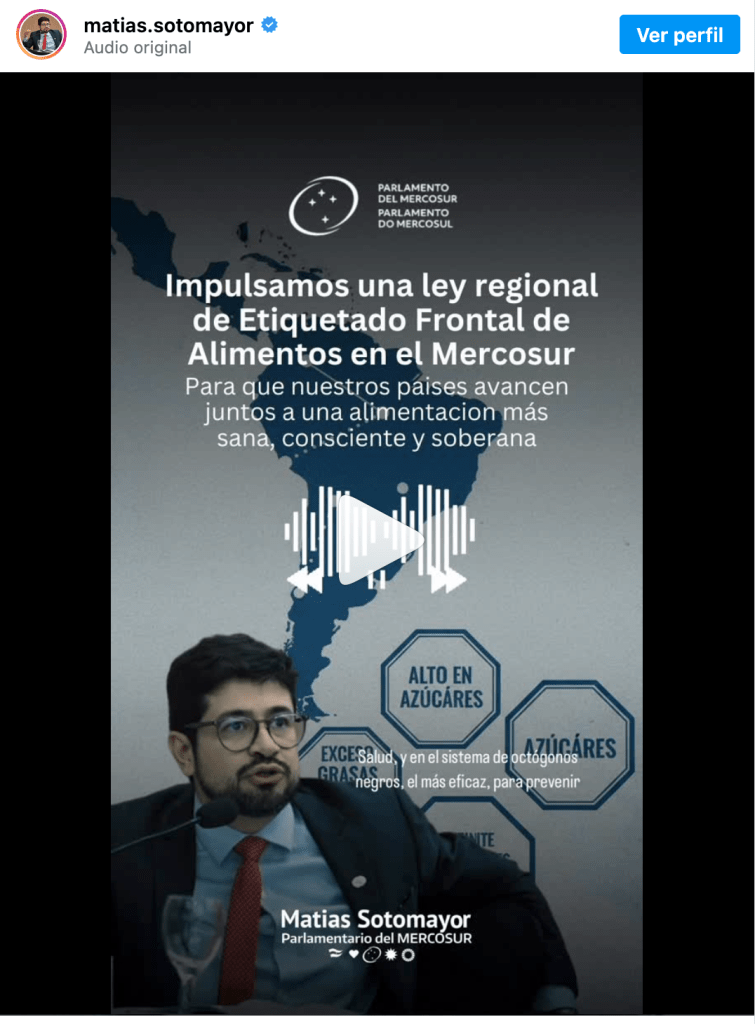
MERCOSUR – They propose a Regional Front-of-Package Labeling Bill

As part of efforts to improve the quality of life of MERCOSUR residents, work is underway to approve a Regional Front-of-Pack Labeling Law. This project, led by Mercosur parliamentarian Matías Sotomayor, seeks to implement a common system that enables consumers to make more informed decisions about the foods they consume, thereby promoting healthier, more conscious, and sovereign eating.

Protocol 000358/2025 – NPr 358-2025 PDE 92/2025 PDecl., entitled “Promotion of a Regional Front-of-Pack Labeling Law in MERCOSUR,” represents a significant step toward regional integration in public health. The implementation of this regulation will require coordinated efforts among governments, academic institutions, social organizations, and the private sector. However, the potential benefits for the population far outweigh the challenges.

The initiative is backed by the Latin American and Caribbean Community of Practice in Nutrition and Health (COLANSA in Spanish), universities, and social organizations that have worked together to develop regulations based on scientific evidence and principles of social justice. The objective is to ensure that food products include clear, visible labels that warn about excessive levels of sugars, saturated fats, sodium, and calories. This will allow consumers to easily identify products that could pose a risk to their health.

Argentina – ANMAT modifies the quality and purity parameters for black, white, green, and allspice peppers

The National Administration of Medicines, Food and Medical Technology (ANMAT in Spanish) and the Secretariat of Agriculture, Livestock and Fisheries, thru Joint Resolution No 5/2025, amend Articles 1234 and 1235 of the Food Code to incorporate and modify the products commonly referred to as “peppers.”

Among the main new features are:

Update of Articles 1234 and 1235, which redefine the quality and purity parameters for black, white, green, and allspice peppers.

Incorporation of new articles (1235 bis and 1237 bis) recognizing red or cayenne pepper and Sichuan pepper, and establishing their composition and labeling requirements.

Argentina – ANMAT incorporates chia gum as a source of soluble dietary fiber

The National Administration of Medicines, Food and Medical Technology (ANMAT) and the Secretariat of Agriculture, Livestock and Fisheries, thru Joint Resolution No 7/2025, amend Article 1.417 of the Food Code to include chia gum or chia mucilage as a source of soluble dietary fiber.

ARTICLE 1.- The following paragraph 24 is added to Article 1417 of the Argentine Food Code, to read as follows:
“24- Chia gum or chia mucilage”
Exuded hydrocolloid obtained after hydrating chia seeds (Salvia hispanica L.).
Qualitative and quantitative composition: Translucent gum with a viscous consistency, odorless, colorless, and tasteless. Soluble in cold or hot water and insoluble in alcohol.

Argentina – ANMAT continues to modernize the food control and import regime

The National Administration of Medicines, Food and Medical Technology (ANMAT in Spanish) has published Decree No. 790/2025, which amends Decree No. 1812/92 and supplements Decree No. 35/25, which introduced changes to the historic Decree No. 2126/71.

The new Annex III of Decree 2126/71 will include countries with which Argentina maintains health cooperation or economic integration treaties, in addition to those already recognized as subject to high international surveillance.

In this way, the new decree promotes a series of structural transformations in the food control system:

  • Simplification of procedures: Procedures for packaged food products intended for direct sale to the public are optimized, in line with the changes already introduced by Decree 35/25. Reforms are also being promoted by SENASA.
  • International recognition: The validity of health certificates issued by high-surveillance countries, such as the United States, Canada, the European Union, Japan, and Australia, among others, which had already been introduced by Decree 35/25, is reaffirmed.
  • Reduced processing times: Inspection and release times for goods are shortened, thanks to the import authorization and notification system interoperating with the Customs Revenue and Control Agency (ARCA) thru the Single Window for Foreign Trade (VUCE).