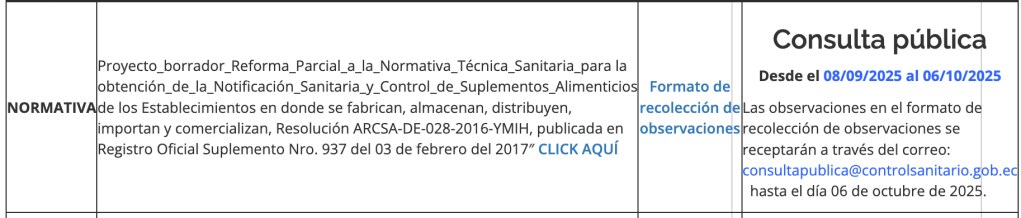
Ecuador – ARCSA suggests amending the regulations regarding dietary supplements

The National Agency for Regulation, Control, and Health Surveillance (ARCSA in Spanish) has released a draft for a Partial Reform to Resolution ARCSA-DE-028-2016-YMIH – Technical Health Regulations for obtaining the Health Notification and Control of Food Supplements in establishments where they are manufactured, stored, distributed, imported, and marketed.

Paraguay – DINAVISA updates the Sanitary Registry of food and establishments through the publication of two new resolutions

The National Directorate of Sanitary Surveillance (DINAVISA in Spanish) has issued two new Resolutions concerning the sanitary registration of food products, aimed at streamlining administrative processes, enhancing market access, and enabling the health authority to focus its regulatory resources on areas that significantly impact public health.

Resolution No. 326/2025
Establishes the requirement for every individual or legal entity to obtain the Establishment Registration (R.E.) prior to commencing any activities related to the manufacturing, importing, storing, or marketing of food products.
It introduces a classification of establishments based on their risk level (low, medium, and high), determined by the types of food they handle. Furthermore, it incorporates a system of sub-levels of risk assessed through a scoring table, which evaluates factors such as the nature of the establishment’s activities (manufacturer, importer, etc.), the implementation of food safety management systems (HACCP, ISO 22000), the degree of automation, and the establishment’s history.
This classification dictates the method and frequency of inspections, which now include modernized procedures:
On-site inspection: traditional in-person verification at the facilities.
Virtual/remote inspection: a distance procedure conducted via videoconference, requiring the establishment to have appropriate technology and connectivity.
Self-inspection: an assessment carried out by the company’s technical director, who swears under oath to comply with Good Practices (either Manufacturing or Storage).
The resolution also reinforces existing obligations, including that every individual or legal entity must possess a valid R.E. to request any Sanitary Registration of Food Product (R.S.P.A. in Spanish); the mandatory appointment of a professional technical director, and the inclusion of the R.E. number on product labeling.

Resolution No. 328/2025

This regulation outlines a risk classification, specifically focused on the final product. Applicants are required to assess the risk level of their products using the criteria and matrix defined in the resolution, which must subsequently be validated by DINAVISA. The regulation provides three registration pathways for obtaining the R.S.P.A.:

Automatic Health Notification (N.S.A.): applicable to low-risk products. Companies can obtain the R.S.P.A. immediately through DINAVISA’s electronic system (SIGRA) by submitting the required documentation under sworn declaration.

Simplified Health Notification (N.S.S.): intended for medium-risk foods. The application will be evaluated by DINAVISA within a maximum period of fifteen (15) days. If no resolution is reached within that timeframe, the registration will be automatically issued.

Ordinary Health Registration (R.S.O.): reserved for high-risk products. The evaluation process will last a maximum of thirty (30) days. Similarly, if there is no issuance within this period, the R.S.P.A. will be automatically granted.

Additionally, the new regulation stipulates that updates following the acquisition of registrations will be applied automatically, without the need for individual evaluation and approval procedures for each product.
Resolution No. 328/2025

This regulation outlines a risk classification, specifically focused on the final product. Applicants are required to assess the risk level of their products using the criteria and matrix defined in the resolution, which must subsequently be validated by DINAVISA. The regulation provides three registration pathways for obtaining the R.S.P.A.:

Automatic Health Notification (N.S.A. in Spanish): applicable to low-risk products. Companies can obtain the R.S.P.A. immediately through DINAVISA’s electronic Integrated Food Records Management and Control System (SIGRA in Spanish) by submitting the required documentation under sworn declaration.

Simplified Health Notification (N.S.S. in Spanish): intended for medium-risk foods. The application will be evaluated by DINAVISA within a maximum period of fifteen (15) days. If no resolution is reached within that timeframe, the registration will be automatically issued.

Ordinary Health Registration (R.S.O. in Spanish): reserved for high-risk products. The evaluation process will last a maximum of thirty (30) days. Similarly, if there is no issuance within this period, the R.S.P.A. will be automatically granted.

Additionally, the new regulation stipulates that updates following the acquisition of registrations will be applied automatically, without the need for individual evaluation and approval procedures for each product.

Mexico – The government announces a change in the deadline for the second phase and updates the commencement of the third phase as stipulated in the Second Transitional Provision of the Amendment to the Official Mexican Standard NOM-051-SCFI/SSA1-2010

Through NOTIFICATION – Addendum G/TBT/N/MEX/178/Add.18 to the World Trade Organization, the government announces an amendment to the Agreement that extends the deadline for the second phase and updates the commencement of the third phase as established in the Second Transitional Provision of the Modification to the Official Mexican Standard NOM-051-SCFI/SSA1-2010, General Specifications for labeling of prepackaged non-alcoholic food and beverages – Commercial and health information, published on April 5, 2010, and published on March 27, 2020.

The deadline for the second phase is extended, and the start of the third phase is updated as established in the Second Transitional Provision of the Modification to the Official Mexican Standard NOM-051-SCFI/SSA1-2010, General Specifications for labeling of prepackaged non-alcoholic food and beverages – Commercial and health information, published on April 5, 2010, and published on March 27, 2020; to read as follows:

SECOND.
For the calculation and evaluation of the values and profiles related to the complementary nutritional information, THREE distinct PHASES will be progressively established, the last of which will be verified starting January 1, 2028, namely:

FIRST PHASE. …

SECOND PHASE.
From October 1, 2023, to December 31, 2027 (4 YEARS and 3 MONTHS), the calculation and evaluation of the complementary nutritional information will be carried out with the following criteria and values:

  1. and 2….

THIRD PHASE.
Starting January 1, 2028, the calculation and evaluation of the complementary nutritional information will be conducted by fully applying the provisions contained in subsections 4.5.3, as well as Table 6 of the modification to the standard regarding Nutritional Profiles.

Peru – INACAL approves a set of Peruvian technical standards for food

The National Institute of Quality (INACAL in Spanish) has approved a set of Peruvian Technical Standards (NTP) in the food sector through Directoral Resolution No 018-2025-INACAL/DN:

  • NTP 011.106:2016 (revised in 2025). VEGETABLES. Green pea. Requirements.
    This standard defines the terminology, classification, and requirements for green peas (Pisum sativum L.) for fresh marketing. Use: agriculture, agro-industry, and quality control entities.
  • NTP 205.059:2015 (revised in 2025) GRAINS AND LEGUMES. Requirements.
    This standard outlines the characteristics that the product made from a mix of precooked oat flakes and quinoa must meet for human consumption. Use: food industry, agro-industry of Andean grains, and quality and safety control.
  • NTP 205.065:2015 (revised in 2025) GRAINS AND LEGUMES. Oat flour. Requirements.
    This standard specifies the requirements for oat flour intended for human consumption. Use: food industry, cereal processing, and quality and safety control.
  • NTP 205.067:2015 (revised in 2025). GRAINS AND LEGUMES. Precooked oat flour with quinoa.
    This standard defines the characteristics of flour made from oats and quinoa (minimum 10% quinoa), intended for human consumption. Use: food industry, agro-industry of Andean grains, and quality control laboratories.
  • NTP 100.102:2016 (revised in 2025) FOOD ADDITIVES. Colorants. Definitions and classification.
    This standard establishes the definition and classification of food additives used as colorants. Use: food industry, food processing, and safety authorities.
  • NTP 209.702:2017 (revised in 2025) FOOD ADDITIVES. Preservatives. Definitions and classification.
    This standard defines and classifies food additives used as preservatives. Use: food industry, food preservation, and safety control entities.
  • NTP 209.704:2017 (revised in 2025) FOOD ADDITIVES. Flavorings. Definitions.
    This standard establishes the definitions of flavorings.
  • NTP 209.168:1999 (revised in 2025) HONEY. Definitions, requirements, and labeling.
    It sets the quality, packaging, and labeling standards for honey intended for human consumption.
    Use: beekeeping, food industry, and control entities.
  • NTP 206.005:1976 (revised in 2025). Egg bread.
    It defines the definitions and requirements for egg bread for human consumption.
    Use: baking industry, small and medium enterprises, and food quality control entities.
  • NTP 206.016:1981 (revised in 2025). COOKIES. Determination of peroxides.
    It establishes the method for determining peroxides as an indicator of quality and preservation in cookies.
    Use: cookie industry, baking, and safety control.
  • NTP 204.054:2011 (revised in 2025). CANNED FISH PRODUCTS.
    It sets the sanitary and quality characteristics that canned Peruvian anchovy or sardine (Engraulis ringens Jenkyns) must have.
    Use: fishing industry, canning, and sanitary control.

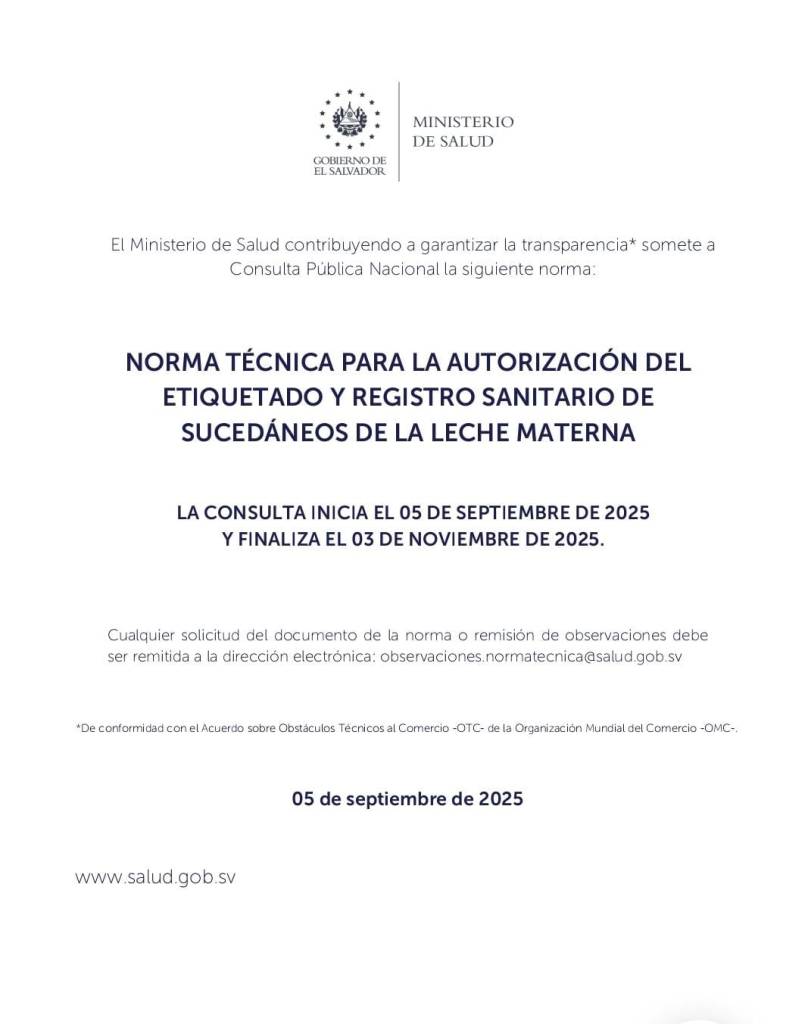
El Salavador – MINSAL has published the draft Technical Standard for the Authorization of Labeling and Sanitary Registration of Breast Milk Substitutes

The Ministry of Health (MINSAL in Spanish) has published the draft Technical Standard for the Authorization of Labeling and Sanitary Registration of Breast Milk Substitutes.

The draft regulation establishes the technical provisions for the authorization of labeling and sanitary registration of breast milk substitutes, administered to girls and boys under six months of age and up to thirty-six months of age, as well as the monitoring and supervision of these products.
They are subject to compliance with this Technical Standard, all natural persons
or legal entities that manufacture, market, distribute, or import substitutes for breast milk maternal.
Specialized metabolic formulas are excluded.