Argentina – INV authorizes the legal enological practice of adding copper citrate to wine in order to reduce unpleasant odors and flavors caused by hydrogen sulfide and its derivatives

The National Institute of Viticulture (INV in Spanish) has issued Resolution 29/2025, which permits the legal enological practice of adding copper citrate to wine in order to mitigate unpleasant odors and flavors caused by hydrogen sulfide and its derivatives.

ARTICLE 2.- The required dose of hydrated copper citrate to achieve the desired objective must be determined through a prior test. This dose must not exceed ONE GRAM PER HECTOLITER (1 g/hl).

ARTICLE 3.- The colloidal copper precipitate formed must be removed from the wine through filtration.

ARTICLE 4.- Upon completion of the treatment, the copper content in the wine must be equal to or less than the limit established by current regulations.

ARTICLE 5.- The copper citrate used must comply with the specifications of the International Enological Codex of the INTERNATIONAL ORGANIZATION OF VINE AND WINE (OIV in Spanish).

ARTICLE 6.- Violations of the provisions set forth in this resolution will be penalized in accordance with the provisions of Article 24 of Law No. 14,878.

Brazil – A new electronic contact form is now available

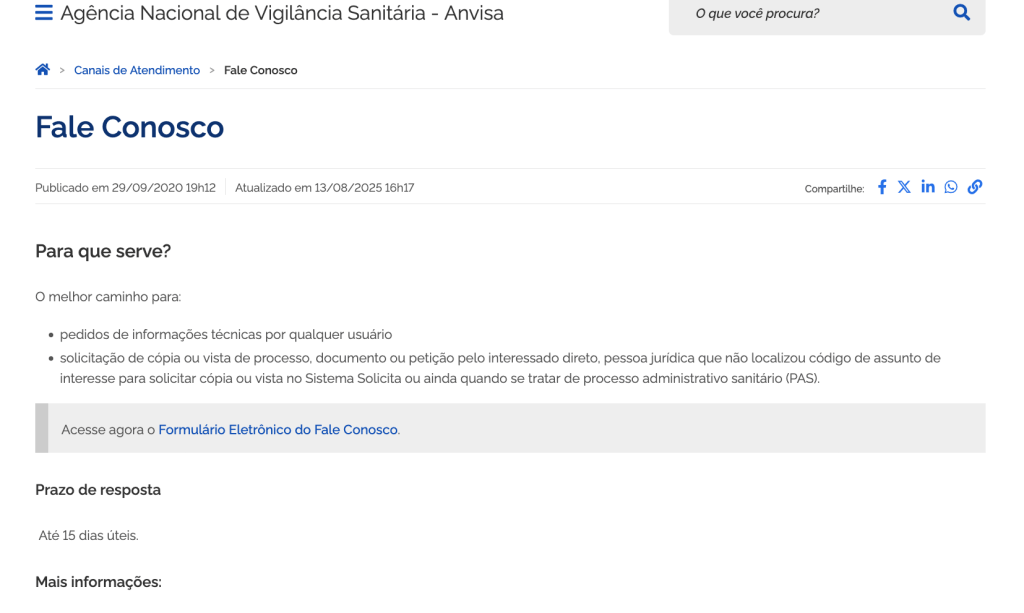
The new electronic form “Contact Us” is now available on the portal of the National Health Surveillance Agency (Anvisa in Portuguese). The main innovation is that it is now integrated with the single sign-on of Gov.br. This means that users can utilize the same username and password they use for other Federal Government services, without needing to re-enter their personal information.

Through the new electronic form, users will be able to make technical inquiries to the Agency’s organic units, as well as request a copy of a procedure, request, or document.

Click here to access and learn more about the electronic form.

Brazil – The quality of dietary supplements is a subject of debate in the Chamber

The Consumer Defense Commission of the Chamber of Deputies will discuss the quality and regulation of dietary supplements sold in Brazil. This discussion is in response to a request from Deputy Felipe Carreras (PSB-PE).

According to the congressman, the market for dietary supplements in Brazil has expanded in recent years, driven by the pursuit of health, wellness, and physical performance. He states that this increase in consumption has raised concerns regarding the quality and safety of these products.

Honduras – ARSA announces ban on the use of additive INS 127 (Erythrosine) in food and beverages

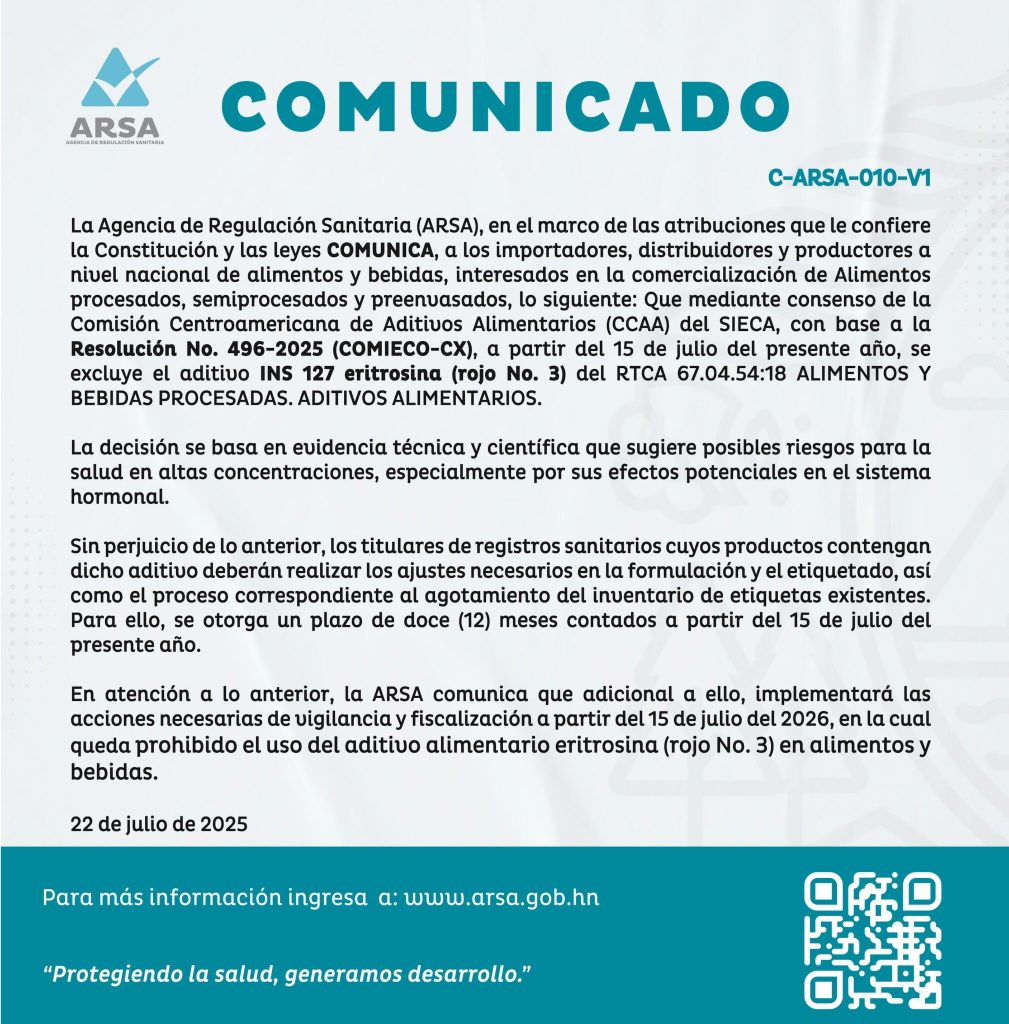
The Health Regulatory Agency (ARSA in Spanish) has issued a statement directed at national importers, distributors, and producers of food and beverages who are interested in the commercialization of processed, semi-processed, and pre-packaged foods, as follows: That through consensus from the Central American Commission of Food Additives (CCAA in Spanish) of SIECA, based on Resolution No. 496-2025 (COMIECO-CX), effective from July 15 of this year, the additive INS 127 erythrosine (red No. 3) is excluded from RTCA 67.04.54:18 PROCESSED FOODS AND BEVERAGES. FOOD ADDITIVES. This decision is based on technical and scientific evidence suggesting potential health risks at high concentrations, particularly regarding its possible effects on the hormonal system. Notwithstanding the above, holders of sanitary registrations whose products contain this additive must make the necessary adjustments in formulation and labeling, as well as the corresponding process for depleting existing label inventory. To this end, a period of twelve (12) months is granted, starting from July 15 of this year.

Brazil – Anvisa authorizes the depletion of food and beverage packaging prior to the inclusion of the new registration number required by the new regulations

Through the Collegiate Board Resolution (RDC) 843/2024, the National Health Surveillance Agency (ANVISA in Portuguese) modifies the Collegiate Board Resolution – RDC 843/2024, allowing for the depletion of food and beverage packaging that has already been produced before the new regulatory number is mandated by the new regulations.
The change, formalized by RDC 983/2025, published on July 28, 2025, responds to requests from the production sector and prevents material waste without compromising health safety. The depletion period will be up to 180 days following the approval of the registration or notification.