Dominican Republic – INDOCAL reviews a set of technical standards regarding food

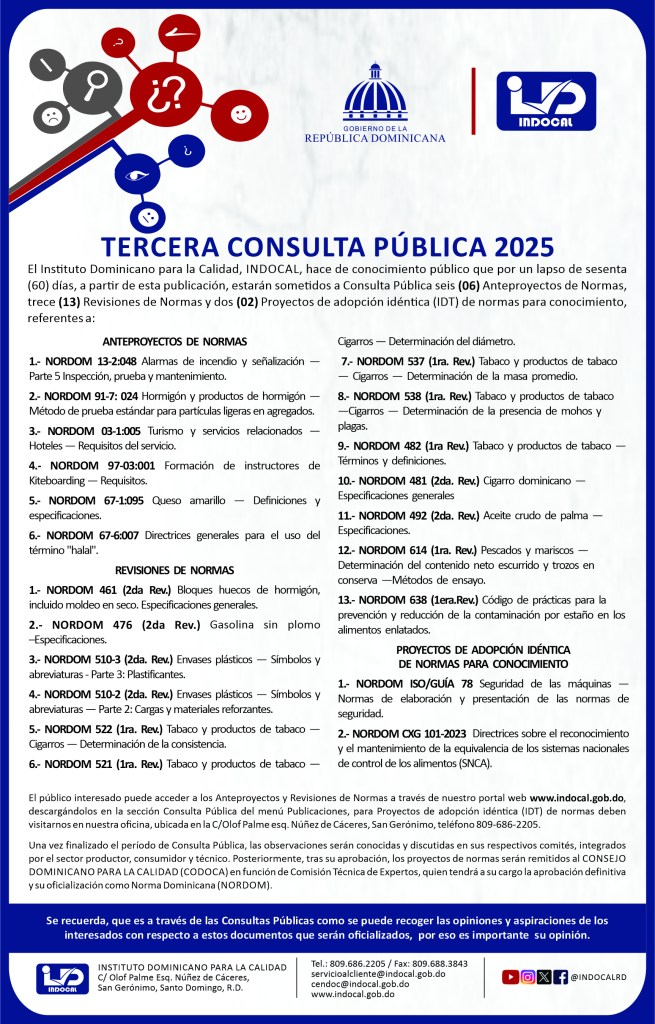
The Dominican Institute for Quality (INDOCAL in Spanish) has released a series of projects aimed at revising technical standards concerning food:

  • NORDOM 67-1:095 Yellow cheese – Definitions and specifications.
  • NORDOM 492 (2nd Rev.) Crude palm oil – Specifications.
  • NORDOM 614 (1st Rev.) Fish and seafood – Determination of drained net content and pieces in preserves – Testing methods.
  • NORDOM 638 (1st Rev.) Code of practices for the prevention and reduction of tin contamination in canned foods.
NORDOM 67-1:095 Yellow cheese – Definitions and specifications.

NORDOM 492 (2nd Rev.) Crude palm oil – Specifications.

NORDOM 614 (1st Rev.) Fish and seafood – Determination of drained net content and pieces in preserves – Testing methods.

NORDOM 638 (1st Rev.) Code of practices for the prevention and reduction of tin contamination in canned foods.

Honduras – ARSA updates the list of ingredients along with their minimum and maximum daily concentrations, as well as the evaluation and classification criteria for nutritional supplements

The Health Regulatory Agency (ARSA in Spanish) has released Communication C-009-ARSA-VA, which updates the list of ingredients along with their minimum and maximum daily concentrations, as well as the evaluation and classification criteria for nutritional supplements (LIS-DAB-001-V2).

Ecuador – ARCSA announces a reform of the Technical Health Regulation for the analysis of post-registration or post-notification quality control of products intended for human use and consumption that are subject to health control and surveillance

The National Agency for Regulation, Control, and Sanitary Surveillance (ARCSA in Spanish) has made public the draft of the Partial Reform to Resolution ARCSA-DE-2021-015-AKRG, through which the “Technical Sanitary Norm for the analysis of quality control post-registration or post-notification of products for human use and consumption subject to sanitary control and surveillance” was published in the Official Register No. 574 on November 10, 2021.

Products for human use and consumption subject to sanitary control and surveillance are those products that the Agency regulates, controls, and monitors, including: processed foods, food additives, processed water, general medications, biological products, processed natural products for medicinal use, homeopathic products, medical devices for human use, cosmetics, domestic hygiene products, personal hygiene absorbent products, industrial hygiene products, hospital-use disinfectant hygiene products, food-grade disinfectants, and pesticides for domestic, industrial, and public health use.

Article 5.- Replace Articles 7 and 8 of CHAPTER IV “ON POST-REGISTRATION OR POST-NOTIFICATION QUALITY CONTROL ANALYSES” with the following:
“Article 7.- The post-registration or post-notification quality control analyses aim to verify that products for human use and consumption maintain the conditions that allowed for the obtaining of the sanitary registration, mandatory sanitary notification, sanitary notification, or the unique BPM code, as applicable, and that the water for human consumption meets the applicable quality standards and criteria.

Public consultation:
From 12/08/2025 to 10/09/2025

Bolivia – SENASAG acknowledges the Network of Official Food Analysis Laboratories

The National Service of Agricultural Health and Food Safety (SENASAG in Spanish) has issued ADMINISTRATIVE RESOLUTION SENASAG No. 0189/2025, which acknowledges the Network of Official Food Analysis Laboratories (RELOAA in Spanish) along with the list of member laboratories. This list is intended for use by the Departmental Managements of SENASAG and is included as an annex, forming an integral part of this administrative resolution.

The Resolution also states that “In cases where the necessary analyses for specific cases are not available within the national territory and in the laboratories and analytical capabilities specified in the first article of this resolution, SENASAG may utilize the services of laboratories abroad, provided that these laboratories are recognized as official laboratories by the competent health authority in the destination country and/or possess accreditation under ISO/IEC 17025 for the specific parameters required.”

Venezuela – New standard project for the determination of fluoride. Volumetric methods

The Decentralized Service for Standardization, Quality, Metrology, and Technical Regulations (SENCAMER in Spanish) has released the draft of the Venezuelan Standard COVENIN 2282:2025 Food Products. Determination of Fluorine. Volumetric Methods.

This standard outlines the testing method for the determination of fluorine in food items such as calcium phosphates, calcium carbonate, bone meal, and other related compounds.