Congresswoman María Agüero Gutiérrez (Free Peru), presented the bill that prohibits the use of red dye No. 3 in the elaboration of food, packaged products, beverages, medicines and cosmetics for human consumption or use that are sold, imported and distributed in the national territory.
The legislative initiative No. 11673/2024-CR, was presented today, Tuesday, June 17, through the institutional portal of the Congress of the Republic. The text has the support of five other parliamentarians of his party.
The proposal comes in a context of growing global concern about the carcinogenic effects of some food additives. In January of this year, the U.S. Food and Drug Administration (FDA) revoked its authorization for the use of red No. 3 in oral products after detecting links with tumors in laboratory animals.
As a result of this pronouncement, the Peruvian Ministry of Health (MINSA in Spanish) recommended the local food industry to progressively replace the use of this substance. Now, Congress is seeking to make this transition mandatory.
Month: June 2025
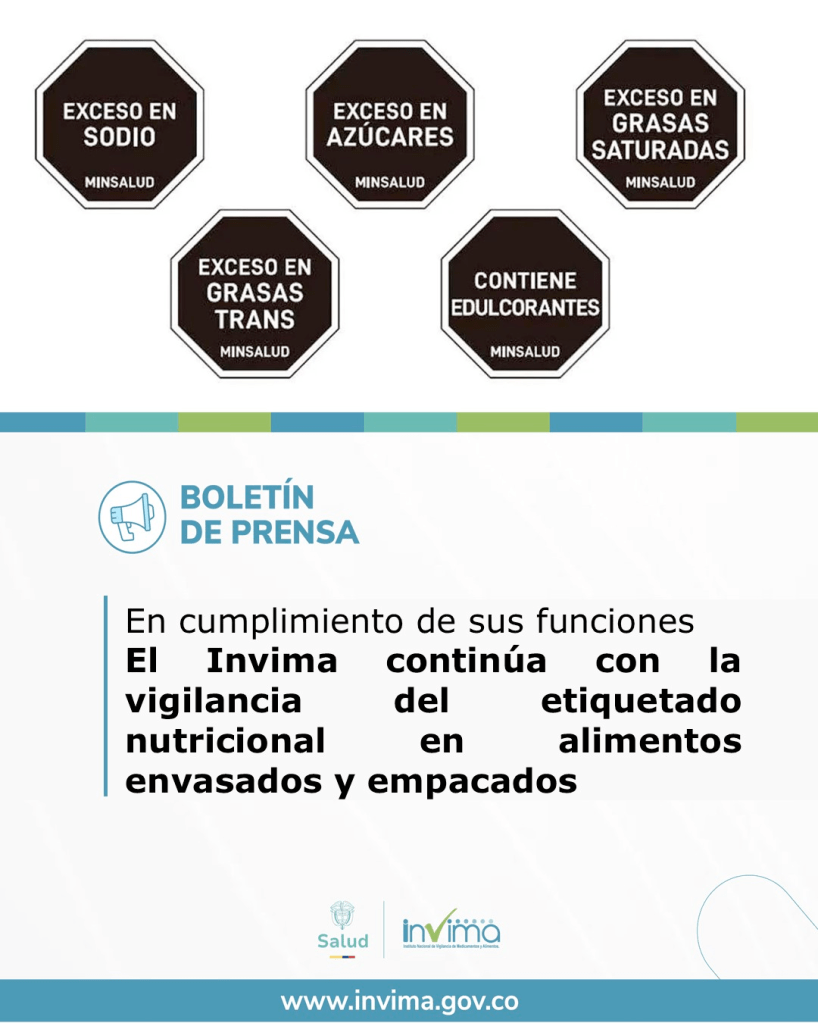
Colombia – Invima continues to monitor nutrition labeling on packaged and packaged foods
The National Institute for Drug and Food Surveillance (INVIMA in Spanish), in exercise of its inspection, surveillance and control functions, has been implementing rigorous actions to verify compliance with the technical regulation of nutritional and front labeling of packaged and/or packaged foods, in accordance with Resolution 810 of 2021, modified by Resolution 2492 of 2022 and by Resolution 254 of 2023).
Since the entry into force of these regulations, INVIMA has worked with the productive and commercial sector to ensure compliance with the requirements that allow consumers to have clear, understandable and truthful information on the products they consume.
These requirements include warning seals for foods that exceed certain levels of sodium, sugars and fats or contain sweeteners, allowing consumers to make better decisions focused on nutritional information.
During the transitional period, manufacturers, producers and sellers were able to use up stocks of previous labels without the need for authorization. Subsequently, the regulations empowered INVIMA, according to its procedures, to grant food manufacturers the exhaustion of labels and the use of adhesives.
Brazil – ANVISA updates the lists of components, usage limits, property declarations, and supplementary labeling of food supplements
The National Health Surveillance Agency (ANVISA in Portuguese) has published Regulatory Instruction No. 373/2025, amending Regulatory Instruction No. 28 of July 26, 2018, which establishes the lists of ingredients, limits of use, property declarations, and supplementary labeling for food supplements.
Updated:
I – “List of ingredients authorized for use in food supplements, except those indicated for infants (0 to 12 months) or young children (1 to 3 years)”, included in Annex I;
II – “List of minimum limits of nutrients, bioactive substances, enzymes, and probiotics that food supplements must provide, according to the recommended daily intake and by population group indicated by the manufacturer”, included in Annex III;
III – “List of maximum limits for nutrients, bioactive substances, enzymes, and probiotics that food supplements may not exceed, according to the recommended daily intake and per population group indicated by the manufacturer,” contained in Annex IV;
IV – “List of claims authorized for use on the labeling of food supplements and their respective composition and labeling requirements,” contained in Annex V; and
V – “List of supplementary labeling requirements for food supplements,” contained in Annex VI.
Brazil – ANVISA publishes the lists of components, usage limits, and property declarations for infant formulas, nutritional formulas, enteral nutrition formulas, and dietary therapy formulas for congenital metabolic disorders
The National Health Surveillance Agency (ANVISA in Portuguese) has released Normative Instruction No. 367/2025, which outlines the lists of components, usage limits, and property declarations for infant formulas, nutritional formulas for high-risk newborns, transitional foods, and cereal-based foods for infants and young children, enteral nutrition formulas, and dietary therapy formulas for congenital metabolic disorders.
Brazil – ANVISA has published regulations regarding sanitary requirements for infant formulas, nutritional formulas, and dietary therapy formulas for congenital metabolic disorders
The National Health Surveillance Agency (ANVISA in Portuguese) has issued Resolution No 976/2025, which outlines the health requirements for infant formulas, nutritional formulas for high-risk newborns, transitional foods, and cereal-based foods for infants and young children, enteral nutrition formulas, and dietary therapy formulas for congenital metabolic disorders.
This Resolution is applicable to:
I – Infant formulas for infants;
II – Follow-on infant formulas for infants and young children;
III – Infant formulas for specific dietary therapy needs;
IV – Nutritional formulas for high-risk newborns;
V – Transitional foods for infants and young children;
VI – Cereal-based foods for infants and young children;
VII – Pediatric formulas for enteral nutrition;
VIII – Standard formulas for enteral nutrition;
IX – Modified formulas for enteral nutrition;
X – Nutritional modules for enteral nutrition; and
XI – Dietary formulas for congenital metabolic disorders.
 infoAlimentario