Peru – INACAL announces the approval of a series of Peruvian Technical Standards for foodstuffs

The National Institute of Quality (INACAL in Spanish) through Directorial Resolution No. 000008-2025-INACAL/DN and Directorial Resolution No. 000010-2025-INACAL/DN announces the approval of a series of technical standards related to food.


Directorial Resolution No. 000008-2025-INACAL/DN

  • NTP-ISO 21415-3:2025 Wheat and wheat flour. Gluten content. Part 3: Determination of dry gluten from wet gluten by an oven-drying method. 1st Edition.
  • NTP-ISO 21415-4:2025 Wheat and wheat flour. Gluten content. Part 4: Determination of dry gluten from wet gluten by a rapid drying method. 1st Edition.
  • NTP-ISO 6887-4:2025 Microbiology of the food chain. Preparation of test samples, initial suspension and decimal dilutions for microbiological examination. Part 4: Specific standards for the processing of miscellaneous products. 1st Edition.

Directorial Resolution N.° 000010-2025-INACAL/DN

  • NTP 011.462:2025 QUINOA AND ITS DERIVATIVES. Quinoa white grain (raw material). Requirements. 2nd Edition. Replaces NTP 011.462:2019.
  • NTP 205.061:2025 QUINOA AND ITS DERIVATIVES. Quinoa flakes. Requirements. 4th Edition. Replaces NTP 205.061:2018.
  • NTP 208.033:2025 COCOA AND CHOCOLATE. Cocoa butter. Test method for the determination of fatty acid composition by gas chromatography. 3rd Edition. Replaces NTP 208.033:2015.
  • NTP 202.136:2025 MILK AND MILK PRODUCTS. Sweetened condensed milk. Sample preparation and test methods (lactic acid, ash, fat, protein, lactose, sucrose and total solids). 2nd Edition. Replaces NTP 202.136:1998 (revised on 2014).
  • NTP 201.003:2024/CT 1:2025 MEAT AND MEAT PRODUCTS. Definitions, classification and requirements for porcine carcasses and meat. TECHNICAL CORRIGENDUM 1. 1st Edition.
Ecuador – New draft standards on complementary infant formulae and fermented milks

The National Standardization Service (INEN in Spanish) has published for public consultation 2 draft standards related to complementary infant formula and fermented milks.

  • NTE INEN-CODEX CXS 156. Standard for supplementary formulae for older infants and products for young children (CXS 156-1987, IDT)

This section of the standard applies to supplementary formulae for older infants defined in Section 2.1, in liquid or powder form.

1.2 This section of the standard contains compositional, quality, safety,labeling, analytical and sampling requirements for complementary formulae for older infants.

1.3 Onlyproducts that meet the criteria established in the provisions of this section of this standard shall be presented as complementary formulae for older infants.

  • NTE INEN 2395. Fermented milks. Requirements

This standard establishes the requirements for fermented milks. This standard is applicable to fermented milks such as: yogurt, yogurt from alternative cultures, acidophilus milk, kefir, kumys, concentrated fermented milk, flavored fermented milks and fermented milk drinks.

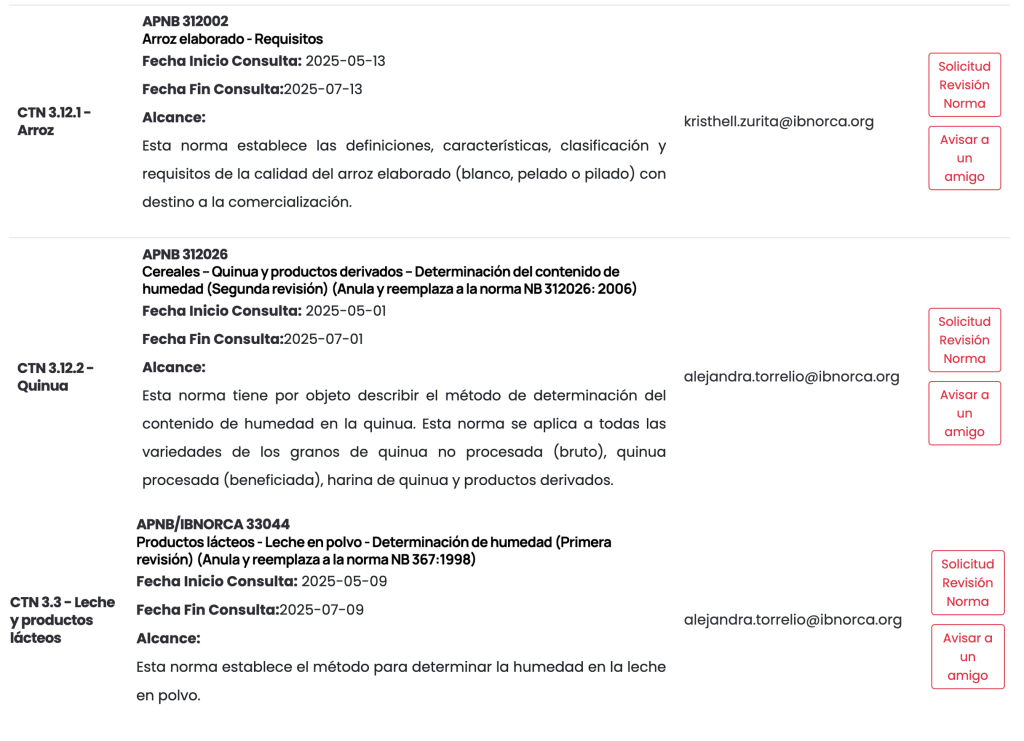
Bolivia – IBNORCA announces public consultation on rice standard and testing standards for Quinoa and milk powder

The Bolivian Institute for Standardization and Quality (IBNORCA in Spanish) has published for public consultation a set of technical standards related to food:

  • APNB 312002
    Processed Rice – Requirements.
  • APNB 312026
    Cereals – Quinoa and derived products – Determination of moisture content (Second revision) (Cancels and replaces NB 312026: 2006).
  • APNB/IBNORCA 33044
    Dairy products – Milk powder – Determination of moisture content (First revision) (Annuls and replaces NB 367:1998).

Argentina – Modification of the Argentine Food Code on requirements for drinking water

Joint Resolution 22/2021 of the Secretariat of Health Quality and the Secretariat of Food, Bioeconomy and Regional Development modifies Article 982 of the Argentine Food Code for drinking water.

ARTICLE 1.- Article 982 of the Argentine Food Code is hereby replaced and shall be worded as follows: “Article 982: The designations Drinking water for public supply and Drinking water for domestic use are understood to mean water suitable for food and domestic use: it shall not contain substances or foreign bodies of biological, organic, inorganic or radioactive origin in such quantities as to be dangerous to health. It shall have a pleasant taste and be practically colorless, odorless, clear and transparent. Drinking water for domestic use is water from a public supply, well or other source, located in domestic reservoirs or tanks.

Drinking water should meet the following physical, chemical and microbiological criteria:

Physical characteristics:

Turbidity: max. 3 N T U:

Color: max. 5 Pt-Co scale;

…….

Argentina – Argentine Food Code amended for corn flour

By Joint Resolution 26/2025 the Secretariat of Health Management and the Secretariat of Agriculture, Livestock and Fisheries have amended Article 694 of the Argentine Food Code on “Farinaceous Foods”, specifically corn flour.

ARTICLE 1.- Article 694 of Chapter IX “Farinaceous Foods” of the Argentine Food Code is hereby replaced and shall be worded as follows: “Article 694: With the denomination of Corn Flour (or Corn Semolina) is understood the product obtained from the milling of clean, healthy and well preserved grains of Zea mays L. to which part of the pericarp and germ are extracted during the process. It must meet the following specifications:

– Water (at 100-105°C, 3 hours): max. 13.5%.

– Ash (at 500-550°C): max. 1.0% on dry matter.

– Fat: max. 1.3% fat on dry matter.

– Proteins: min. 7.0% on dry matter.

– It should not leave residues on the 2,000 micron sieve and no more than 5% should pass through the 250 micron sieve.

……