Argentina – Modification of the duties of the establishment manager in matters of management of hygienic and sanitary conditions published

Through Joint Resolution 6/2025, the Secretariat of Health Management and the Secretariat of Agriculture, Livestock and Fisheries have published an amendment on the responsibilities of the holder of the establishment’s authorization related to the management of the safety of the establishment and the products from a hazard-risk approach, in a clear and concrete manner, to facilitate understanding, application and compliance with the regulations by health authorities, establishment owners and the Technical Directors themselves.

ARTICLE 1.- Article 16 of the Argentine Food Code is hereby replaced, which shall read as follows: “Article 16: The holder of the establishment’s authorization must guarantee:

  1. That the hygienic, sanitary, and legal conditions determined by current regulations and established in the corresponding health authorization are maintained in the establishment.
  2. That the products produced or put into circulation comply with the hygienic, sanitary, and legal conditions determined by current regulations and established in the corresponding health authorization.
  3. The resources to implement the necessary measures in the establishment to obtain products that comply with the corresponding health authorization.
  4. That the establishment has the corresponding documentation supporting the traceability of authorized products, from the receipt of raw materials to the marketing of the final product.
  5. That, when required by current regulations, the establishment has the Technical Directorate provided for in Article 17 of the Code and provides it with the resources to fulfill its functions.
Argentina – Modification of the name of fructose in the Argentine Food Code published

By means of Joint Resolution 5/2025, the Secretariat of Health Management and the Secretariat of Agriculture, Livestock and Fisheries have published the modification of the denomination of fructose.
ARTICLE 1.- Article 778 fourth of Chapter X “Sugary Foods” of the Argentine Food Code is hereby replaced and shall be worded as follows: “Article 778 fourth: With the denomination of Fructose, Levulose, D-Fructose or Fruit Sugar is understood the product obtained by hydrolysis of a starch suspension followed by processes of isomerization, concentration and crystallization.

CHARACTERISTICS
White or crystallized powder, soluble in water, giving a clear, transparent, colorless, sweet-tasting solution.

COMPOSITION AND REQUIREMENTS
D-fructose content in dry product: Min.: 98,0% m/m
Glucose content, Max: 0.5% m/m
Loss on drying, Max.: 0,5% m/m
Total sulfur dioxide, Max.: 15 mg/kg
Ash by conductivity, Max.: 0.10% by weight
Color (ICUMSA), Max: 30 units
pH of solution at 10.0% (m/m): 4.5 – 7.0

Argentina – Amendment to the Food Code regarding paste mustard or table mustard

Through Joint Resolution 9/2025, the Secretariat of Health Management and the Secretariat of Agriculture, Livestock, and Fisheries have issued an amendment to the Food Code regarding Mustard Paste or Table Mustard.

ARTICLE 1.- Article 1285 of the Argentine Food Code is replaced and will be stated as follows: “Article 1285: Mustard Paste or Table Mustard is defined as a condiment made from flour and/or seeds of mustard species Brassica nigra L, Brassica juncea Hooker, and Sinapis alba, depending on the type of mustard, whether whole, ground, defatted, or not, mixed with a liquid composed of one or more of the following ingredients: water, vinegar, grape must, fruit juice, alcoholic beverages, or a combination of these liquids.

Table mustard or mustard paste may include: salt, sugars, honey, edible oils, spices, flavorings (excluding mustard flavorings, particularly allyl isothiocyanate), and additives permitted by this Code for such products.

The mustard seed content must be at least 15% by weight of the finished product.

Cereal flours and other starch substances allowed by this Code may be added in a maximum proportion of 3% by weight of the finished product.

It should be presented as a uniform semi-solid paste with a characteristic flavor, packaged in a food-safe container.

Argentina – Amendment to the Food Code regarding cinnamon pepper

Through Joint Resolution 10/2025, the Secretariat of Health Management and the Secretariat of Agriculture, Livestock, and Fisheries have issued an amendment to the Food Code regarding canelo pepper.

ARTICLE 1.- The Article 1236 bis is hereby added to Chapter XVI: “Correctives and Adjuvants” of the Argentine Food Code, which shall be stated as follows: “Article 1236 bis: The term ‘canelo pepper’ refers to the mature, dried berries of the species Drimys winteri J.R. Forst. & G. Forst., whether whole or ground. Canelo pepper, in either whole or ground form, must meet the following requirements:

Moisture at 100-105°C: Maximum 7%

Total ash at 500-550°C: Maximum 3%.

Ash insoluble in 3% hydrochloric acid: Maximum 1%.

Fixed ether extract: Minimum 6%.

Foreign matter in whole canelo pepper:

a) Maximum 1.5% of foreign matter (any plant material from the specific plant except for the required part),

b) Maximum 0.5% of extraneous materials (any visible and/or apparent matter that is not typically associated with the product).”

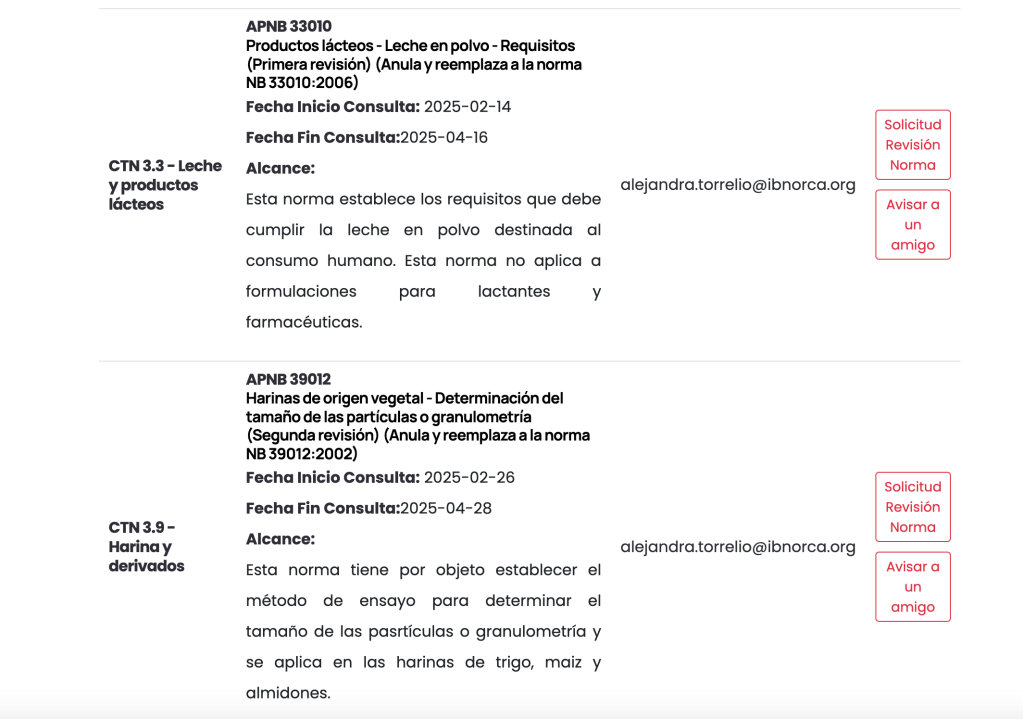
Bolivia – IBNORCA announces two draft standards for dairy products and plant-based flours in public consultation

The Bolivian Institute for Standardization and Quality (IBNORCA in Spanish) has published two draft standards related to Dairy Products and Flours of Plant Origin for public consultation.