Peru – Bill proposed to highlight synthetic dyes in food and beverage labeling

Congressman Idelso García Correa presented Bill N°10373/2024 – CR which proposes to establish the labeling of food, beverages, medicines and cosmetics containing synthetic dyes.

The purpose of the legislative proposal is to guarantee the integrity and health of consumers in the event of exposure to synthetic dyes N°03, yellow N°05 and bright blue N° E133 in the consumption of such products.

Products must clearly, legibly, prominently and understandably state the following phrases, as the case may be:

“Contains red synthetic coloring N°03: Excessive consumption of this product could be related to adverse health effects”.

“Contains yellow synthetic coloring N°05: Excessive consumption of this product could be related to adverse health effects”.

“Contains bright blue dye N°E133: Excessive consumption of this product could be related to adverse health effects.”

It also mentions that the National Institute for the Defense of Competition and Protection of Intellectual Property (INDECOPI in Spanish), within the framework of its functions, will be the entity in charge of overseeing compliance with the law.
Brazil – ABERT requests before the Federal Supreme Court the nullity of ANVISA resolutions that establish rules for the advertising of foods considered harmful to health

The Brazilian Association of Radio and Television Broadcasters (ABERT in Portuguese) filed a Direct Action of Unconstitutionality before the Supreme Federal Court in which it questions two resolutions (24/10 and 96/08) of the National Health Surveillance Agency (ANVISA in Portuguese) that establish rules for the advertising of foods considered harmful to health and for the advertising of medicines.
According to ABERT, ANVISA’s rules (24/10) and (96/08) establish limits that could only be created by federal law. The association also maintains that the restrictions are disproportionate and affect economic freedom, since instead of providing information to consumers, they seek to make the advertising of these products unfeasible.
In the request, Abert stressed that the resolutions have already been suspended by court decisions, but may be reinstated soon.
Resolution 24 of 2010 imposes new restrictions on advertising of “foods considered to have high amounts of sugar, saturated fats, trans fats, sodium and beverages with low nutritional content,” according to the lawsuit. Regulation 96 of 2008 deals with practices aimed at advertising or promoting medicines.
The lawsuit alleges that the resolutions violate the principles of “legal reserve, proportionality and free initiative,” as well as the “rights to freedom of commercial expression and consumer information” and should be declared unconstitutional.
Some of the restrictions challenged by Anvisa restricted, for example, the participation of celebrities in product advertising and prohibited the use of expressions such as “proven in clinical trials” and “scientifically proven.”
The rules have been suspended for more than 10 years by judicial decisions, but are being discussed in the Supreme Court in some appeals. In one of the actions, the rapporteur, Minister Cristiano Zanin, ruled that Resolution 24 of 2010 was valid. He is also the rapporteur of the current Abert action.
In another case, Minister Flávio Dino recognized the validity of Rule 96 of 2008. Both trials of the cases were suspended in 2024 at the request of Minister Cármen Lúcia to have more time for analysis.
The association denounces that the decisions generate “legal uncertainty” and asks the rapporteur to unilaterally grant a precautionary measure (urgent) “to immediately suspend the effectiveness” of the resolutions. It also requests that the analysis be sent to the full Court.

Source:

https://www.opoder.com.br/noticias/22779/abert-questiona-normas-da-anvisa-sobre-propaganda-de-alimentos-e-remedios

https://www.migalhas.com.br/quentes/425728/regras-de-publicidade-de-remedios-e-alimentos-sao-questionadas-no-stf

Mexico – Morena political party proposes frontal labeling of foods with transgenic content

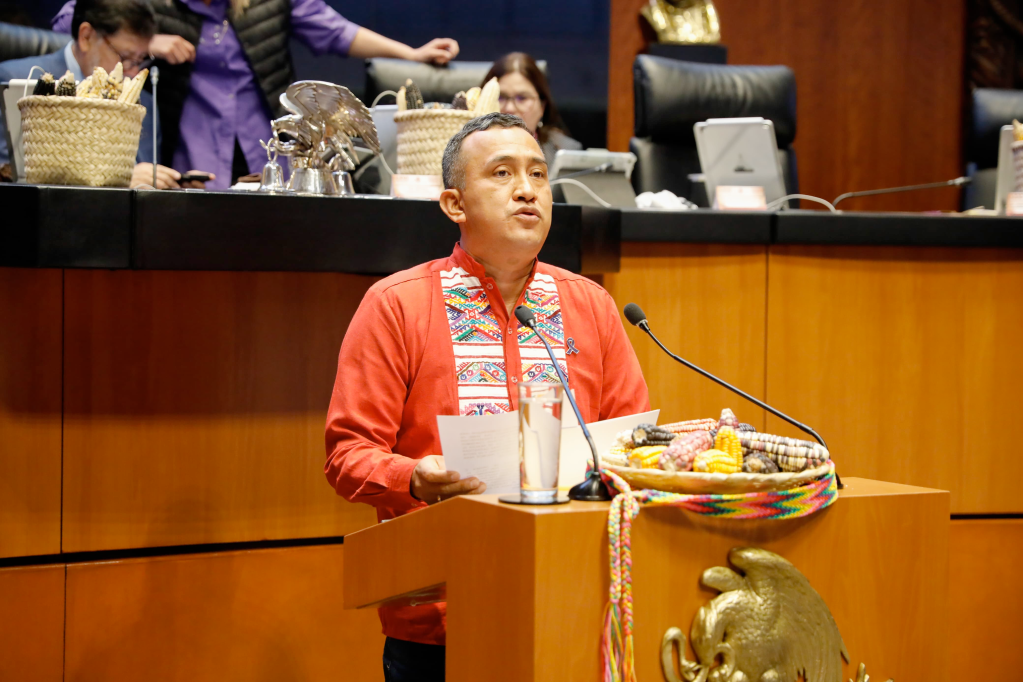
In order to protect the health of consumers, Morena Senator Antonino Morales Toledo proposed a frontal labeling for foods with transgenic content.

Within the framework of the discussion of the reform to prohibit the cultivation of transgenic corn in our country, the Morena Senator emphasized that the population must have certainty as to whether the products they consume are free of genetically modified organisms.

He proposed, in this sense, that seals be placed on food packages to inform consumers about their content and make them aware of the products they eat.

Mexico – Mexico City Congress approves draft decree on the protection of native maize

As a member of the Permanent Constituent, the Congress of Mexico City approved the draft decree reforming and adding several provisions of articles 4 and 27 of the Political Constitution of the United Mexican States, regarding the conservation and protection of native corn.

Legislator Olivia Garza de los Santos (PAN) indicated that her parliamentary group is in favor of protecting traditions and diversity, but that banning transgenic corn may bring consequences that must be considered, since a reform of this type cannot be applied in isolation, without mitigation measures. He said that “we still do not have food sufficiency in this basic product of the daily diet”, since a historic investment is needed to achieve it.

Congressman César Emilio Guijosa Hernández (MORENA in Spanish) emphasized his support for the protection of the identity and sovereignty of native corn, and pointed out that transgenic corn must be evaluated with strict criteria to avoid risks to the population.

“Mexico is the cradle of corn, a grain that has been an essential part of the culture, tradition and history of our people for millennia. Native corn not only feeds our bodies, but also nourishes our roots and traditions,” said Congresswoman Erika Lizeth Rosales Medina (Asociación Parlamentaria Progresista de la Transformación), who considered that the introduction of transgenic corn puts cultural identity, the autonomy of farmers and public health at risk.

Argentina – Modification of the denomination of edible mushrooms in the Argentine Food Code is published

By means of Joint Resolution 4/2025, the Secretariat of Health Management and the Secretariat of Agriculture, Livestock and Fisheries have published the modification of the denomination of edible mushrooms.

ARTICLE 1.- Article 1249 of the Argentine Food Code is hereby replaced and shall be worded as follows: “Article 1249: The term edible fungi means the fruiting body of higher fungi belonging to the Kingdom Fungii (Ascomycetes and Basidiomycetes) wild or cultivated and that fresh, dried or canned, are used in human food. For the purposes of this Code for edible mushrooms it is understood by:

  • Broken or crushed: those parts of mushrooms that pass through a 15 x 15 mm mesh sieve in the case of fresh mushrooms and 5 x 5 mm mesh sieve in the case of dried mushrooms.
  • Charred: whole or cut mushrooms with traces of damage due to high surface temperature or burnt.