Argentina – INAL publishes guidelines on the procedures and implementation of the Decree on the import and export of food and materials, containers and utensils intended to be in contact with food

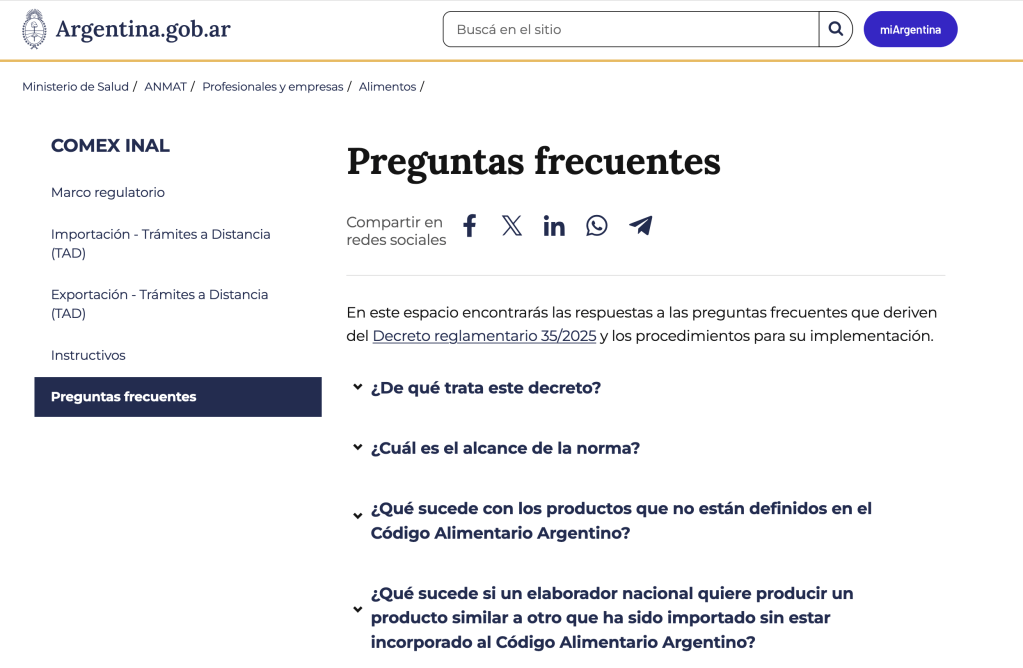
The National Food Institute (INAL in Spanish) has published a series of questions and answers to clarify doubts related to Regulatory Decree No 35/2025, which establishes the procedures for the import and export of food and materials, containers and utensils intended to be in contact with food.

  • What is this decree about?
  • What is the scope of the standard?
  • What happens with products that are not defined in the Argentine Food Code?
  • What happens if a national manufacturer wants to produce a product similar to another one that has been imported without being included in the Argentine Food Code?
  • Economic Integration Treaties and Reciprocity Agreements: Which countries would be specifically addressed in this point and what happens when the agreements are limited to some food categories?
  • In relation to origin, is the country of manufacture of the product (origin) or the origin of the product considered?
  • Do imported Annex III products actually have to comply with all the requirements of the FAC (excluding articles 1416 bis, tris, quarter and fifth)?
Brazil – ANVISA publishes draft modification of the list of contaminants in foodstuffs

The National Health Surveillance Agency (ANVISA in Portuguese) has published Public Consultation No. 1.311/2025, Subject: Proposal of Normative Instruction that modifies Normative Instruction – IN No. 160, of July 1, 2022, which establishes the maximum tolerated limits (MRL) of contaminants in food.

  • Peanuts, including those intended for later consumption. treatment.
  • Corn kernels (whole, split, crushed, ground) for further processing.

Uruguay – Modification of GMC Resolution No. 63/18 “MERCOSUR Technical Regulation for the Allocation of Additives and their Maximum Limits for the Food Category: Category 8: Meats and Meat Products

The E-Government and Information and Knowledge Society Agency has published for public consultation “Modification of Resolution No. 63/18 ‘MERCOSUR Technical Regulations on the Allocation of Additives and their Maximum Limits for Meat and Meat Products’.
The document submitted for public consultation includes acetic acid, INS 260, with acidulant function, concentration limit 2g/100g and with the note “only for treatment of natural wrappings”, for food category 8: Meat and Meat Products, subcategories 8.2.1.2 Dried Sausage and 8.2.1.3 Cooked Sausage, regulated in Resolution GMC No. 63/18.

Uruguay – Draft Resolution No. 05/24 Modification of Resolution GMC No. 25/02 “MERCOSUR Technical Regulation on Maximum Limits of Admissible Aflatoxins in Milk, Peanuts and Corn

The E-Government and Information and Knowledge Society Agency has published for public consultation “Draft Resolution Nº 05/24, prepared within the scope of the Food Commission (CA) of the MERCOSUR Working Subgroup Nº 3 ‘Technical Regulations and Conformity Assessment’ (SGT Nº 3), which introduces amendments to Resolution GMC Nº 25/02 regarding the maximum limits of admissible aflatoxins in milk, peanuts and corn”.
he document submitted for public consultation replaces item 3 of the Annex to Resolution GMC Nº 25/02, modifying the maximum limits applicable to aflatoxins in the case of peanuts and corn, based on the revision of these thresholds in the Codex Alimentarius.

Uruguay – Public consultation on Draft Resolution No. 03/23 “Technical Regulations and Conformity Assessment” (SGT No. 3) of MERCOSUR, which introduces amendments to GMC Resolutions No. 53/98, 54/98, 07/06 and 08/06 on food additives

The E-Government and Information and Knowledge Society Agency has published for public consultation Draft Resolution No. 03/23 Revision 1, prepared within the scope of the Food Commission (CA) of the MERCOSUR Working Subgroup No. 3 “Technical Regulations and Conformity Assessment” (SGT No. 3), which introduces amendments to GMC Resolutions No. 53/98, 54/98, 07/06 and 08/06 on food additives.
The document submitted for public consultation includes beta-carotene from Blakeslea trispora, INS 160a(iii), with coloring function and certain maximum concentration limits, as a food additive for food categories 3. Edible ice cream, 5. Jams (Candies, Tablets, Confectionery, Chewing Gums, Nougats, Cocoa and Cocoa Products, Chocolates, Bonbons, Filled Baths and other Similar Products), 13. The allocation of additives and their maximum concentrations for these food categories are regulated by GMC Resolutions Nº 53/98, 54/98, 07/06 and 08/06 respectively.