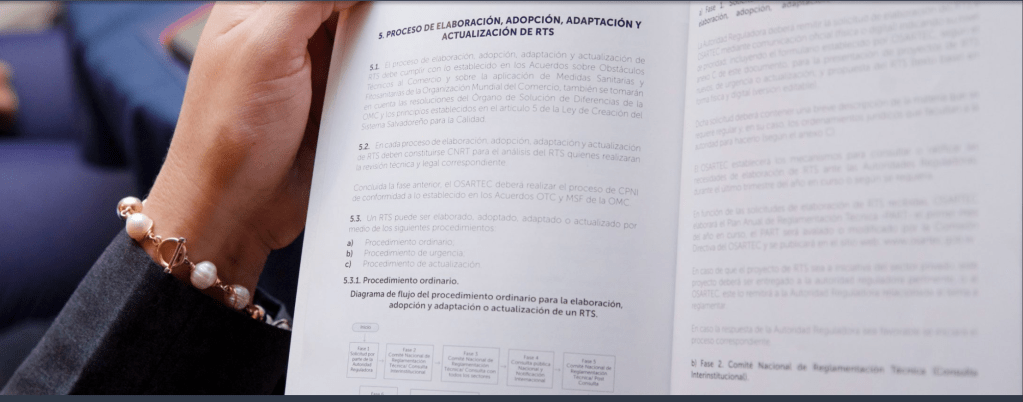
El Salvador – Official launch of the Regulations for the Preparation of Salvadoran Technical Regulations

The official launch of the Regulation for the Preparation of Salvadoran Technical Regulations was held. This document establishes the guidelines for Good Practices in the preparation, adoption, adaptation and updating of Salvadoran technical regulations.

This legal instrument allows us to harmonize criteria to be fulfilled by the State’s regulatory authorities, in compliance with the commitments signed by El Salvador before the World Trade Organization.

For the Government of El Salvador, this launch is important, since the technical regulations are directly related to exports and contribute to the country’s objectives, to provide tools that open paths for Salvadoran products to enter international markets. Said Licda. Andrea Pérez, Director of Innovation and Productivity of the Ministry of Economy.

PAHO congratulates Colombia for approving regulations that will promote the elimination of industrially produced trans fats in foods

The Pan American Health Organization (PAHO/WHO) congratulates Colombia for the approval of resolution 2066 of October 23, 2024, which establishes “the technical regulation that defines the uses and maximum contents of industrial trans fats and partially hydrogenated oils and dictates other provisions.”

This measure will promote the elimination of industrially produced trans fats in food, helping to protect the cardiovascular health of the population. Excessive consumption of trans fats is associated with an increased risk of developing and dying from coronary heart disease.

The regulation, after going through a transparent process of public consultation and regulatory impact analysis, was approved by the executive branch. In this regulatory instrument, the Ministry of Health and Social Protection adopts the best practices of PAHO/WHO for the elimination of industrially produced trans fats from food in Colombia. The first is the prohibition of the use of partially hydrogenated oils in food. The second is the establishment of a 2% limit for other industrially produced trans fatty acids within the total fats.

Mexico – President of the nation promises that Congress will legislate the prohibition of transgenic corn

Mexican President Claudia Sheinbaum Pardo announced that in February 2025, Congress will legislate on the prohibition of planting genetically modified corn in national territory with the aim of protecting the country’s biodiversity, in response to the resolution of the panel of the Treaty between Mexico, the United States and Canada (T-MEC) on measures related to genetically modified corn.

“The Mexican Congress, here with the help of the senators and deputies, we are going to turn this resolution around, because very soon, in February (in the next session period), they are going to legislate, I am sure, that transgenic corn cannot be planted and that Mexico’s biodiversity must be protected in our country. As we say: Without corn, there is no country!”

However, on December 20, 2024, the Panel established under Chapter 31 (Dispute Settlement) of the Treaty between the United Mexican States, the United States of America and Canada (USMCA) distributed to the Parties in dispute its Final Report on the case Mexico – measures related to genetically modified corn (MEX-USA-2023-31-01).

As part of its conclusions, the Panel considered that some elements of the Decree on glyphosate and genetically modified corn, published in the Official Journal of the Federation on February 13, 2023, cannot be applied “because they are not based on an adequate risk assessment, scientific evidence and relevant international standards.”

Brazil – Senate approves regulations to reform consumption tax on high-sugar foods

With the approval of the tax reform regulation in the Chamber of Deputies, the items that will be subject to the new Selective Tax (IS in Portuguese) are defined. Known as the “impuesto al sin”, it will be a type of recharge that will apply from 2027 to goods and services considered harmful to health or the environment. The new legislation now only depends on the sanction of President Luiz Inácio Lula da Silva (PT).

Complementary Bill Project (PLP) 68/2024, in the Chamber, recovered the extra tax on sugary drinks, a departure that had “been saved” in the Senate.

The Selective Tax will be an additional fee that will apply to each product. These tariffs must still be defined in the future, in specific ordinary laws. Therefore, these products will be recorded at 26.5% (the standard tax rate on goods and services established by the reform) more IS.

The IS will be recorded only once for the entire service, with any type of use of tax credits for previous operations or the generation of credits for subsequent operations being prohibited. Products intended for export are exempt from engraving.

The list of products that will be charged for is exactly what appears in the text sent by the Chamber. The first version of the report by senator Eduardo Braga (MDB-AM) proposes the inclusion of sugary drinks and weapons and ammunition in the list. These articles were eliminated during the vote in the Constitution and Justice Commission (CCJ in Portugues).

Dominican Republic – INDOCAL publishes for public consultation several draft technical standards on foodstuffs

The Dominican Institute for Quality (INDOCAL in Spanish) has published a series of draft technical standards on food.

NORDOM 626 (1st Rev.). Guidelines for assessing the competence of testing laboratories involved in the
Guidelines for Assessing the Competence of Testing Laboratories Involved in Food Import and Export Control.

NORDOM 494 (3rd Rev.2024). Fermented milks (Yogurt, Kefir, Kumys and others) and fermented milks heat-treated after fermentation.

NORDOM 281 (2nd Rev.). Oat flakes-Specifications.

NORDOM 237 (2 da Rev.). Refined coconut oil – Requirements.

NORDOM 67-35:014. Nutrition and foods for special diets and/or dietetic purposes. Infant formulae and formulae for special medical purposes intended for infants.