The National Health Surveillance Agency (ANVISA in Portuguese) announces Public Consultation No. 1280 of 19/09/2024 – DRC – sanitary requirements applicable to regenerated cellulose films in contact with food.
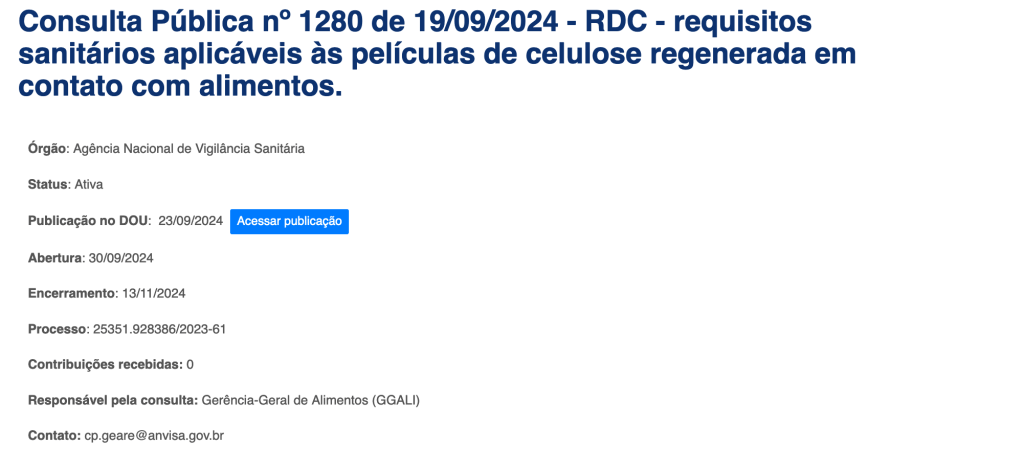
The National Health Surveillance Agency (ANVISA in Portuguese) announces Public Consultation No. 1280 of 19/09/2024 – DRC – sanitary requirements applicable to regenerated cellulose films in contact with food.
This work aims to analyze the characteristics of the legislative codification technique in Argentina, and whether, since the enactment of the Food Code to the present, this technique has been affected by a decoding normative evolution, considering the food labeling regime a particular study case. As a result, three lines of legislative alteration or modification distorting the mentioned technique re identified. This generates inconsistencies and ambiguities in the legislation, and consequent negative effects on the application, compliance and understanding of food regulations in the industry.
The Federal Commission for the Protection against Health Risks (COFEPRIS in Spanish) recognizes the decision of the Supreme Court of Justice of the Nation (SCJN Spanish) to reiterate the constitutionality of the provisions that regulate the front labeling for prepackaged foods and non-alcoholic beverages, to indicate products that exceed the maximum limits of energy content, added sugars, saturated fats, sodium and other critical nutrients and ingredients established by such provisions.
In this sense, the plenary of the highest court of the country determined that front labeling fulfills a constitutionally valid purpose, by inhibiting or discouraging the consumption of certain foods to avoid chronic non-communicable diseases; to make effective the right to nutritious, sufficient and quality food, as well as to protect the right to health of the population.

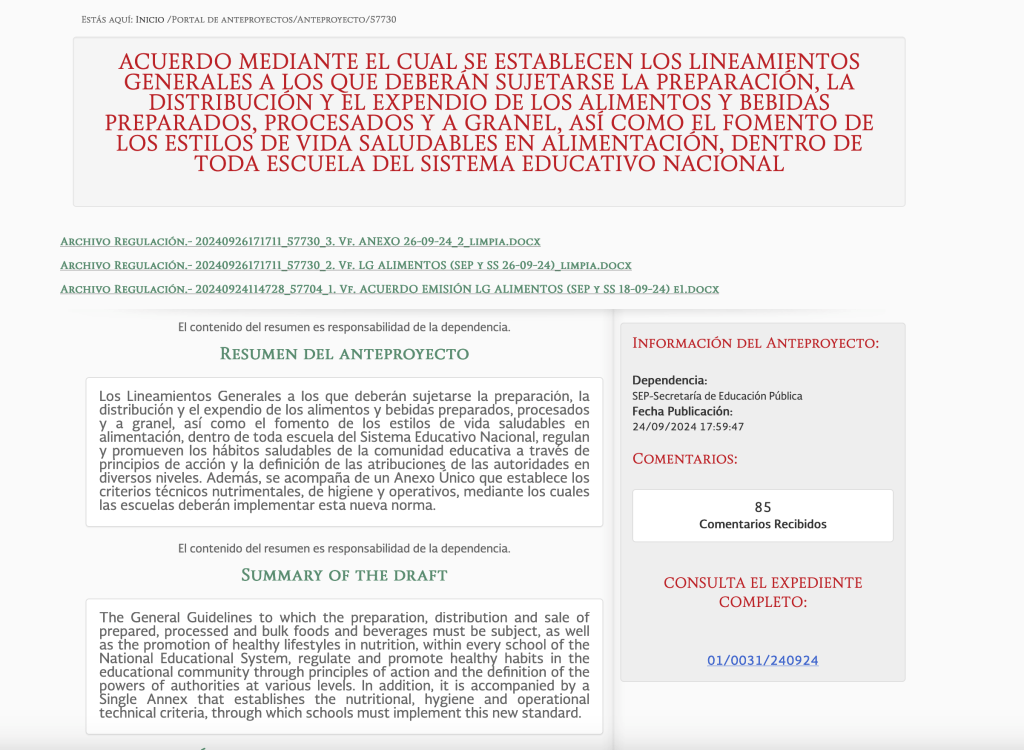
In order to promote healthy eating lifestyles, the federal government through the National Commission for Regulatory Improvement (CONAMER) will implement a draft of General Guidelines to regulate cooperatives, canteens, vending machines or businesses that sell food and beverages to students in any school of the National Education System.
The draft bill seeks to stop the sale of processed products with high levels of sodium, sugars or fats in educational centers at preschool, elementary, middle, high school, technological institutes and universities.
What foods will no longer be sold?
- Chilaquiles
- Quesadillas
- Tacos
- Fried foods
- Cookies
- Sweets
- Sugary drinks
- Donuts
- Ice cream
- Boxed cereals
- Juices
- Chewing gum
- Nectars or puddings
- Products with front labeling and that are used to prepare foods such as panpizza, banderillas or hot dogs.
It also seeks to eliminate the advertising of foods and beverages with sugar, salt and high caloric or fat content.
Over the last few decades, there has been growing interest on the part of consumers in sustainable agri-food products. As a result, voluntary standards have emerged as a tool to promote sustainability in production and consumption in agri-food value chains. Objective. To evaluate the profile of consumers and the degree of knowledge of sustainability seals for agricultural products in Costa Rican markets. Materials and methods. During October and November 2021, a nationwide virtual survey was conducted through the Qualtrics platform, from which 397 valid responses were collected. The sustainability seals considered were certifications of organic production, fair trade, denomination of origin, country-essential Costa Rica brand and carbon neutral. The Poisson regression model (PRM) was used to study the behavior of the variables, using Stata software version 16.0. Results. The Essential Costa Rica seal is the most recognized. People residing in the Greater Metropolitan Area (GAM) are more familiar with various seals. The income variable turned out to be a significant factor; those with higher incomes tend to identify and value sustainability seals more. The level of knowledge and consumption of certified products increases when the consumer has some link to the agricultural sector. Conclusions. People’s interest in certified products is not reflected in their purchasing behavior, due in part to the price of the products, lack of trust or excessive information on labels. The findings of the study allow companies to define their marketing strategies according to the characteristics of the consumers of these differentiated products.
 infoAlimentario