The article analyzes the regulation of food environments in Brazil based on the premise that the guarantee of the right to food and nutrition depends on the capacity of the public power to play certain roles effectively. It also assumes that regulation is the result of public-private disputes, being influenced by lobbying or legal arguments that limit the State’s options. Based on cases involving advertising, nutritional labeling and the tax regime for sugary drinks, the paper seeks to analyze the roles that regulation has played in the field of food environments, especially in ultra-processed foods.
Day: 02/10/2024
Brazil – Food insecurity and labeling of transgenic foods in Brazil: an overview of legislative advances and setbacks, from the perspective of the human right to adequate food
This work is a continuation of the research published in the Revista CEJ, of the Brazilian Federal Court, in 2018, and presented at the II International Congress of Public Law: justice and the enforcement of human rights, held at the University of Coimbra/Portugal, in 2017. The labeling of transgenic foods is addressed as a means of guaranteeing full access to the Human Right to Adequate Food, in order to guarantee the promotion of Food and Nutritional Security to consumers. The current research aims to update the previous work, taking into account the context of worsening food insecurity rates in Brazil, especially in the post-Covid-19 pandemic period, and also taking into account the new resolutions of Anvisa that deal with food labeling, as well as the unarchiving, in the Federal Senate, of the Bill addressed in the previous research, known as “PL to end transgenic labeling”, seeking a critical approach to its possible effects. The essay uses the deductive method to compose a bibliographical research, using legislation, doctrine, jurisprudence and data contained in public and private information banks as sources.
Argentina – CONAL publishes several draft amendments to the Food Code related to alcoholic beverages, enzymes and labelling of foods and food supplements
The National Food Commission (CONAL in Spanish) has announced a series of draft amendments to the Argentine Food Code, specifically on the following topics:
- Incorporation of dehydrated grape pomace.
- Incorporation of dried apple pomace
- Incorporation of partially dealcoholized and dealcoholized wine.
- Incorporation of new enzymes for food use, Inc. of incorporation of microbiological criteria in article 1192.
- Incorporation of glazing additives and anti-humectants / anti-caking agents in fruits.
- Modification of Articles 1381 and 235.

Brazil – ANVISA in Portuguese) updates the regulation establishing lists of constituents, limits of use, claims and supplementary labeling of dietary supplements
The Brazilian National Health Surveillance Agency (ANVISA in Portuguese) published Normative Instruction IN No. 318, which updates Normative Instruction IN No. 28 that establishes the lists of constituents, limits of use, declarations and supplementary labeling of dietary supplements.
It updates:
I – List of constituents authorized for use in dietary supplements, except for dietary supplements indicated for infants (0 to 12 months) or early childhood children (1 to 3 years), established in Annex I.
II – “List of constituents authorized for use in food supplements indicated for infants (0 to 12 months) or young children (1 to 3 years)”, set out in Annex II.
III – “List of minimum limits of nutrients, bioactive substances, enzymes and probiotics to be provided by food supplements, in the daily consumption recommendation and by population group indicated by the manufacturer”, established in its Annex III.
IV – “List of maximum limits of nutrients, bioactive substances, enzymes and probiotics that cannot be exceeded by food supplements, in the daily consumption recommendation and by population group indicated by the manufacturer”, established in Annex IV.
V – “List of claims authorized for use in the labeling of dietary supplements and the respective composition and labeling requirements”, set forth in Annex V.
VI – “List of supplementary labeling requirements for food supplements”, set out in Annex VI.
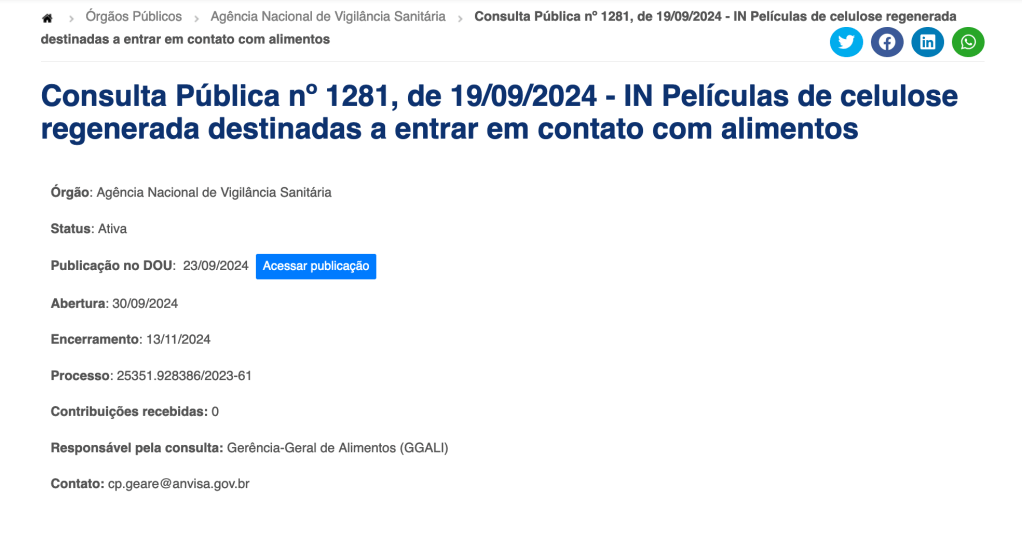
Brazil – ANVISA proposes positive lists of substances authorized for the manufacture of regenerated cellulose films intended to come into contact with foodstuffs
The National Health Surveillance Agency (ANVISA in Portuguese) announces Public Consultation No. 1281, dated 19/09/2024 – Normative Instruction IN on Regenerated Cellulose Films intended to come into contact with food. The IN establishes the positive lists of substances authorized for the manufacture of regenerated cellulose films.
 infoAlimentario