The Sanitary Regulation Agency (ARSA in Spanish) published the Regulation for the sanitary control of food and beverages. The regulation aims to establish the regulatory standards for food, nutritional supplements and food additives and other related products, as well as for the establishments and services that participate in these activities, including transportation.
The regulation states that the products covered must have a valid authorization issued by the ARSA to be marketed. Likewise, manufacturers and wineries must comply with the hygienic-sanitary standards established in the RTCA for the processed food and beverage industry and in the procedure for granting sanitary licenses, being subject to surveillance and inspection by the ARSA.
Month: August 2024
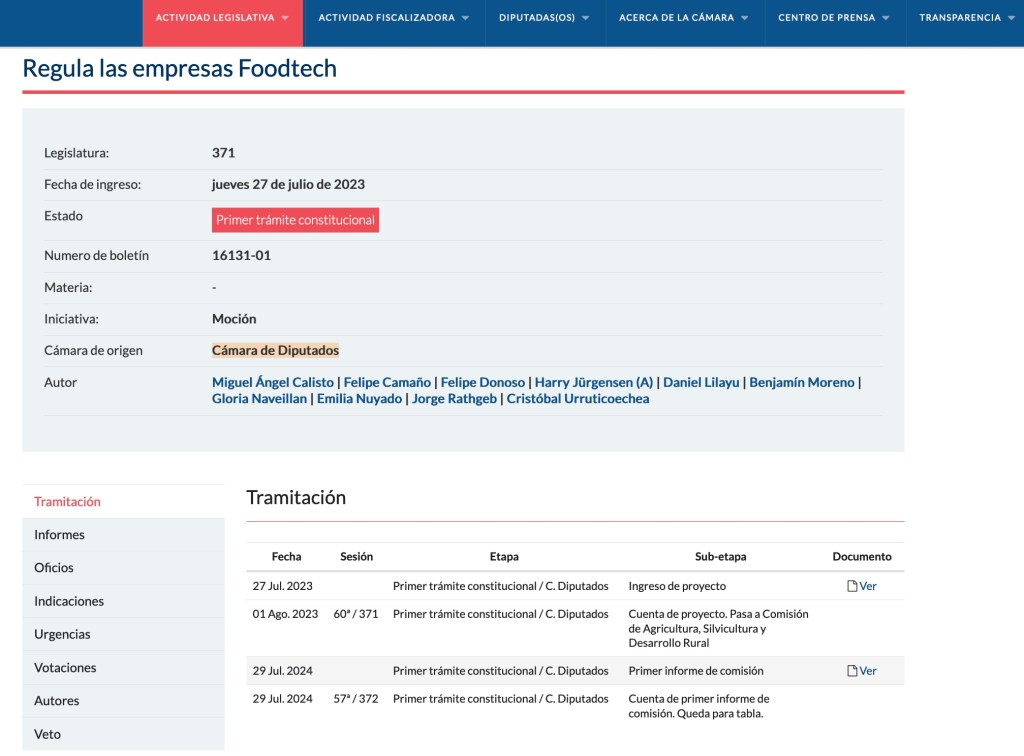
Chile – Chamber of Deputies approves bill to regulate foodtech companies developing meat-like plant products
The Agriculture Committee of the Chamber of Deputies Chamber of Deputies approved, in particular and sent to the Chamber, the bill (bulletin 16.131) that regulates Foodtech companies.
FoodTechs are companies that use technologies such as the Internet of Things (IoT), big data and Artificial Intelligence (AI) to produce a range of food products.
The proposal establishes a free competition status between foods of animal origin and those foods of plant origin, when the latter mimic the properties of the former.
To this end, it distinguishes natural origin from synthetic origin, so that everyone knows exactly what type of food they are consuming.
Chile – Ministry of Health updates maximum limits for pesticide residues in food
The Ministry of Health hereby advises that MINSAL Exempt Decree No. 47 amending Technical Standard No. 209 establishing maximum residue limits for pesticides in food, approved by MINSAL Exempt Resolution No. 892 of 2020, was published in the Official Journal on 3 August 2 024 and will enter into force nine months later, i.e. on 3 May 2025.
Uruguay Food Additive Regulation Changes: Meats and Soft Drinks
The government of Uruguay announces Draft Resolution GMC Nº 03/24 “Modification of GMC Resolutions Nº 09/06 and 63/18 on Food Additives”.
The draft resolution proposes the modification, under certain conditions, of rosemary extract, INS 392, to GMC Resolution Nº 63/18 on additives and their limits in meat and meat products, and of jagua blue additive (genipin-glycine), INS 382, to GMC Resolution Nº 09/06 on aerated and non-aerated non-alcoholic beverages. The text specifies the function for which these additives are admitted in the indicated product categories, as well as their acceptable concentration limits, based on the toxicological evaluations carried out by the Joint FAO/WHO Expert Committee on Food Additives (JECFA).

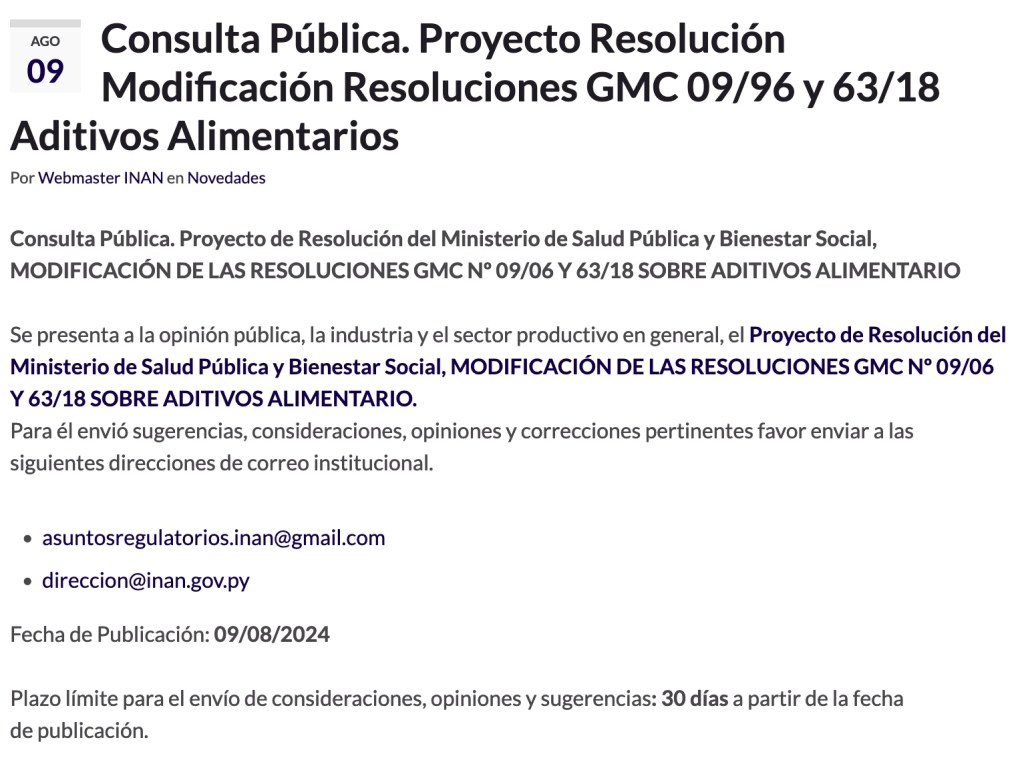
Paraguay – INAN announces public consultation on modification of GMC Resolutions 09/96 and 63/18 Food Additives
The National Institute of Food and Nutrition (INAN in Spanish) published the Draft Resolution for the Modification of Resolutions GMC 09/96 and 63/18 Food Additives. The draft aims to include the additive rosemary extract, INS 392, with antioxidant function, with limit 0.015 g/100 g and with the note “expressed as the sum of carnosic acid and carnosol” in Food Category 8 – Meat and Meat Products, subcategories 8. 2.1.1 Fresh Sausages; 8.2.1.2 Dried Sausages; 8.2.1.3 Cooked Sausages; 8.2.2.1 Raw salted meats; 8.2.2.2.2 Cooked salted meats; 8.2.3.1 Canned and mixed meats; 8.2.3.2 Semi-preserved and mixed meats; and 8.2.4.1 Dehydrated meat products, of MERCOSUR Resolution GMC Nº 63/18.
 infoAlimentario