Mexico – Supreme Court of Justice of Mexico denies injunction against labeling to Herdez, McCormick, Del Fuerte and Nutrisa

The Plenary of the Supreme Court of Justice of the Nation (La Corte) determined the constitutionality of the provisions that regulate the front labeling for prepackaged food and non-alcoholic beverages, to indicate the products that exceed the maximum limits of energy content, added sugars, saturated fats, sodium and other critical nutrients established by the provisions:

  • Article 212, of the General Health Law.
  • The “Modification to the Mexican Official Standard NOM-051-SCFI/SSA1-2010, General labeling specifications for prepackaged food and non-alcoholic beverages – commercial and sanitary information”, published on March 27, 2020, particularly, paragraphs 4.5.3.4 and 7.1.3.
  • The Guidelines for the Organization of National Standardization Advisory Committees.
  • The Rules of Operation of the National Consultative Committee for Standardization.
  • The Rules of the National Consultative Committee for Standardization of Regulation and Sanitary Promotion.

Uruguay – Public Consultation on MERCOSUR Technical Regulations on additives for the manufacture of plastic materials and polymeric coatings in contact with foodstuffs

Draft Resolution No. 14/23 seeks to update the positive list of additives for the manufacture of plastic materials and polymeric coatings intended to come into contact with food, by amending GMC Resolution No. 39/19.

The document put out for public consultation was prepared within the scope of the Food Commission (CA) of GTS No. 3 and aims to update Table I of the Annex to Resolution GMC No. 39/19, including the substances silver-magnesium-sodium-boron phosphate (silver glass) and diethylaminoethanol with the respective restrictions and specifications. For the preparation of the referred MERCOSUR Technical Regulation, Resolution GMC No. 03/92 on “Criteria for the application of the MERCOSUR Technical Regulation” was considered.
(External link) on “General criteria for food packaging and equipment in contact with food” and Resolution GMC No. 39/19 (External link), which approved the “General criteria for food packaging and equipment in contact with food”.
(External link) which approved the “MERCOSUR Technical Regulation on positive list of additives for the manufacture of plastic materials and polymeric coatings intended to come into contact with food”.

Venezuela – Draft Venezuelan Standard COVENIN 5035:2024 Foods for celiac, non-celiac gluten-sensitive and wheat-allergic individuals

The Decentralized Service for Standardization, Quality, Metrology and Technical Regulations (SENCAMER in Spanish) has published the Draft Venezuelan Standard COVENIN 5035:2024 Food for celiac, non-celiac gluten-sensitive and wheat-allergic people.
This standard applies to national and imported foods for immediate consumption and manufactured foods;
that are formulated, prepared, processed, packaged, stored, marketed and/or distributed to cover the special dietary needs of celiac, non-celiac gluten-sensitive and wheat-allergic people.

Chile: The Ministry of Health has published the public amendment to the Food Health Regulation on sugars

The Ministry of Health has published Decree 41 in the Official Gazette (Number 43,827), which modifies article 383 of the Health Food Regulations.

“Article 383.- The name sugars will be understood as sweetening carbohydrates, refined, concentrated and/or crystallized monosaccharides and disaccharides, for labeling purposes, which must be labeled with their specific name.
Sugars will be classified into “traditional” sugars and “non-traditional” sugars.
“Traditional” sugars mean carbohydrates, refined, concentrated and/or crystallized monosaccharides and disaccharides, which provide 4 kcal per gram, such as: glucose, fructose, galactose, sucrose, lactose and maltose.
“Non-traditional” sugars mean the following carbohydrates: Tagatose and Allulose.
When, in this regulation, sugars are mentioned without another name, they will be understood as traditional sugars. Furthermore, in the case of establishing sugars as a condition in the ingredients of various products regulated in this regulation, their replacement, total or partial, with non-traditional sugars will be accepted.
Both types of sugars, traditional and non-traditional, must be labeled with their specific name in the ingredient list.
In the declaration of nutrients, non-traditional sugars must be declared with their specific name and must not be considered either in the contribution of total sugars or total sugars, or in the contribution of available carbohydrates.
The caloric contribution of non-traditional sugars must be considered in the energy contribution of the product, and will be calculated according to the energy conversion factors established, for these purposes, by the Ministry of Health through a technical standard published in the Official Gazette.
In products made with non-traditional sugars, the following phrase must be labeled, as appropriate:

  • In the case of Allulose: “Intakes of 28 grams/serving or more of Allulose may cause gastrointestinal discomfort or a laxative effect.”
  • In the case of Tagatose: “Intakes of 30 grams/serving or more of Tagatose may cause gastrointestinal discomfort or a laxative effect.”

Article 2.- This decree will come into force 24 months after its publication in the Official Gazette.

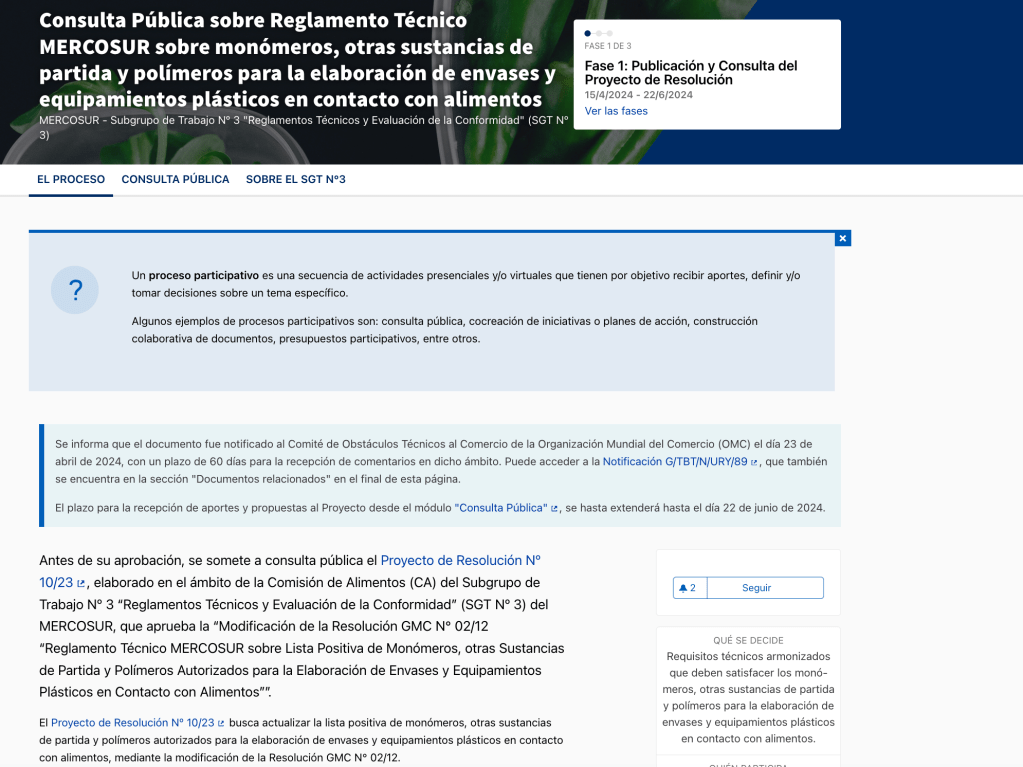
Uruguay – Public Consultation on the MERCOSUR Technical Regulation on monomers, other starting substances and polymers for the production of plastic containers and equipment in contact with food

Draft Resolution No. 10/23 seeks to update the positive list of monomers, other starting substances and polymers authorized for the manufacture of plastic containers and equipment in contact with food, by amending Resolution GMC No. 02/12.

The document put out for public consultation was prepared within the scope of the Food Commission (CA) of GTS No. 3 and aims to include, at the end of the positive list of Part I of the Annex to Resolution GMC No. 02/12, the substance Tetramethyl bisphenol F Diglycyl ether (TMBPF-DGE) and to include, in the “List of authorized polymers” of Part V of the Annex to Resolution GMC No. 02/12, the substance Polyamide-imide 2 (PAI-2), with the restrictions and specifications determined. For the preparation of the above-mentioned MERCOSUR Technical Regulation, Resolution GMC No. 03/92 on “General criteria for food packaging and equipment in contact with food” and Resolution GMC No. 02/12, which approved the “MERCOSUR Technical Regulation on food packaging and equipment in contact with food”, were taken into account. which approved the “MERCOSUR Technical Regulation on Positive List of Monomers, other Starting Substances and Polymers authorized for the manufacture of Plastic Containers and Equipment in Contact with Food”.