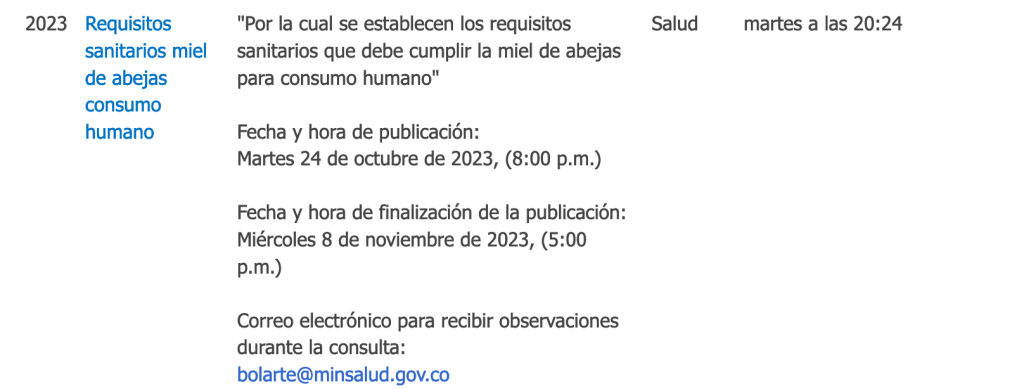
Colombia: Ministry of Health publishes draft resolution on sanitary requirements to be met by honey bees for human consumption

The purpose of the resolution is to establish the sanitary requirements The purpose of the resolution is to establish the sanitary requirements that must be met by bee honey for human consumption that is extracted, packaged, stored, transported, imported, marketed and sold in the national territory, in order to ensure the safety of this product, protecting human health and preventing possible damage to it. possible damages to it.

Article – Front-of-package warning labelling system for pre-packaged foods and beverages: an intersectoral position of expertsin Central American and Dominican Republic

The Latin American region has been a pioneer in the implementation of a front- of-pack warning labeling system (FOPWL), which has demonstrated its efficacy and effectiveness in correctly identifying when a product contains excessive amounts of nutrients associated with Non-Communicable Diseases (NCDs). However, countries of the Central American Integration System (SICA); which includes Belize, Costa Rica, El Salvador, Guatemala, Honduras, Nicaragua, Panama and the Dominican Republic, have no adopted it. For this reason, the Institute of Nutrition of Central America and Panama convened a group of experts from academia and civil society with the aim of establishing an evidence-based technical position, in relation to front-of-pack labelling for critical nutrients of pre-packaged foods and beverages in the Central American region. Specific evidence from the SICA region demonstrating the superiority of FOPWL over other labels such as the Guideline Daily Amount (GDA), the traffic light and Nutriscore to select healthier choices is presented. Within the framework of children’s and consumer rights, arguments are provided, and a call is made to governments for the prompt adoption of FOPWL as a cost-effective policy for the prevention of NCDs. In addition, recommendations for its monitoring and evaluation are provided, as well as recommendations for other cost-effective policies such as the regulation of unhealthy food advertising aimed at children and adolescents, among others, for the prevention of NCDs and the creation ofhealthier and more sustainable environments and food systems.
Chile – INTA performs Plant Based Certifications informing the absence of animal ingredients in foods

The Institute of Nutrition and Food Technology (INTA in Spanish) of the University of Chile, through the Directorate of Technical Assistance, is recently offering a Plant Based Certification that reports the absence of animal ingredients in its foods.
INTA, as an impartial external certifying body, developed this certification that can additionally include an INTA “Plant Based” seal to be used in the labeling of products that are marketed in Chile and Latin America.
The applicant company, in order to obtain a certification like this, must agree to a review of its documentary records, an audit of its production plant and eventually laboratory analysis.

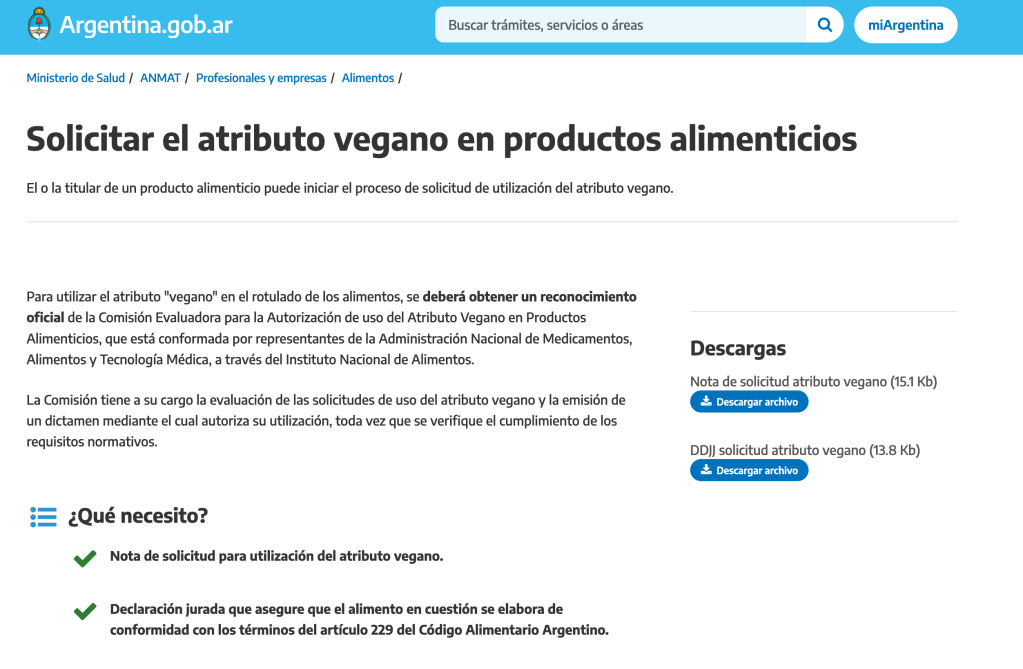
Argentina – ANMAT has published the requirements for the official labeling of vegan and vegetarian products

The National Administration of Medicines, Food and Technology (ANMAT) shared the information to request the recognition as “Vegan Product”. ANMAT made available the information to request the official recognition for the use of the labeling of the “vegan attribute” in different food products.
Thus, by means of the resolution of the Secretariat of Health Quality of the Ministry of Health together with the Secretariat of Agriculture, Livestock and Fisheries of the Ministry of Economy, Article 229 was incorporated into the Argentine Food Code (CAA), establishing the requirements to identify on food labels the legends: “Vegan Product or Food” and “Vegetarian Product or Food”.