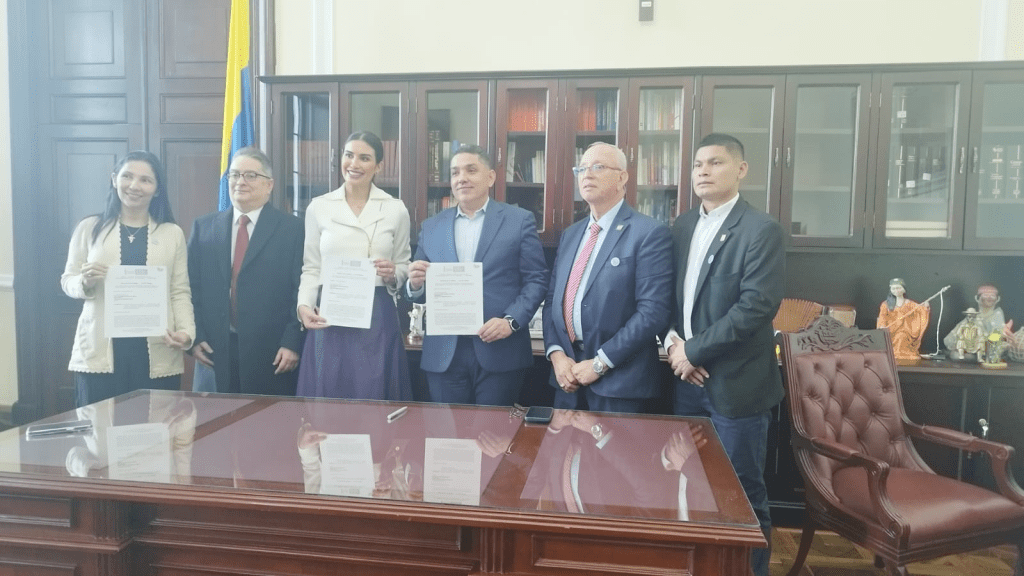
Colombia – Congressmen introduce bill to promote food donations

Congresswoman Saray Robayo Bechara, presented the bill that promotes food donation and food security, to address malnutrition and face the food crisis that millions of Colombians live today, who do not have enough to eat three meals a day.

According to the congresswoman, the project is motivated so that between 40 and 60% of the food that is wasted today, that is, about 6 million tons per year, can reach the tables of 5 million of the most vulnerable Colombians according to the DNP.

Saint Kitts & Nevis – Labelling of packaged water

The St. Kitts & Nevis Bureau of Standards published Standard on labelling of packaged water. This Standard specifies requirements for the purity, treatment, bacteriological acceptability, packaging and labelling of all waters that are pre-packaged for sale and used as beverages or in foods.
This Standard does not apply to water distributed by the public water supply system, to carbonated beverages, soda water or to packaged water sold for purposes other than as a beverage.

Argentina – Senasa confirmed that there is no labeling for GM wheat flour

Once the commercialization and the “mixture” with conventional flour is known, it remains to know which are the wheat by-products elaborated with transgenic. This information request was sent by ERA Verde to the National Agri-Food Health and Quality Service, which replied that “there are no regulations on labeling of GMOs in food, neither in Senasa nor in other agencies in Argentina”, it was stated.

Through the Press area, the General Coordinator of Biotechnology of the Directorate of Strategy and Risk Analysis, Andrés Ignacio Maggi, explained that “this is based on the fact that prior to the commercialization of any GMO for food, an evaluation is carried out in Senasa regarding its food suitability, so that they are considered as safe and not less nutritious than non-GMO products”.

The consumption of HB4 wheat flour, as that of any GMO food, for the time being, will remain an enigma in Argentina.

Peru – Bill prohibiting food advertising with octagons aimed at minors would go against freedom of enterprise

For Jaime Dupuy, manager of legal and regulatory affairs of ComexPerú, any initiative in favor of taking care of the health of minors is positive. However, he warned that this regulation is unconstitutional, as it is disproportionate in that it prevents the transmission of advertising of all types of products with high sodium or fat content that should be consumed in moderation, such as milk or butter, when these cannot be considered junk food.

“Any provision that restricts advertising itself is an affectation to the freedom of enterprise, this principle considers all acts that help the commercialization of the products that the company develops. Advertising is included. Currently there are already restrictions due to health issues, for example for alcoholic beverages and cigarettes, but we cannot equate food in general, such as milk, butter or bread, with these products”, he explained.

Article – Ultra-processed products in Argentina: evaluation of the nutrients profile model of the Pan American Health Organization

Introduction: In Argentina, problems related to excess weight constitute one of the main challenges for public health. The background indicates that the consumption of ultra-processed products contributes to this trend due to their high sugar, total saturated, trans fat and sodium content. This study analyzes the PAHO nutrient profile in some ultra-processed products available in the Argentine market.

Materials and methods: Field, cross-sectional, comparative study. Nutrient profile (free sugars, total fat, saturated fat, trans fat, sodium) and caloric density were evaluated. The categories were: sweet cookies, alfajores, chocolates, candies, ice creams, cereals, drinks, spreads, salty and dairy snacks. A descriptive and inferential statistical analysis was performed.

Results: The sample was made up of 682 products and all of them exceeded the cut-off point of at least one nutrient, 94.4% presented an excessive amount of free sugars, 47.9% an excessive amount of total fats, 59. 2% excessive amount of saturated fat, 10.6% excessive amount of trans fat and 9.1% excessive amount of sodium. The average of the total caloric density was 3.19. Products with an excessive amount of total, saturated and trans fats had a higher caloric density (p<0.05); however, the caloric density of the products with an excessive amount of free sugars was lower (p=0.000), the same trend was found in the as of sodium, but this difference was not statistically significant.

Conclusions: All the products exceeded the cut-off point for at least one critical nutrient and having a lower caloric density did not guarantee their nutritional quality. The nutrient profile accurately reflects the nature of ultra-processed products.